











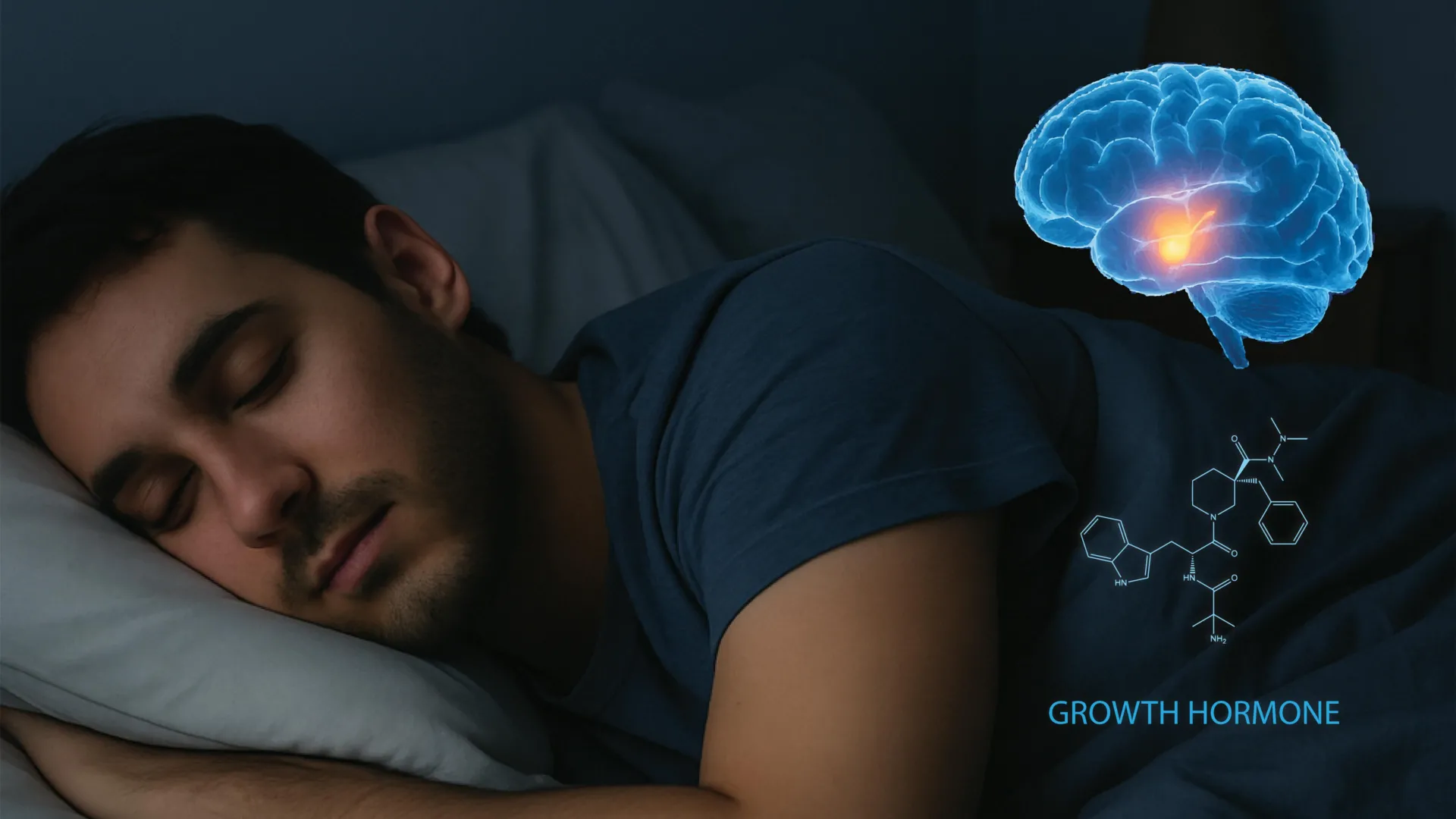
For decades, the medical community has operated under a fundamental truth: sleep is not merely a period of inactivity, but a highly orchestrated biological repair phase. Beyond the subjective feeling of being "refreshed," sleep acts as the primary engine for the release of growth hormone (GH)—a vital chemical messenger responsible for building muscle, strengthening bone density, modulating fat metabolism, and facilitating physical maturation.
While athletes have long prioritized sleep for its recovery benefits and parents have intuitively understood that children "grow while they sleep," the exact biological mechanisms governing this process have remained shrouded in mystery. Now, a groundbreaking study from the University of California, Berkeley, has pierced that veil. By mapping the neural circuitry that regulates growth hormone during sleep, researchers have not only identified how the brain triggers this essential release but have also uncovered a sophisticated feedback loop that links metabolic health to cognitive alertness.
The Neural Blueprint: Mapping the Sleep-Hormone Connection
The research, published in the prestigious journal Cell, represents a significant leap forward in neuroscience. Led by the laboratory of Yang Dan, a professor of neuroscience and molecular and cell biology at UC Berkeley, the team utilized advanced optogenetic techniques and neural recording in mice to observe the brain’s inner workings in real-time.
The Hypothalamic Hub
The investigation focused on the hypothalamus, an ancient, deep-brain structure conserved across mammalian species. Within this region, researchers identified specific nerve cells responsible for the hormonal orchestration: growth hormone-releasing hormone (GHRH) neurons and two distinct populations of somatostatin neurons.
By placing electrodes in the brains of mice and employing light to stimulate hypothalamic neurons, the team was able to witness the intricate dance of these peptides. Their findings reveal that GHRH and somatostatin act as the brain’s internal "gas" and "brake" pedals. GHRH promotes the release of growth hormone, while somatostatin suppresses it. The study discovered that the ratio of these two signals shifts dramatically depending on the sleep stage, creating unique hormonal signatures for both REM (rapid eye movement) and non-REM sleep.
A Chronology of Discovery: From Observation to Neural Recording
Historically, our understanding of growth hormone was limited by the methodology of the era. For years, clinicians relied on invasive blood draws, monitoring hormone levels while patients slept in clinical settings. These snapshots provided data on when the hormone was released, but they provided no insight into the why or the how—the neural commands that initiated the process.
The Shift to Real-Time Monitoring
The UC Berkeley team shifted the paradigm by transitioning from systemic observation to direct neural recording. Because mice sleep in frequent, short bursts throughout the 24-hour cycle, they provided an ideal model for capturing repeated transitions between wakefulness and sleep.
- Initial Phase: Researchers mapped the specific neuronal populations within the hypothalamus, confirming that GHRH neurons are the primary drivers of growth hormone secretion.
- The REM/Non-REM Divergence: The team observed that during REM sleep, both GHRH and somatostatin levels surge, resulting in a robust release of growth hormone. Conversely, during non-REM sleep, somatostatin levels drop while GHRH levels rise only moderately. This distinct pattern suggests that the brain modulates growth hormone output differently depending on the depth and type of sleep, likely to serve specific physiological needs associated with those sleep states.
- The Feedback Discovery: The most surprising development came when the team identified a previously unknown feedback mechanism involving the locus coeruleus—a brainstem region historically associated with alertness, focus, and the body’s stress response.
Supporting Data: The Locus Coeruleus and the Wakefulness Loop
The discovery of the link between growth hormone and the locus coeruleus (LC) provides a missing piece in the puzzle of how metabolism influences consciousness.
The researchers found that as growth hormone accumulates during sleep, it actively stimulates neurons in the locus coeruleus. Under normal conditions, activation of the LC promotes wakefulness and arousal. However, the study uncovered a counter-intuitive phenomenon: if the activity of the LC becomes too intense, it unexpectedly triggers a switch toward sleepiness.
The Regulatory Feedback Loop
This indicates that the relationship between sleep and growth hormone is not a one-way street; it is a closed-loop system:
- Sleep initiates the cycle: The hypothalamus triggers the release of growth hormone.
- Growth hormone signals the brain: As levels rise, the hormone interacts with the locus coeruleus.
- The Feedback effect: This interaction regulates the individual’s transition back to wakefulness, ensuring that growth and repair are balanced with the need for cognitive alertness during the day.
This "thermostat" mechanism ensures that the body does not over- or under-produce growth hormone, maintaining systemic metabolic stability.
Official Perspectives: Implications for Future Therapies
The research team, which includes experts from both UC Berkeley and Stanford University, believes this discovery could revolutionize how we treat sleep-related metabolic and neurodegenerative disorders.
Insights from the Researchers
"People know that growth hormone release is tightly related to sleep, but only through drawing blood," said Xinlu Ding, a postdoctoral fellow and the study’s first author. "We’re actually directly recording neural activity in mice to see what’s going on. We are providing a basic circuit to work on in the future to develop different treatments."
Daniel Silverman, a study co-author and postdoctoral fellow, highlights the potential for gene therapy as a clinical application. "Understanding the neural circuit for growth hormone release could eventually point toward new hormonal therapies to improve sleep quality or restore normal growth hormone balance," Silverman noted. "There are some experimental gene therapies where you target a specific cell type. This circuit could be a novel handle to try to dial back the excitability of the locus coeruleus, which hasn’t been talked before."
Implications: Beyond Muscle and Bone
The ramifications of this study extend far beyond the gym or the pediatric clinic. Because growth hormone is a master regulator of glucose and fat metabolism, the discovery has profound implications for global health.
Metabolic Health
Consistently poor sleep is a known risk factor for obesity, type 2 diabetes, and cardiovascular disease. By establishing the specific neural pathway for GH release, researchers may be able to develop targeted interventions for patients whose metabolic health is compromised by chronic sleep deprivation. If we can "re-tune" the hypothalamic circuit, we might potentially restore metabolic homeostasis in patients who are otherwise resistant to standard diet and exercise interventions.
Neurodegeneration and Cognition
The role of the locus coeruleus is particularly intriguing in the context of neurodegenerative diseases like Parkinson’s and Alzheimer’s. The LC is one of the first areas of the brain affected by the pathology of these conditions. By understanding how the locus coeruleus interacts with growth hormone to manage arousal and cognitive focus, scientists may identify new biomarkers or protective therapies that could delay cognitive decline.
The "Cognitive Benefit" of Sleep
As Ding points out, the benefits of this system are not purely physical. The interaction between growth hormone and the locus coeruleus suggests that growth hormone might contribute to the "arousal level" one feels upon waking. This implies that the restorative power of sleep is a holistic process—one that repairs the body while simultaneously priming the brain for the mental demands of the coming day.
Conclusion: A New Era of Sleep Medicine
The research conducted at UC Berkeley marks a fundamental shift in our comprehension of human biology. By moving from a vague understanding of "needing sleep to grow" to a granular, circuit-level map of the hypothalamus and the locus coeruleus, the team has provided a new frontier for medical exploration.
While the current study was conducted in murine models, the conserved nature of these brain regions suggests that similar mechanisms are at play in humans. As the scientific community begins to explore the potential for gene-based therapies and pharmacological interventions that target this specific circuit, we move closer to a future where sleep disorders are no longer managed by broad-spectrum sedatives, but by precise, targeted neural adjustments.
Ultimately, this study reinforces that the brain is not merely a passenger during the night. It is an active participant, working through an intricate hormonal feedback loop to ensure that we wake up not just physically repaired, but cognitively prepared to navigate the world. As we continue to decode the "circuits of sleep," the promise of healthier, more efficient lives—governed by the elegant chemistry of our own neural architecture—becomes increasingly attainable.