











ALTADENA, CA — In a landmark move to address the escalating mental health crisis among American youth, Active Minds, the nation’s premier nonprofit dedicated to student-led mental health advocacy, has announced a massive $5 million expansion of its national programming. Supported by Google’s philanthropic arm, Google.org, the initiative represents a strategic shift toward integrating digital safety, artificial intelligence (AI) literacy, and peer-to-peer support into the fabric of the American high school experience.
The announcement, made on June 12, 2026, sets an ambitious target: to equip 100,000 youth and young adults with the mental health literacy and digital agency required to navigate an increasingly complex technological landscape by 2028. This expansion will specifically catalyze student engagement across 154 high schools nationwide, focusing on communities where resources are often most scarce.
Main Facts: A New Frontier in Youth Advocacy
The partnership between Active Minds and Google.org comes at a critical juncture for Gen Z and Gen Alpha. As digital environments become indistinguishable from physical ones, the traditional boundaries of mental health support have been redefined. The $5 million grant is designed to bridge the gap between technological consumption and emotional wellbeing.
Key Objectives of the Initiative:
- National Scaling: The program will expand its footprint to 154 high schools, providing a blueprint for youth-led advocacy that can be replicated across diverse geographic and socioeconomic regions.
- Digital Safety & AI Literacy: Recognizing that technology and AI are now foundational to how youth learn and connect, the curriculum focuses on "foundational digital safety skills" and "responsible mental health video creation."
- The Active Minds Program Fund: A significant portion of the funding will be diverted to under-resourced schools, rural communities, and communities of color. This fund ensures that budget constraints do not prevent students from accessing evidence-informed mental health experiences.
- Targeted Impact: The overarching goal is to empower 100,000 young leaders by 2028, turning them from passive consumers of digital content into active advocates for community wellbeing.
By centering youth voices, the initiative seeks to ensure that the tools of the future—including AI-driven educational platforms and social networks—are used to foster safety and innovation rather than isolation and anxiety.
Chronology: From Local Crisis to National Strategy
The path to this national announcement was paved by both organizational growth and localized tragedy. To understand the gravity of the June 2026 launch, one must look at the events that shaped its focus.
The Foundation (2020–2024)
Active Minds has spent over two decades mobilizing youth. However, the post-pandemic era saw a surge in the need for digital-first mental health solutions. Between 2020 and 2024, the organization began experimenting with peer-led digital safety modules, recognizing that social media was both a source of stress and a potential platform for support.
The Catalyst: The 2025 Eaton Fire
In 2025, the Altadena and Pasadena areas were devastated by the Eaton Fire. The disaster did more than destroy property; it shattered the sense of security for thousands of students in the Pasadena Unified School District (PUSD). In the aftermath, community leaders noted that students were not only struggling with the physical loss but were also navigating a "compounding pressure" from digital news cycles and social media-driven trauma.
The Pilot and Launch (Late 2025 – June 2026)
Following the fire, Active Minds worked closely with local California officials, including Assemblymember John Harabedian, to pilot a localized version of the resilience program. The success of this pilot, which combined disaster recovery with digital wellbeing, provided the "reproducible blueprint" that Google.org ultimately chose to fund on a national scale.
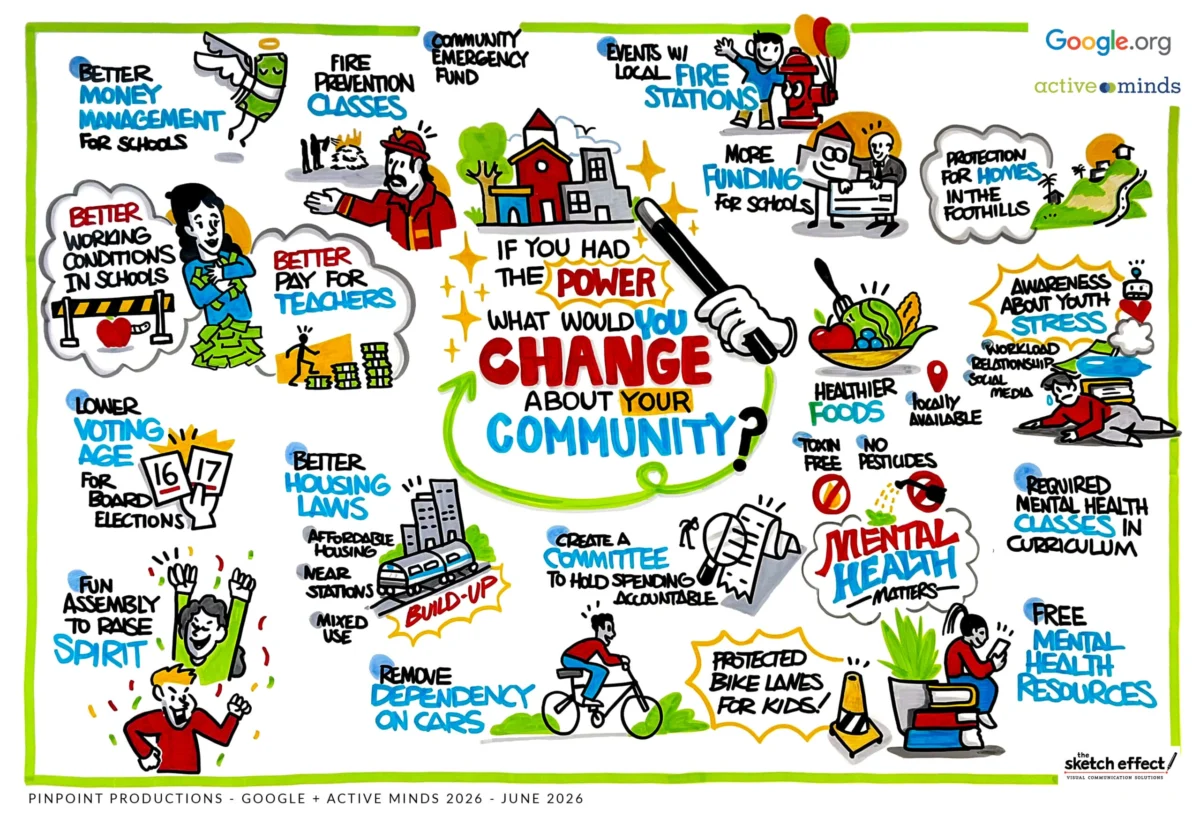
On June 12, 2026, the official launch event in Altadena served as a demonstration of this model. High school students participated in workshops where their ideas for community safety—ranging from fire prevention to healthier digital habits—were captured in real-time by artists and then presented to industry leaders.
Supporting Data: The Statistics of Digital Wellbeing
The necessity of this $5 million investment is underscored by a growing body of data regarding youth mental health and technology usage.
The Digital Landscape
Recent studies indicate that the average American teenager spends upward of seven hours a day on screen-based media for non-school-related activities. With the integration of AI into social platforms, the complexity of these interactions has increased. Active Minds’ internal research suggests that while 80% of youth know where to turn for physical health issues, less than 40% feel confident navigating a mental health crisis that originates or is exacerbated online.
Scaling for Success
The "100,000 by 2028" goal is not merely a round number; it represents a tipping point. Social science research suggests that when 10% to 25% of a population adopts a new behavior or value, it creates a "social contagion" effect that can shift the entire culture. By targeting 154 high schools, Active Minds aims to create these cultural hubs where mental health is prioritized and "digital safety" is a standard part of the curriculum.
Equity in Access
The Active Minds Program Fund specifically addresses the "resource gap." Data from the National Center for Education Statistics shows that schools in rural and under-resourced areas have 20% less access to dedicated mental health professionals compared to affluent suburban districts. The Google.org funding aims to level this playing field by providing the curriculum and the "peer-network" infrastructure for free.

Official Responses: Leaders on the Front Lines
The initiative has garnered high-level support from the sectors of government, technology, and non-profit leadership.
Alison Malmon, Founder and Executive Director of Active Minds, emphasized the interconnectedness of modern life:
“Youth and young adults are navigating an increasingly complex world where mental health, technology, and connection are deeply intertwined. This support from Google.org allows us to significantly expand our work, ensuring that more young people have access to the stories, resources, and peer connections that help them feel seen, supported, and equipped to take action.”
Assemblymember John Harabedian (D-Pasadena) highlighted the resilience of his constituents and the importance of localized advocacy:
“The youth of Pasadena Unified School District have shown immense resilience in the wake of last year’s devastating Eaton Fire, but we cannot overlook the profound, compounding pressures they face… This empowers them to play an active, vital role in building community resilience. I am proud to see the future leaders of California at the forefront of this movement, using their voices to inform the policies that govern our state.”
Dr. Megan Jones Bell, Senior Director of Clinical at Google, spoke to the tech giant’s responsibility in this space:
“At Google, we believe that child safety and digital wellbeing warrant unique, proactive protections. By supporting Active Minds to put youth at the center of this movement, we are championing student-led leadership that shifts the paradigm toward proactive empowerment and long-term resilience.”
Implications: Shaping the Future of the Digital Citizen
The partnership between Active Minds and Google.org signals a major shift in how society approaches the "digital native" generation. The implications of this program extend far beyond the 154 schools initially targeted.
1. A Shift from Reactive to Proactive
For years, digital safety education was reactive—focusing on "what not to do" (e.g., avoiding strangers or blocking cyberbullies). This new initiative shifts the focus to proactive agency. By teaching students how to co-create solutions and advocate for better digital tools, the program fosters a generation of "informed architects" of the digital world rather than just passive users.
2. Redefining Corporate Responsibility
Google’s involvement suggests a move toward "holistic" digital wellbeing. By funding external non-profits like Active Minds, tech companies are acknowledging that software solutions (like parental controls) must be paired with human-centric solutions (like peer support networks). This could set a precedent for other Silicon Valley giants to invest in the social infrastructure required to support their user bases.
3. Policy and Legislation
As noted by Assemblymember Harabedian, student voices are beginning to inform state-level policy. As these 100,000 students gain the "knowledge, skills, and self-efficacy" to advocate for themselves, we can expect to see a surge in youth-led lobbying for stricter digital safety laws, better mental health funding in schools, and more ethical AI development.
4. Community Resilience Models
The integration of the Eaton Fire recovery into the launch event suggests that mental health programming is becoming more "disaster-aware." In an era of climate change and frequent community-wide traumas, the Active Minds model provides a way for schools to process local grief while simultaneously building the digital skills necessary for the modern economy.
In conclusion, the $5 million commitment from Google.org to Active Minds is more than a charitable donation; it is a strategic investment in the emotional and digital infrastructure of the next generation. By 2028, the "100,000" will not just be a statistic—they will be a workforce of advocates ready to ensure that the future of technology is as healthy as it is innovative.