








As the body ages, the natural decline in muscle mass—a condition known as sarcopenia—can begin to significantly impact daily quality of life. For adults over 60, the simple act of standing up from a chair, navigating a flight of stairs, or maintaining balance while walking can become increasingly taxing. However, research suggests that you don’t need a high-impact gym membership or complex equipment to reverse this trend. By utilizing the humble chair, older adults can engage in a sophisticated, targeted strength-training regimen that builds confidence, stability, and independence.
The Core Problem: Why Leg Strength Declines After 60
The physiological reality for individuals entering their seventh decade is that muscle fibers, particularly those responsible for explosive movement and endurance, begin to atrophy if not consistently challenged. Scientific literature, including studies published in the Journal of the American Geriatrics Society, highlights that lower-limb weakness is a primary predictor of mobility loss and fall-related injuries.
When leg muscles—the quadriceps, hamstrings, and glutes—weaken, the body loses its ability to absorb impact and generate force. This leads to a sedentary cycle: because movement becomes harder, the individual moves less, which in turn accelerates muscle loss. Breaking this cycle requires a transition from passive activity to deliberate, progressive resistance training.
The Methodology: Why Chair-Based Training Works
For many, the standard "squat" or "lunge" is intimidating due to concerns about joint pain or balance. Chair-based training serves as an essential bridge. By providing a fixed, stable surface, a chair allows the exerciser to focus on form and muscle recruitment without the "guesswork" of balancing.
This approach is highly regarded by physical therapists and gerontologists because it creates a "closed-chain" environment where the feet are fixed, reducing shear stress on the knees while maximizing the activation of the posterior chain.
The Five-Move Protocol: A Clinical Approach to Home Strength
To achieve full-spectrum leg restoration, a routine must move beyond simple vertical motions. This five-move protocol is designed to address the front, back, and sides of the legs.
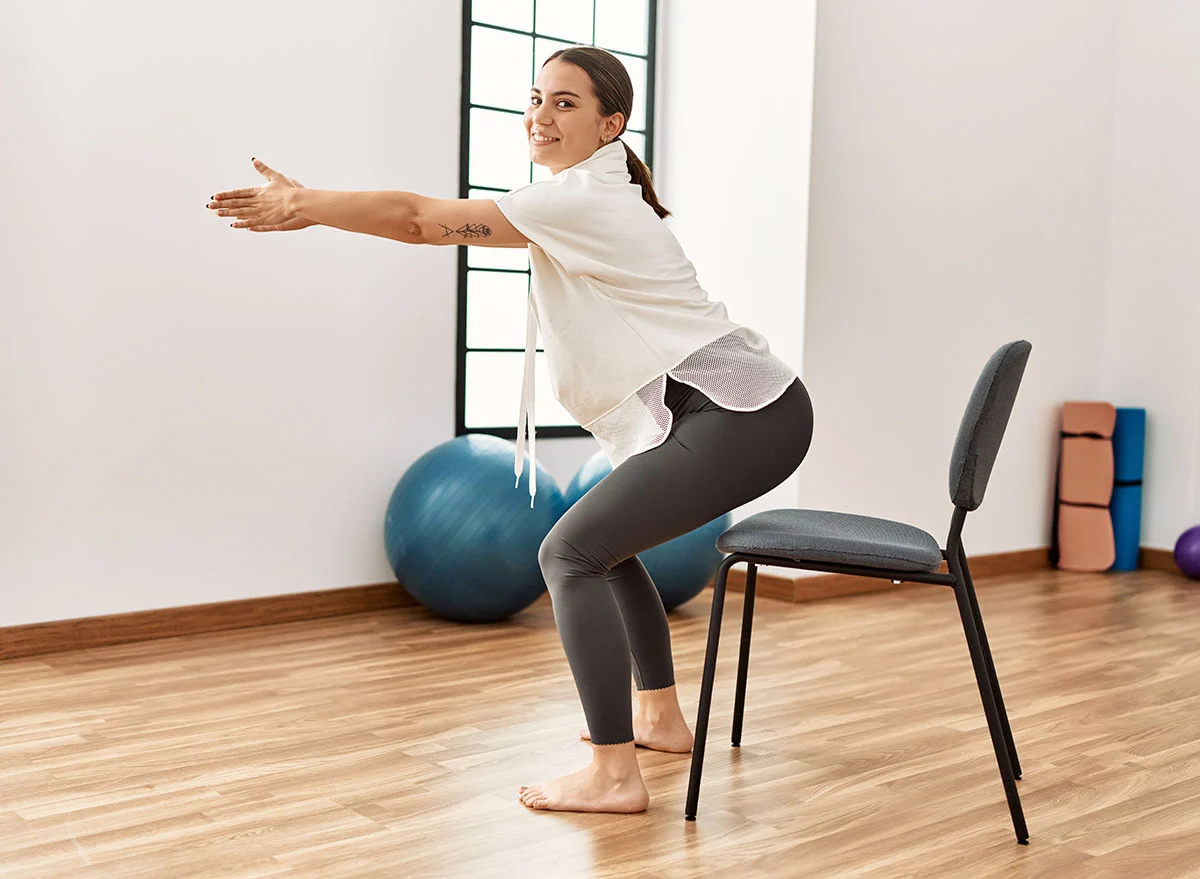
1. The Chair Box Squat
This movement is the "gold standard" for daily independence. It mimics the mechanics of sitting down and standing up, which is a foundational requirement for living autonomously.
- Target: Quadriceps, glutes, hamstrings, and core.
- The Science: By using the chair as a "box," you establish a clear target for depth, ensuring consistent range of motion.
- Execution: Position yourself in front of a stable chair. Lower your hips until your glutes lightly tap the seat, then immediately drive through your heels to return to a standing position.
- Clinical Tip: Avoid "collapsing" onto the chair. The contact should be a light tap to signal depth, not a release of tension.
2. Chair-Supported Reverse Lunge
Reverse lunges are superior to forward lunges for the aging population because they place significantly less stress on the patellar tendon and the knee joint.
- Target: Quadriceps, glutes, and balance-stabilizing muscles.
- The Science: The chair provides a tactile reference for stability, allowing the user to focus on the eccentric (lowering) phase of the movement, which is critical for preventing falls.
- Execution: Hold the back of the chair. Step one foot back, dropping the knee toward the ground while keeping the torso upright. Drive through the front heel to return to the starting position.
3. Seated Leg Extension
While machines in gyms are often used for this, a seated version with an emphasis on the "squeeze" provides excellent quadriceps isolation.

- Target: Rectus femoris and vastus lateralis (the "tear-drop" muscle above the knee).
- The Science: Strengthening the quads is the most effective way to alleviate chronic knee pain caused by lack of support.
- Execution: Sit upright, core engaged. Extend one leg fully until it is parallel with the floor. Pause for two seconds at the top to force peak contraction.
4. Seated Band Hamstring Curl
The hamstrings are often the most neglected muscle group in seniors, yet they are vital for walking speed and stride power.
- Target: Hamstrings and calves.
- The Science: Because gravity works against us, we often lose the ability to flex the knee with force. Resistance bands provide constant tension that mirrors the muscle’s natural pulling function.
- Execution: Secure a resistance band to a table leg or heavy anchor. Wrap the other end around your ankle. While seated, curl your heel toward your glutes.
5. Seated Band Hip Abduction
Balance is not just about leg strength; it is about hip stability. The glute medius, located on the side of the hip, prevents the pelvis from dropping when you walk.
- Target: Glute medius and minimus.
- The Science: Weakness here causes a "waddling" gait, which increases the risk of tripping.
- Execution: Place a resistance band around your knees. While seated, press your knees outward against the resistance, hold for a beat, and return slowly.
Chronology of Progress: What to Expect
Consistency is the mechanism of success. The following timeline outlines the typical adaptation phase for a sedentary adult starting this program:
- Weeks 1-2 (Neural Adaptation): The body learns the movement patterns. You may feel "new" soreness as your central nervous system recruits previously dormant muscle fibers.
- Weeks 3-6 (Muscle Hypertrophy): You will notice the exercises becoming easier. This is the time to increase the number of repetitions or the intensity of the resistance bands.
- Weeks 6-12 (Functional Carryover): This is the "Aha!" moment. You will notice that climbing stairs no longer leaves you breathless and that getting out of your car or a deep sofa feels effortless.
Supporting Data: The Impact of Resistance Training
Clinical trials have consistently shown that resistance training in those over 60 improves insulin sensitivity, bone density, and cognitive function. A study cited in the Archives of Physical Medicine and Rehabilitation noted that participants who engaged in twice-weekly resistance training showed a 15% increase in walking velocity within three months. This increase in gait speed is a significant health marker, as it is inversely correlated with all-cause mortality.
Official Recommendations and Safety
The American College of Sports Medicine (ACSM) recommends that older adults engage in muscle-strengthening activities at least two days a week. However, before beginning this program, consider these safety implications:
- Clearance: If you have a history of hip or knee replacements, consult with your orthopedic surgeon or physical therapist.
- Equipment Integrity: Ensure your chair is non-slip and positioned against a wall to prevent it from sliding.
- Hydration and Nutrition: Muscle repair requires protein. Ensure your diet includes adequate protein intake (roughly 1.2 grams per kilogram of body weight) to support the repair of the fibers you are stressing during the workouts.
Implications for Longevity
The implications of this chair-based regimen extend far beyond aesthetics. By maintaining leg strength, you are essentially "insuring" your future mobility. The loss of leg muscle is the silent thief of independence; once an individual loses the ability to rise from a chair unassisted, they often lose the ability to live alone.
By dedicating just 20 to 30 minutes, two to four days a week, to these five movements, you are not just exercising; you are building the structural integrity required to live a vibrant, active life well into your 80s and beyond. The chair, once a symbol of rest, becomes the most effective tool in your kit for rejuvenation.
Final Thoughts on Consistency
The beauty of this program lies in its accessibility. There are no excuses regarding travel, weather, or gym crowds. Whether you are in your living room or a hotel room, these movements are always available. The goal is not to train like an athlete, but to live like one—with the strength, stability, and confidence to navigate your world on your own terms. Treat each repetition as a "down payment" on your future mobility, and the dividends will be paid in every step you take.