For decades, patients living with hypermobile Ehlers-Danlos syndrome (hEDS) have navigated a medical landscape characterized by skepticism. They arrive at clinics with widespread, burning, and debilitating pain, only to be told that their structural imaging—MRIs and X-rays—appears "normal." While the connective tissue laxity inherent to hEDS explains joint dislocations and subluxations, it has long failed to account for the systemic, invisible, and agonizing neuropathic pain that plagues the patient community.
A groundbreaking study published in the July 2026 issue of Scientific Reports has finally begun to bridge this gap. By meticulously mapping the nervous system of hEDS patients, researchers have provided the first systematic evidence that small fiber neuropathy (SFN) is not merely a comorbid curiosity, but a core, distinct, and measurable component of the hEDS experience.
Main Facts: The Neurological Reality of hEDS
Small fiber neuropathy occurs when the delicate, microscopic nerve fibers responsible for sensing pain, temperature, and regulating involuntary bodily functions become damaged or depleted. In the general population, SFN is often diagnosed after a history of diabetes or exposure to neurotoxins. However, in the hEDS population, the findings suggest a different, more complex mechanism.
The study, led by a team of researchers in Italy, compared 35 patients diagnosed with both hEDS and SFN against a control group of 38 patients with "idiopathic" SFN (iSFN)—a form of the condition with no identifiable cause. The data reveals that the hEDS cohort experiences a significantly higher burden of disease. This includes not only more generalized pain but also a profound disruption of the autonomic nervous system—the biological "autopilot" that governs heart rate, blood pressure, digestion, and thermoregulation.
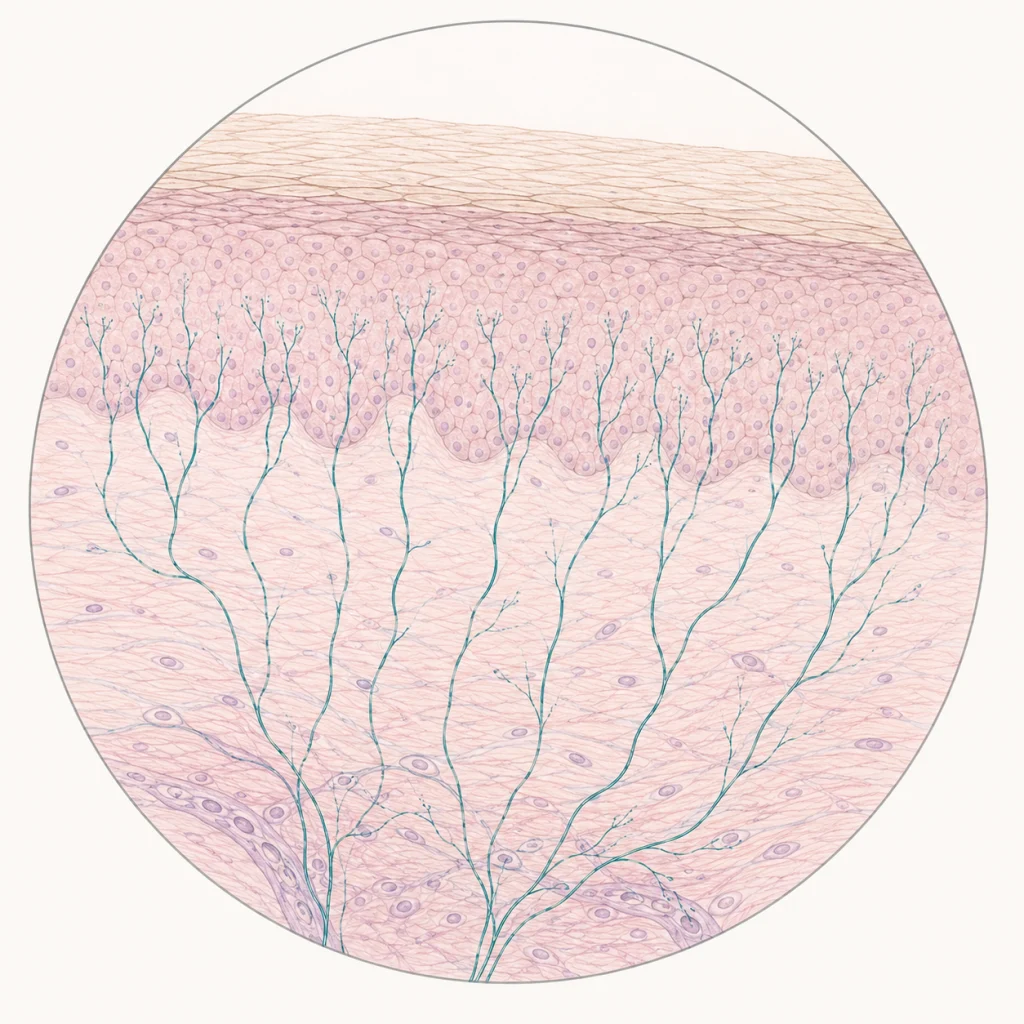
Most importantly, the study provides objective biological markers, moving the conversation from the subjective "patient experience" to the objective "clinical observation." By utilizing skin punch biopsies to visualize nerve density, the researchers have confirmed that the pain reported by these patients is tethered to tangible physiological decay.
A Chronological Perspective: The Burden of Early Onset
One of the most striking revelations of the study is the age of symptom onset. In the group with idiopathic SFN, patients typically began experiencing symptoms in their mid-30s. In stark contrast, patients with hEDS reported the emergence of neuropathic pain and autonomic dysfunction at an average age of 19.
This 16-year discrepancy is profound. It suggests that many individuals with hEDS are traversing their formative adolescent and young adult years while living with an unrecognized and untreated neurological condition. By the time many of these patients receive an hEDS diagnosis, they have often lived with chronic pain for nearly two decades. This chronic delay contributes to the "diagnostic odyssey" that characterizes the hEDS experience, where patients are frequently dismissed as having psychosomatic complaints until their symptoms become too severe to ignore.
The data indicates that the longer the disease duration, the more complex the clinical picture becomes. The study suggests that for the hEDS patient, the nervous system is under a constant, slow-burning siege, leading to a cumulative disability that impacts education, career, and quality of life long before it is acknowledged by the medical community.
Supporting Data: The Autonomic Divide
The study’s most compelling evidence lies in its comparison of autonomic function. While both groups suffered from SFN, the hEDS cohort demonstrated a significantly more severe autonomic profile.
The POTS Connection
Perhaps the most notable finding is the high prevalence of Postural Orthostatic Tachycardia Syndrome (POTS) in the hEDS/SFN group. Over 51% of these patients met the criteria for POTS, compared to zero in the control group.
Historically, the link between hEDS and POTS has been attributed primarily to blood vessel laxity—the idea that stretchy veins simply allow blood to pool in the legs when standing. However, this study suggests that the problem is rooted in the peripheral autonomic nervous system itself. The nerve fibers that signal the heart and blood vessels to adjust to gravity are damaged or functioning poorly. This shifts the clinical focus from mere structural support (such as compression garments) to targeted neurological intervention.
Sensory and Regional Pain
The study also identified unique pain patterns. While both groups experienced burning, tingling, and sensitivity, the hEDS cohort reported significantly more widespread pain. A particularly interesting finding was the high rate of perineal pain—reported by 34% of hEDS patients and 0% of the control group. Researchers hypothesize that this may be due to "nerve displacement." Because the connective tissue in hEDS patients is hypermobile and structurally loose, the nerves themselves may be stretched or physically misaligned, leading to localized, chronic irritation that would not be present in the general population.
Under the Microscope: The Evidence of Repair
The skin biopsy results provided the most definitive biological proof of the condition’s uniqueness. While the sensory nerve fibers in the top layer of the skin showed similar loss in both groups, the hEDS group exhibited a significantly higher depletion of autonomic fibers, particularly those involved in sweating.
More intriguing was the discovery of "alternating patterns" of nerve damage and regrowth. This suggests that the nervous system in hEDS is not just dying off; it is in a state of chaotic, chronic struggle. The nerve fibers are attempting to regenerate, but the underlying environment—characterized by connective tissue instability and systemic inflammation—likely interferes with successful repair. This cycle of degeneration and futile regeneration may explain the fluctuating, unpredictable nature of the pain described by many hEDS patients.
Implications for Clinical Care
The implications of these findings for the medical community are transformative. For years, patients have been told that their symptoms were unrelated or "all in their head." This study provides a roadmap for a new standard of care.
- Diagnostic Shifts: The study advocates for the integration of autonomic testing and skin biopsies as standard tools for hEDS evaluation. If a patient presents with systemic, unexplained pain and autonomic dysfunction, they should be screened for SFN.
- Targeted Management: Recognizing that the pain is neuropathic rather than purely mechanical changes the therapeutic approach. It moves the needle away from physical therapy alone and toward medications and interventions that target nerve stabilization, autonomic function, and neuropathic pain management.
- Validation: For the hEDS community, this research provides the "missing link" they have sought for generations. It validates that the widespread sensitivity and systemic symptoms are not a reflection of anxiety or psychosomatic distress, but rather a documented neurological pathology that demands serious medical attention.
Conclusion: A New Path Forward
The research conducted in 2026 marks a turning point in our understanding of connective tissue disorders. By uncovering the complex, systemic nerve involvement in hEDS, the scientific community has moved one step closer to providing the care and respect that patients deserve.
Understanding the neurological dimension of hEDS is no longer a matter of scientific curiosity—it is an ethical imperative. As researchers continue to map the interplay between connective tissue and the nervous system, the goal remains clear: to transition from merely managing symptoms to addressing the root causes of the suffering that has defined the hEDS experience for far too long. With these findings, patients now have the data to ask for, and expect, a higher standard of comprehensive, evidence-based care.