










Originally published in the May-June 1989 issue of Yoga Journal, this exploration of Parsvottanasana remains a cornerstone for practitioners seeking to understand the intricate mechanics of pelvic alignment.
The Challenge of Alignment
In the vast landscape of Hatha Yoga, few postures present a challenge as deceptively simple as Pyramid Pose, or Parsvottanasana. While it may appear as a straightforward forward fold, the pose demands a level of precision regarding the pelvis that often eludes even seasoned practitioners. For many, the transition from the stability of Mountain Pose (Tadasana) into the forward-leaning intensity of the Pyramid feels like stepping into a labyrinth; the comfort of the known dissolves into a sea of shifting balances and nebulous physical sensations.
The core difficulty lies in the relationship between the pelvis and the thighbones. When moving into forward bends, the tendency is often to collapse, causing the lower back to round, the abdomen to compress, and the legs to lose their structural integrity. Mastering this pose requires more than mere flexibility; it requires a deep, kinesthetic awareness of how the pelvis moves through space.
Chronology of Discovery: From Observation to Practice
The journey to perfecting Pyramid Pose begins with understanding how the body reacts to forward extension. In a standard Standing Forward Bend (Uttanasana), the common mistake is to pull the pelvis forward onto the thighs prematurely. This leads to a bloated abdominal sensation and excessive downward pressure on the thighs, which can compromise the integrity of the knees and lower spine.
By shifting the focus—using the fingers on the front hip bones as a tactile guide—the practitioner can learn to lift the pelvis up and away from the thighbones. This simple mechanical adjustment creates vital space in the hip sockets, allowing the torso to move naturally rather than through force. This principle serves as the chronological foundation for a variety of poses:
- Seated Forward Bends: Pressing the sitting bones back to lengthen the spine.
- Triangle Pose: Lifting the pelvis to prevent hyperextension of the front knee.
- Side Angle Pose: Relieving groin compression through hip socket expansion.
- Half Moon and Warrior III: Using the lift of the pelvis to find balance and structural support.
Supporting Data: Techniques for Precision
To assist practitioners in developing this awareness, several instructional variations have been developed, moving from supported wall work to full, unassisted expression.
The Wall-Supported Approach
For beginners or those with limited hamstring flexibility, the wall is an essential tool. By standing 18 inches from the wall and moving into the pose, one can place the hands against the surface. This allows the practitioner to keep the torso parallel to the floor, drawing the pelvis back away from the shoulders. The wall provides an external resistance that encourages the lengthening of the lumbar spine and the broadening of the back ribcage.
The Strap-Assisted Method
For those dealing with chronic lower back discomfort, a rope or strap around the pelvis acts as a stabilizer. By anchoring the strap to a door or wall, the practitioner can allow the weight of the torso to "hang" into the loop. This passive stretch helps release the buttock muscles and deep tissues of the lower back. Once the spine is lengthened, the student can press the front leg into the floor, using the strap as a fulcrum to lift the pelvis over the head of the femur.
Navigating the Lopsided Pelvis
One of the most significant hurdles in Pyramid Pose is the natural tendency for the pelvis to rotate and tilt. When turning the torso toward the front leg, the hip of the front leg often drops while the back hip rises. By placing the fingers on the pelvic rims, the practitioner can monitor this tilt. The objective is to keep both sides of the pelvis equidistant from the floor, moving the front hip back and the back hip forward to square the pelvis to the front of the mat.
Advanced Expressions: Integration and Stillness
As practitioners gain proficiency, the pose transitions from a mechanical exercise into a sophisticated expression of strength and flexibility.
Interlocked Fingers and Chest Expansion
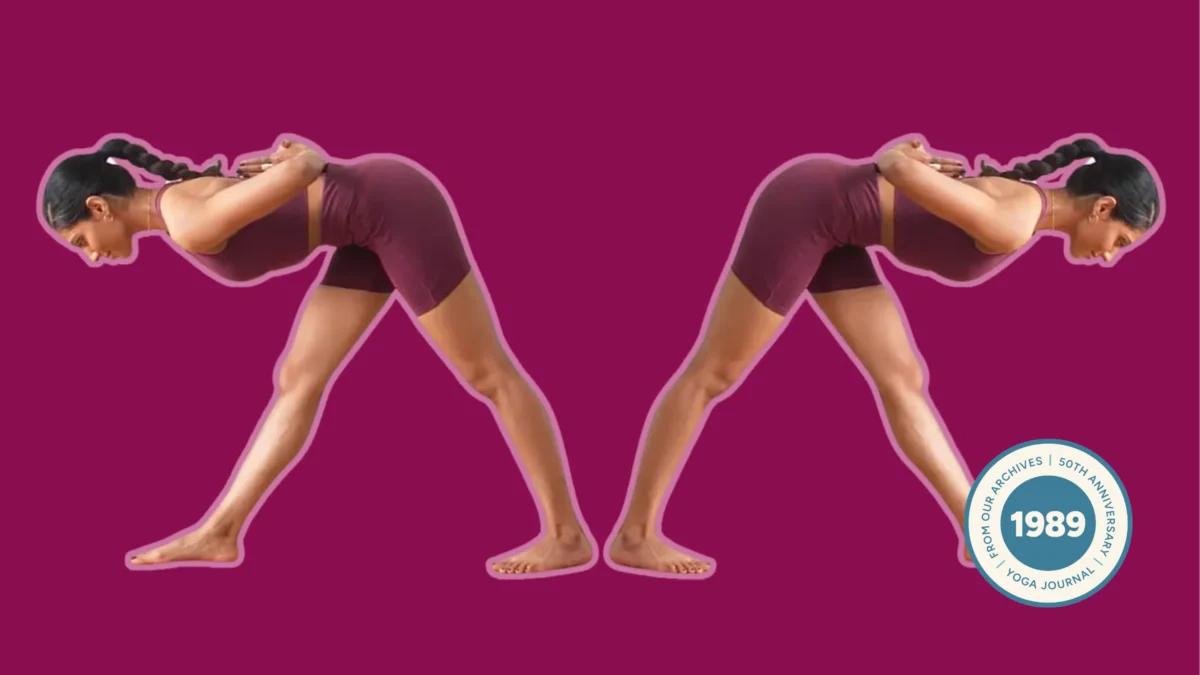
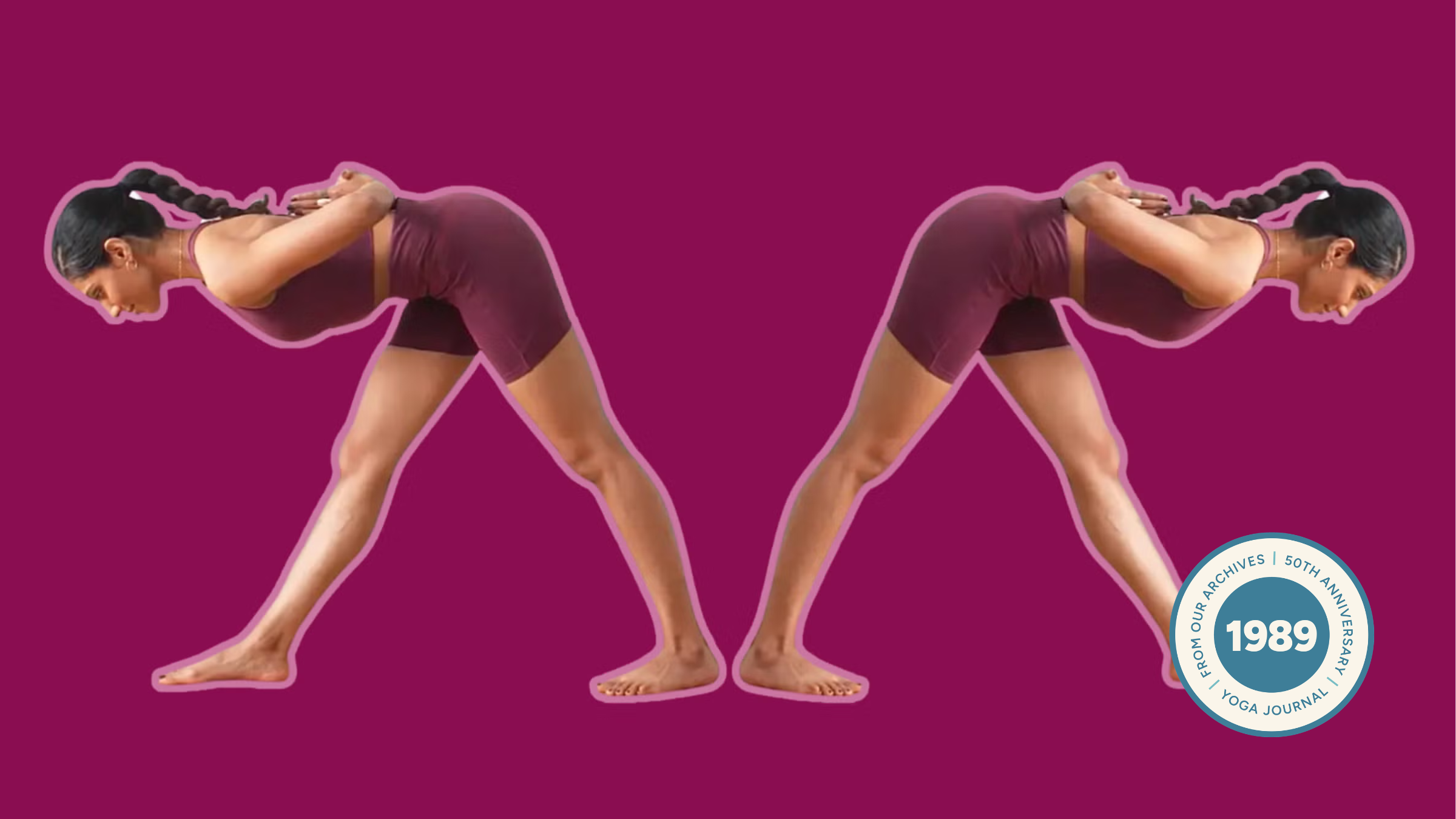
Advanced students often utilize an arm variation—interlocking fingers behind the back. This serves two purposes: it forces the shoulder blades to track down toward the waist and creates a counterweight that helps the chest remain open. This, in turn, ensures that the spine reaches its maximum extension before the torso folds over the leg.
The Namaste Variation
The final, classical expression involves bringing the hands into a namaste position (or holding opposite elbows) behind the back. This configuration requires a deep internal rotation of the shoulders and an expansion of the upper chest. By pressing the inner front leg into the floor for stability, the practitioner can lift the pelvis away from the thigh, ensuring the spine remains elongated even as the abdomen and ribcage make contact with the shin.
Implications for the Practitioner
The instruction provided in these classic methodologies should be viewed as "clues" rather than rigid rules. As noted by Charles V. W. Brooks in Sensory Awareness, the act of stretching should not be treated as a performance, but as a spontaneous, meditative discovery.
When a student adheres too strictly to a set of instructions, they may bypass the body’s actual needs in the present moment. The true value of a practice session lies in the "freshness" of perception—the moment when the mind becomes clear because the body is reacting to a new, subtle movement. Over time, as muscles adapt to these patterns, the excitement of discovery may fade. At this junction, the student is encouraged to be creative, to experiment with props, and to listen to the "inner logic" of their own anatomy.
The Higher Logic of Movement
What is most profound about this disciplined approach to yoga is the realization that the body reveals its requirements in an orderly, methodical fashion. Each adjustment—whether it is lifting the pelvis or rotating the hip—is part of a secret, interconnected network.
When one reflects on these inadvertent discoveries, they appear less like random trial-and-error and more like a systematic unfolding of potential. This inherent logic suggests that the body possesses a self-regulating intelligence. As a practitioner moves from one pose to the next, they are not merely performing a routine; they are engaged in a dialogue with a higher power locked within, learning precisely what is needed at each stage of their development.
In the final analysis, Pyramid Pose is not just about the alignment of the bones or the length of the hamstrings. It is an exercise in surrender—a balance between the strength required to maintain the posture and the willingness to let go of the weight of the brain. When the student reaches a place of stillness, the pose ceases to be an exercise and becomes, in the truest sense, a meditation in motion.