









Reviewed by Brian St. Pierre, MS, RD
When GLP-1 receptor agonists—the class of medications including semaglutide (Ozempic) and tirzepatide—first permeated the mainstream market, a tremor of uncertainty rippled through the health and fitness industry. "Is this drug going to steal my job?" was the prevailing anxiety among coaches who feared that a pharmacological solution would render their expertise in habit formation, nutrition, and exercise obsolete.
That was the sentiment in 2017. Now, in 2026, the landscape has shifted entirely. With over one in ten U.S. adults currently utilizing GLP-1 medications, the "theoretical threat" has become a daily reality. The industry has moved past the panic phase; the consensus among leading fitness professionals is that medication is not a replacement for coaching, but a powerful, albeit complex, variable that requires a new framework for support.
The Evolution of the Coaching Paradigm
The initial defensive posture taken by many coaches has softened into a more nuanced approach. Instead of viewing GLP-1s as an "antagonist" to traditional fitness, the modern coach views them as an additive tool. However, this transition requires a fundamental reframing of the coaching business model.
Kate Solovieva, Director of Community at Precision Nutrition, offers a vital perspective: "As a coach, you’re not in the GLP-1 world; you’re in the GLP-1 support world." This distinction is critical. Coaches are not tasked with managing the medication itself—that remains firmly in the hands of medical professionals. Rather, they are tasked with helping the subset of patients who are ready, willing, and able to receive behavioral support.
Trying to force a "coaching-first" philosophy on a patient who is not interested is a misuse of resources. Success in this new era lies in identifying who is ready for help and tailoring the intervention to their specific stage in the medical journey.
Chronology: From Novelty to Necessity
The rise of GLP-1s followed a predictable, yet rapid, trajectory:
- 2017–2019 (The Introduction): Limited availability and high costs kept these drugs in the realm of specialized diabetes management. Coaching remained largely unaffected.
- 2020–2023 (The Mainstream Surge): Rapid adoption for weight management turned these drugs into a cultural phenomenon. Coaches began encountering more clients who were either on the medication or actively seeking it.
- 2024–2026 (The Integration Phase): We are now in a period of stabilization. The focus has shifted from "are these drugs good or bad?" to "how do we maximize health outcomes for those taking them?"
The Seven Archetypes of GLP-1 Clients
To effectively coach in this space, one must recognize that "GLP-1 user" is not a monolith. Below are the seven distinct profiles that coaches encounter today, categorized by their level of readiness.
1. The Honeymooner (Low Readiness)
These clients have recently started the medication and are seeing rapid results with minimal effort. They often feel no need for external guidance.
- Coaching Move: Respect their space. Avoid the "righting reflex"—the urge to lecture them on why they should be doing more. Instead, celebrate their success and leave the door open for when the honeymoon phase inevitably wanes.
2. The Ambivalent Candidate (Low-to-Moderate Readiness)
These individuals are on the fence, often paralyzed by the social stigma or fear of side effects.
- Coaching Move: Use tools like the "4 Crazy Questions" exercise to explore their underlying hesitations. Remember: deciding to take the drug is a medical decision, but helping them clarify their values is a coaching masterpiece.
3. The Ready-to-Quitter (Moderate Readiness)
They are losing weight but suffering from severe side effects—nausea, fatigue, or gastrointestinal distress.
- Coaching Move: Provide neutral education to normalize their experience. Encourage them to consult their doctor about potential dosage adjustments or nutritional strategies (like smaller, more frequent meals) to manage symptoms.
4. The Muscle-Loss Risk (Moderate Readiness)
The scale is dropping, but the client is losing lean mass because they aren’t prioritizing resistance training or protein.

- Coaching Move: Bring the "invisible" to light. Use DEXA scans or functional strength baselines to demonstrate what is actually being lost. Pivot their focus to protein density and incremental strength gains.
5. The Under-Fueler (Moderate-to-High Readiness)
The medication has suppressed their appetite to a point where they are barely eating.
- Coaching Move: This is a red flag for potential disordered eating. If the client resists tracking, lead with empathy and a "show me" approach. Establish a mandatory eating schedule to ensure their body is fueled, even if they lack the internal cues of hunger.
6. The Graduate (High Readiness)
These clients are successfully weaning off the medication and are terrified of weight regain.
- Coaching Move: This is where the most profound coaching occurs. You are helping them build the "ruts in the trail"—the neural pathways and habits that will sustain them once the pharmacological appetite suppression is gone.
7. The Priced-Out (High Readiness)
These clients are forced off the medication due to insurance or financial constraints, often feeling a sense of personal failure.
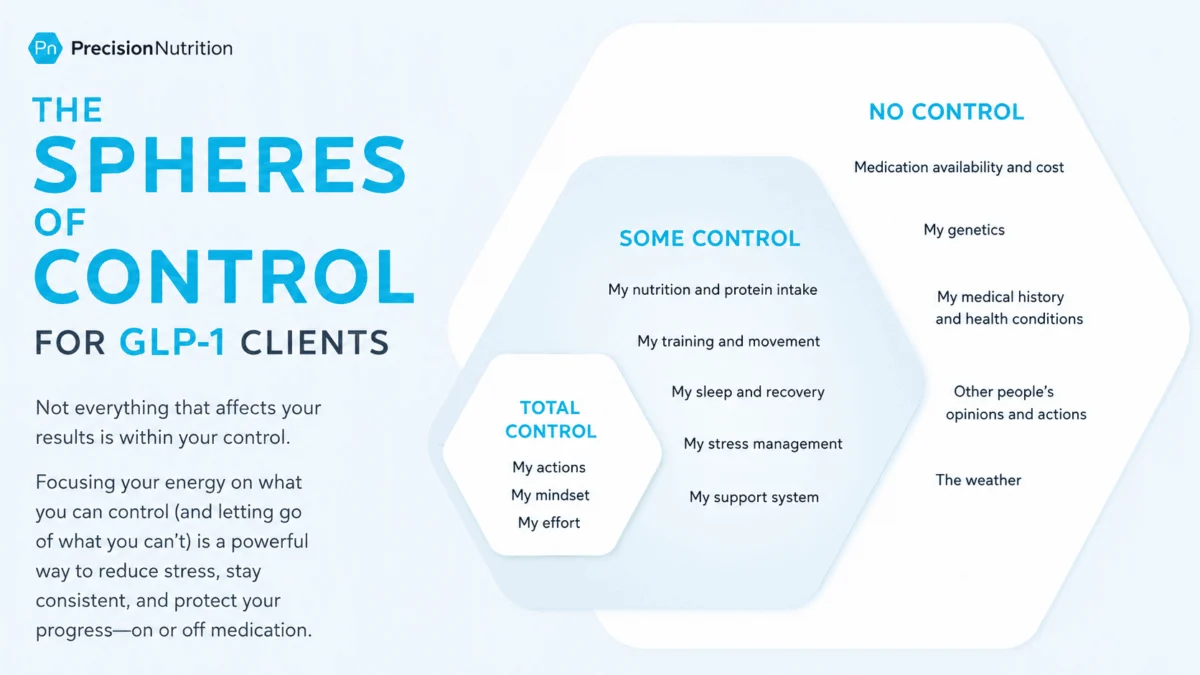
- Coaching Move: Emphasize that this is a systemic failure, not a personal one. Use the "Spheres of Control" model to help them refocus on what they can influence: their sleep, their protein intake, and their movement.
Supporting Data and Medical Implications
The data regarding muscle mass retention is particularly sobering. Research indicates that without intentional intervention, up to 40% of weight lost on GLP-1s can come from lean mass. This is a critical pivot point for fitness professionals. By emphasizing protein (25–40g per meal) and resistance training, coaches provide a protective layer that the medication alone cannot offer.
Furthermore, statistics show that nearly 50% of GLP-1 users discontinue the medication within the first year. This high "attrition rate" reinforces the necessity of the coaching profession. Those who have built strong, sustainable behavioral habits during their time on the medication are four times more likely to maintain a 10% or greater weight loss once the drug is discontinued.
Official Responses and Ethical Boundaries
Professional organizations and lead coaches like Toni Bauer, PN’s Director of Coaching and Education, are adamant about one thing: Scope of practice is non-negotiable.
Coaches should never suggest dosage changes or claim to know what is "right" for a client’s specific metabolic health. The role of the coach is to:
- Educate: Provide information on common side effects and nutritional strategies.
- Monitor: Help clients identify when symptoms warrant a call to a doctor (e.g., persistent vomiting, severe abdominal pain, or signs of depression).
- Facilitate: Help clients integrate the necessary lifestyle changes that turn temporary weight loss into a permanent lifestyle transformation.
Implications for the Future of Fitness
The "GLP-1 revolution" has forced the fitness industry to grow up. We are moving away from the "eat less, move more" mantra of the past and into a more sophisticated era of bio-behavioral coaching.
The promise of coaching in 2026 is not "you will never need a drug." The promise is this: While the medication does the heavy lifting, we will cut the ruts of your habits so deep that they will remain long after the medication is gone.
For the coach, this means that the target market hasn’t disappeared; it has simply become more specialized. The clients who will succeed—the ones who will maintain their weight, their muscle, and their metabolic health—are the ones who have a partner in their corner helping them build an identity as a healthy, active person.
As we look toward the future, it is clear that GLP-1s are not the end of the coach; they are the catalyst for a new, more vital, and more deeply impactful standard of care. If you are a coach looking to thrive in this new environment, your primary asset is no longer just your knowledge of sets and reps—it is your ability to guide, support, and anchor your clients through the complex transition of permanent lifestyle change.