










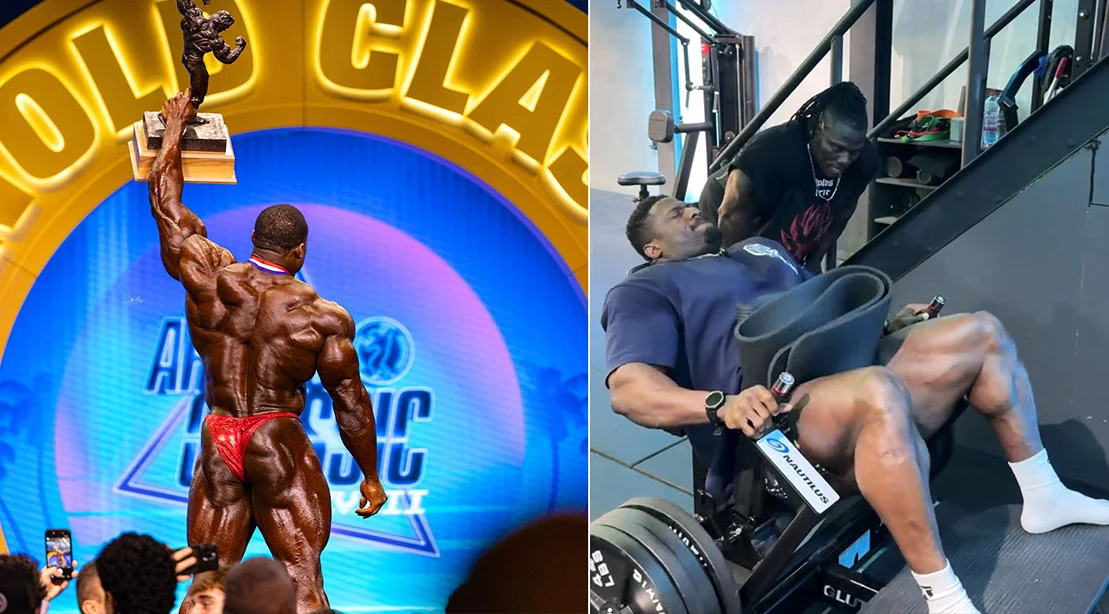
In the world of professional bodybuilding, the pursuit of the Sandow trophy—the ultimate prize in the sport—is a journey defined by obsessive refinement. As the 2025 Mr. Olympia competition approaches, the spotlight is firmly fixed on Chinedu Andrew “Jacked” Obiekea. Having already cemented his status as an elite force with dominant victories at the Arnold Classic and the Arnold Classic UK, the Nigerian-born powerhouse is now looking to complete his transformation from a rising contender to the king of the bodybuilding world.
To claim the throne in Las Vegas this September, Obiekea understands that mere size is no longer enough. Judges are looking for the “Mona Lisa” of physiques: a masterpiece of symmetry, conditioning, and artistic flow. Recognizing that his lower body must be as breathtaking as his upper-body silhouette, Obiekea has turned his focus to one of the most underrated, yet vital, exercises in the strength athlete’s arsenal: the heavy hip thrust.
Chronology of a Contender: The Rise of Andrew Jacked
Andrew Jacked’s trajectory in the IFBB Pro League has been nothing short of meteoric. His rise through the ranks serves as a testament to his tactical approach to physique development and his refusal to remain stagnant.
- 2022: In his Olympia debut, Obiekea placed eighth. It was a respectable showing for a newcomer, but it served as a wake-up call regarding the sheer level of detail required to break into the top tier.
- 2023–2024: Through rigorous training and refined nutritional protocols, he clawed his way up to fifth place. During this period, critics and fans alike began to notice his improved conditioning and structural balance.
- 2025: A pivotal year. Obiekea secured a hard-fought third-place finish at the Mr. Olympia, signaling that he had finally cracked the code of the top three. His subsequent victories at the Arnold Classic and Arnold Classic UK were not just wins; they were statements of intent.
As he prepares for the upcoming Joe Weider’s Olympia Weekend (September 24–27), Obiekea is not resting on his laurels. His social media activity, specifically a recent Instagram post shared with his one million followers, highlights the granular focus he is applying to his glute development. By integrating heavy hip thrusts into his regimen, he is refining the “posterior chain” to ensure that his physique displays a level of anatomical perfection that cannot be ignored by the judges.
The Science of the Gluteus: Why Hip Thrusts Matter
For the uninitiated, bodybuilding is often viewed through the lens of “big quads” and “broad shoulders.” However, the modern stage demands total integration. A physique that lacks proper glute development will often look “flat” or disconnected from the hamstrings, disrupting the flow of the entire leg.
Scientific literature supports Obiekea’s focus on the hip thrust. Research published in journals such as the Journal of Applied Biomechanics suggests that while traditional compound movements like the back squat are foundational for overall leg mass, they are not the most efficient tools for isolating the gluteus maximus.
Anatomical Advantages of the Hip Thrust
The hip thrust offers a unique mechanical advantage: it operates in a horizontal plane, placing the gluteus maximus under maximum tension at the shortened position. Unlike the squat, which requires significant ankle and knee stabilization, the hip thrust minimizes the load on the joints while maximizing the “squeeze.”
- Gluteus Maximus Activation: As the primary hip extensor, the gluteus maximus is the engine of the lower body. Hip thrusts provide a direct line of resistance to this muscle group, allowing for greater fiber recruitment than vertical movements.
- Synergistic Support: The exercise also engages the adductor magnus (the inner thigh muscle) and the hamstrings. By developing these supporting tissues, an athlete creates a “shelf” that makes the quads appear more pronounced and the overall leg structure more imposing.
- Reduced Spinal Compression: By utilizing a machine-based hip thrust, Obiekea can push heavier weights without the risk of lumbar spine fatigue associated with free-weight squats, allowing him to train with higher frequency and intensity.
Technical Execution: The “Jacked” Method
Obiekea’s approach to the gym is clinical. In his recent training footage, he is seen navigating a 352-pound (160 kg) weight stack. However, the weight itself is secondary to the technical execution—a hallmark of his training philosophy.
The Anatomy of a Perfect Rep
To emulate the level of hypertrophy Obiekea is aiming for, one must adhere to strict biomechanical standards:
- The Setup: Obiekea utilizes a foam mat to distribute the pressure of the belt across his hips. At 352 pounds, the potential for soft-tissue discomfort is high; mitigating this allows him to focus entirely on the mind-muscle connection rather than physical pain.
- Time Under Tension: The key to his growth is the pause. At the peak of the thrust, he holds the weight, bracing his core and intentionally contracting his glutes. This isometric hold maximizes metabolic stress, a primary driver of muscle hypertrophy.
- The “Straight Line” Rule: Obiekea emphasizes that the body must form a straight line from the knees to the shoulders at the top of the movement. If the hips fail to reach full extension, the glutes are not being fully worked. Obiekea’s advice to his followers is simple: if you cannot achieve that full extension, reduce the weight. Ego lifting in this movement is a shortcut to injury and a waste of training volume.
Implications for the 2025 Olympia
The 2025 Mr. Olympia in Las Vegas is shaping up to be one of the most competitive in recent history. The gap between the third-place finisher and the champion is often measured in millimeters of muscle separation and the crispness of a pose.
By prioritizing his posterior chain, Obiekea is addressing one of the most common critiques of contemporary bodybuilding: the lack of “glute-ham tie-in.” When a bodybuilder hits a rear double-bicep pose or a side-chest pose, the silhouette of the legs dictates the score. A powerful, defined glute region provides the necessary contrast to the quads, creating the illusion of a larger, more dense lower body.
Expert Analysis and Industry Response
Industry insiders have noted that Obiekea’s evolution is not just physical; it is psychological. By sharing his training methodology, he is signaling confidence. He is not hiding his preparation behind closed doors; he is showing the world exactly how he intends to win.
“The level of detail Andrew is putting into his training shows a maturity that he didn’t have in 2022,” says one industry analyst. “He understands that the judges are looking for a complete picture. By perfecting the glutes, he is essentially framing the rest of his physique. It’s an artistic decision as much as an athletic one.”
The Road to Vegas
As the calendar turns toward September, the bodybuilding world turns its eyes to Las Vegas. The competition is expected to be fierce, with established legends and hungry challengers vying for the Sandow. However, Andrew Jacked’s combination of aesthetic grace and calculated, science-backed training places him in a unique position.
Whether or not this specific focus on gluteal hypertrophy will be the deciding factor remains to be seen. However, in a sport where the smallest details can determine a champion, Obiekea’s commitment to the process is undeniable. He is, quite literally, building his way to the top.
For fans eager to witness this year’s historic event, the Joe Weider’s Olympia Weekend promises to be a spectacle of human potential. The stage is set, the training is done, and the “Mona Lisa” of bodybuilding is ready to be unveiled under the bright lights of the Olympia stage.
Event Details:
- What: Joe Weider’s Olympia Weekend
- When: September 24–27
- Where: Las Vegas, Nevada
- More Information: mrolympia.com
Follow the Journey: