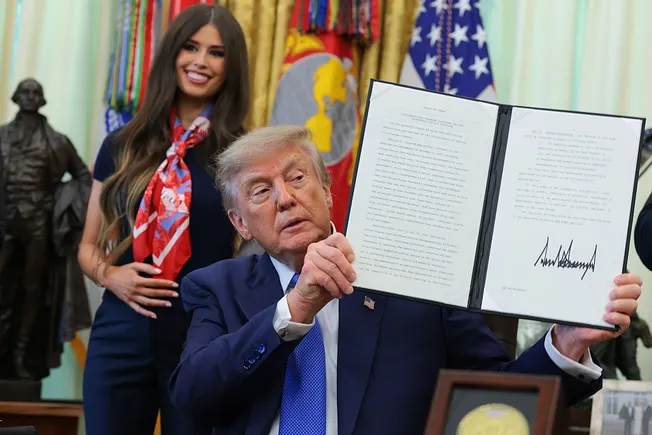
In a move that has reignited a fierce national debate over public health policy and scientific integrity, President Donald Trump signed an executive order on Monday aimed at fundamentally restructuring the longstanding childhood immunization schedule in the United States. The directive, dubbed the "Gold Standard Childhood Vaccine Recommendations," seeks to significantly reduce the number of universally recommended vaccines, mandate the spacing of shots across additional medical visits, and challenge the regulatory framework that has governed pediatric health for decades.
The policy shift represents the latest chapter in a long-standing tension between the administration’s skepticism toward established medical consensus and the medical establishment’s reliance on peer-reviewed, data-driven immunization protocols.
Main Facts: A Shift in Protocol
The core of the executive order centers on reducing the number of universally recommended childhood vaccinations from 17 to 11. Under the new guidelines, the administration aims to:
- Fragment the MMR Vaccine: The directive mandates that the combined measles, mumps, and rubella (MMR) vaccine be split into three separate shots as soon as they become domestically available.
- Decouple Administrations: All childhood vaccines are now directed to be administered at separate medical appointments, effectively ending the use of combination shots that minimize the number of needle sticks a child receives.
- Reclassify Recommendations: While core immunizations for polio, pertussis, tetanus, and measles remain universally endorsed, vaccines for respiratory syncytial virus (RSV) and hepatitis A and B are being shifted to "high-risk group" status.
- Shared Clinical Decision Making: Immunizations for COVID-19 and influenza are now relegated to a "shared clinical decision-making" model, shifting the responsibility away from universal public health mandates toward individual provider-patient discussions.
During a press briefing at the Oval Office, President Trump defended the move as a long-overdue alignment with international norms. "This finally aligns the United States with other advanced and developed nations around the world," Trump stated. "More importantly, it aligns us with common sense and knowledge."
Chronology: The Road to the Executive Order
The path to this executive order has been marked by a series of legal, political, and administrative clashes.
- Early Initiatives: Following his appointment, HHS Secretary Robert F. Kennedy Jr. initiated a series of aggressive efforts to overhaul the CDC’s recommended vaccine schedule. These attempts were largely met with institutional resistance and were eventually blocked by federal courts.
- The Pivot: Throughout mid-2026, the White House appeared to adopt a more conservative posture. Following a resurgence of measles cases and internal warnings that anti-vaccine rhetoric could be a political liability, the administration pivoted toward food safety and nutrition.
- The Expert Review: The administration tasked a review team, led by former FDA official Dr. Tracy Beth Høeg and former CDC advisor Dr. Martin Kulldorff, to analyze the U.S. immunization schedule. Their report concluded that the U.S. was a "global outlier" regarding the volume of recommended doses.
- The Signing: Following the court-ordered freeze on earlier policies, the administration drafted the current executive order, which acts as a direct challenge to the authority of the CDC’s Advisory Committee on Immunization Practices (ACIP).
Supporting Data and The Science of Safety
The administration’s argument rests on the claim that the U.S. childhood vaccine schedule is overly aggressive compared to peer nations. However, public health experts argue that such comparisons are deeply flawed.
The Myth of the "Autism Link"
Central to the President’s justification for the order is a persistent concern regarding a link between vaccines and autism. This theory, which originated from a now-discredited study, has been systematically debunked by decades of large-scale, rigorous scientific research. Organizations including the National Academy of Medicine and the American Academy of Pediatrics have repeatedly confirmed that no credible evidence exists to support a causal relationship between vaccines and autism.
Public Health Impact
The American Academy of Pediatrics (AAP) notes that the current vaccination schedule has been one of the most successful public health interventions in modern history. Over the last three decades, established vaccine protocols have:
- Prevented an estimated 1.13 million deaths in the United States.
- Saved trillions of dollars in downstream healthcare costs associated with infectious disease treatment, hospitalizations, and long-term disability.
Contextualizing International Comparisons
Critics of the new order point out that comparing the U.S. schedule to other nations ignores the specific health infrastructure and disease burdens present in different countries. Differences in healthcare coverage, population density, and local disease prevalence necessitate tailored schedules. Experts emphasize that the U.S. schedule is specifically calibrated to provide optimal protection within the domestic context.
Official Responses: A House Divided
The reaction to the executive order from within the Republican party and the medical community has been swift and largely critical.
The Congressional Pushback
Senator Bill Cassidy (R-LA), a physician and Chairman of the Senate Health Committee, issued a sharp rebuke on social media. "I’m a doctor. This executive order is wrong," Cassidy wrote. "The President does not have the expertise to make these changes. Vaccines are overwhelmingly safe. Vaccines are effective. Vaccines DO NOT cause autism. Breaking up vaccines will mean children have to get more shots to get the same protection."
Institutional Concerns
Jan Carney, president of the American College of Physicians, released a formal statement condemning the bypass of the scientific review process. "This executive order is part of a troubling pattern by the administration to attempt to unilaterally change vaccine guidance, particularly for children, rather than relying on the transparent, scientific review that has guided the U.S. childhood vaccine schedule for decades," Carney said.
Even within the administration, there has been a struggle to balance political goals with scientific reality. CDC Director Erica Schwartz, who was confirmed with a mandate to uphold scientific integrity, has previously promised to "never betray the science," placing her in a precarious position as she is now expected to oversee the implementation of policies that contradict the agency’s own evidence base.
Implications: Legal, Regulatory, and Public Health
The executive order introduces significant uncertainty into the American healthcare system.
Regulatory Authority
The most immediate question is whether the President has the legal authority to bypass the ACIP. Traditionally, alterations to vaccine policy are made through a transparent, evidence-based review process by an expert panel at the CDC, which is then ratified by the agency. By attempting to use an executive order to circumvent this process, the administration is inviting a new wave of litigation.
The Role of State Governments
It is critical to note that the federal government does not have the power to dictate school or daycare vaccination mandates; that authority resides with individual states. However, if the federal government alters its recommended schedule, it could create a confusing patchwork of policies, potentially emboldening state legislatures to roll back their own mandates, leading to an erosion of herd immunity.
Legal Challenges
The order also directs the Attorney General to pursue legal challenges against state laws governing religious and medical exemptions. This represents a significant federal intrusion into state-level public health policy, likely triggering a constitutional battle regarding the limits of executive power in health-related matters.
Long-term Public Health Outlook
The most concerning implication for public health officials is the potential for a decline in childhood immunization rates. Even in the absence of a federal change, the mere discussion of "spacing out" vaccines can increase parental vaccine hesitancy. By framing established, life-saving vaccines as "optional" or requiring "shared clinical decision-making," the administration risks undermining the public trust necessary to maintain high vaccination coverage, which is essential to preventing outbreaks of preventable diseases like measles, polio, and pertussis.
As the 90-day window for the HHS task force to formulate a plan begins, the nation remains at a crossroads. The conflict between the administration’s populist approach to medicine and the institutional rigor of the scientific community suggests that the battle over childhood vaccinations is far from over. For now, pediatricians and public health advocates are bracing for a period of profound uncertainty, warning that the cost of these policy shifts may be paid in the health of the nation’s children.