











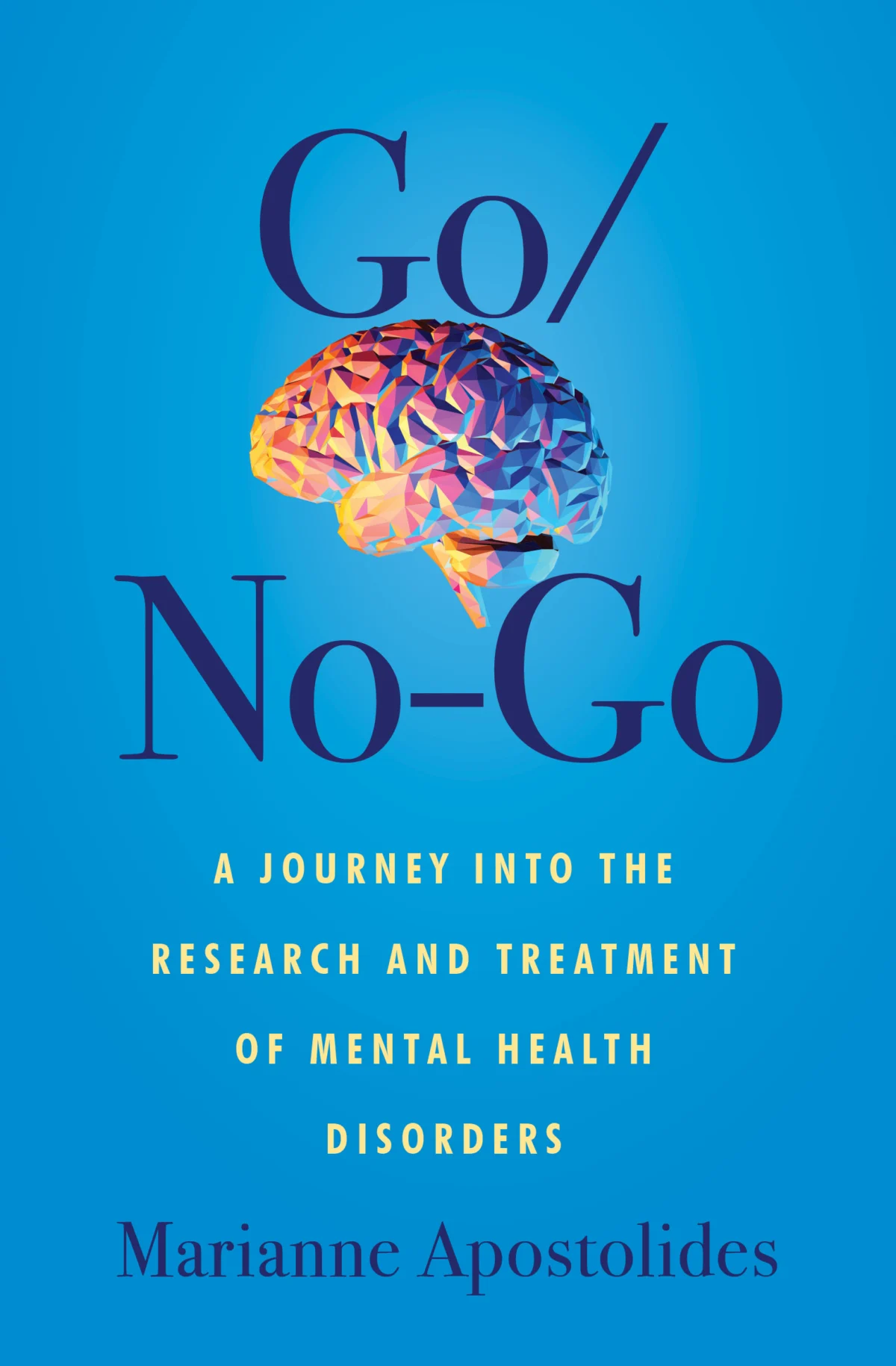
In an era where mental health is increasingly viewed through the lens of neural circuitry and data-driven algorithms, award-winning author Marianne Apostolides offers a profound and unsettling intervention. Her latest work, Go/No-Go: A Journey Into the Research and Treatment of Mental Health Disorders, serves as both a journalistic investigation and a literary quest, questioning the very foundations of contemporary neuroscience. By blending her personal history of disordered eating with a rigorous critique of psychiatric research, Apostolides highlights a growing "dead end" in how we understand and treat the human mind.
Main Facts: The Intersection of Literature and Neuroscience
Marianne Apostolides, a two-time recipient of the Chalmers Arts Fellowship and winner of the K.M. Hunter Award for Literature, has spent her career exploring the boundaries between the body, memory, and desire. With eight books to her name, including I Can’t Get You Out of My Mind and Deep Salt Water, she has established herself as a writer capable of navigating the complex terrain of human interiority. However, Go/No-Go marks a significant departure—or perhaps an evolution—of her work.
The book investigates the current state of psychiatry, focusing on the rise of "computational psychiatry" and "neuromodulation." These fields suggest that mental distress can be decoded as a series of malfunctions in the brain’s decision-making algorithms. Apostolides critiques the shift toward high-tech interventions, such as Deep Brain Stimulation (DBS), transcranial magnetic stimulation (TMS), and digital phenotyping, arguing that these methods often strip patients of their agency and neglect the social and emotional contexts of their suffering.
Central to her argument is the observation that while billions of dollars have been funneled into brain-based research over the last three decades, the "needle has not moved" in terms of improved clinical outcomes for the general population. Apostolides suggests that by treating the brain as a "computational organ" to be fixed, the field has lost sight of the person living within that brain.
Chronology: From Creative Crisis to Scientific Inquiry
The 2022 Pivot
The genesis of Go/No-Go lies in a period of profound personal and global instability. In 2022, as the COVID-19 pandemic continued to disrupt the social fabric, Apostolides found herself in the midst of an emotional and creative crisis. She had intended to write a science-fiction novel, supported by a prestigious fellowship, but found the imaginative world inaccessible. Instead, she was consumed by a resurgence of her own eating disorder—a struggle she had documented decades earlier in her first book.
Unable to "settle" into fiction, Apostolides turned to research as a way to engage with her immediate reality. She began investigating new treatments for eating disorders, looking for answers in the frontiers of neuroscience. What began as a series of straightforward journalistic articles rapidly expanded into a book-length project as she realized that the issues she was uncovering—transdiagnostic approaches and algorithmic modeling—applied to the entire spectrum of mental health.
The Disillusionment Phase
Over the course of nine months, Apostolides’s initial hope for scientific answers was replaced by a "creeping sense that something was really not right." As she dug deeper into the primary literature, she noticed a startling discrepancy between how findings were portrayed in press releases and the actual results of the studies. She found that the "concrete" images of fMRI scans often masked highly subjective and sometimes traumatizing experimental conditions.
By the time she reached the mid-point of her research, the project had transformed from a search for a cure into a "quest narrative" to understand how psychiatry had arrived at its current technological obsession.
Supporting Data: The "Thirsty Monkey" and the Algorithmic Turn
To understand the current state of psychiatry, Apostolides traces the history of "computational psychiatry" back to a seminal study published in the journal Science in the late 1990s.
The Schultz, Montague, and Dayan Study
Apostolides refers to this as the "thirsty monkey" study. In this experiment, researchers Wolfram Schultz, P. Read Montague, and Peter Dayan monitored the dopamine neurons of a monkey performing a task for a reward of sweet liquid. By making the monkey "a little thirsty," they increased the value of the reward, allowing them to derive a mathematical algorithm for how the brain anticipates and responds to rewards.
This study laid the groundwork for the idea that the brain operates like a computer. If behavior is governed by an algorithm, then "malfunctioning" behavior—such as addiction or obsessive-eating—can be viewed as a "suboptimal" decision-making process. This concept fundamentally changed the funding landscape of the National Institute of Mental Health (NIMH) under the leadership of Tom Insel, who moved the focus toward Research Domain Criteria (RDoC), a framework that prioritizes biological markers over traditional clinical diagnoses.

The Reliability Crisis in Neuroimaging
Apostolides points to significant flaws in the data used to justify these high-tech approaches. Recent meta-analyses have shown that many older fMRI studies, which form the basis for current "biomarkers" of mental illness, were based on samples too small to be statistically reliable. Furthermore, computational models designed to predict suicidality or relapse often fail to "generalize," meaning they do not work when applied to any group of people other than the specific cohort used to build the model.
Official Responses: Expert Perspectives and the Power of Metaphor
Throughout her investigation, Apostolides interviewed several leading figures in neuroscience. Their responses reveal a field that is simultaneously brilliant and blinkered by its own methodology.
The View from the Lab
- Helen Mayberg (DBS Pioneer): Mayberg, known for her work on Deep Brain Stimulation for depression, noted that every patient has a "pet metaphor" for their disorder. Apostolides used this to reflect on her own "beast" metaphor for her eating disorder, questioning whether a mechanical intervention could ever truly address a feline, predatory force within the psyche.
- Alik Widge (Neuromodulation Researcher): Widge described DBS as a "hand on a bicycle," providing a boost to help a person move forward. While he was generous with his time and genuinely motivated to help, Apostolides found his reliance on "rating scales" and "decision-making percentages" to be a "new language" that essentially replaces human experience with data points.
The Critique of "Risible" Research
Apostolides highlights the "multi-item buffet" experiments as a prime example of the dehumanization inherent in some clinical trials. In these studies, individuals with eating disorders are placed in MRI scanners and shown triggering images, or placed in rooms with thousands of calories of food and told to "let themselves go" while being watched through a one-way mirror.
Apostolides argues that these experiments are not just "silly" or "risible" from a scientific standpoint—given the stress and humiliation involved likely skew the neural data—but are "repulsive" from a humanistic one. She suggests that the researchers’ inability to see the trauma they are inflicting is a byproduct of a paradigm that views humans as "thirsty monkeys" rather than complex subjects.
Implications: The Future of Mental Health Care
The conclusion of Go/No-Go is a call for a radical "reset" of the mental health research agenda. Apostolides posits that we have reached a "dead end" where technology is used to scale up treatments that are increasingly divorced from human-to-human connection.
The Threat of the "Black Box"
One of the most pressing implications is the rise of digital phenotyping and AI chatbots. Apostolides warns that "data-driven psychiatry" creates an AI "black box" where neither the doctor nor the patient knows how a diagnosis was reached. This is the antithesis of the therapeutic process, which traditionally focuses on self-knowledge and the deciphering of one’s own desires and fears.
The Political and Economic Landscape
The book arrives at a time of significant political flux. In the United States, funding for the "social determinants of health"—such as housing, community support, and economic stability—is often the first to be cut, while the private sector continues to invest in profitable, technology-based interventions. Apostolides argues that we must resist the "scaling up" of mental health chatbots and instead redirect resources toward community-based care that returns agency to the individual.
Reclaiming Agency
For Apostolides, the path forward is not found in a more precise algorithm, but in "settling into the body" and "situating care within communities." She argues that scientific research must reconnect people with themselves and others, rather than asking them to cede their agency to a pill or a brain implant.
As Go/No-Go makes its way into the hands of clinicians, researchers, and patients, it stands as a reminder that while the brain may be an organ of computation, the mind is a vessel of story. To treat one without the other is to fail at the very task of healing.
References & Further Reading:
- Go/No-Go: A Journey Into the Research and Treatment of Mental Health Disorders by Marianne Apostolides (BookHug Press).
- Schultz, W., Dayan, P., & Montague, P. R. (1997). A neural substrate of prediction and reward. Science.
- Insel, T. (2022). Healing: Our Path from Mental Illness to Mental Health.
- Research Domain Criteria (RDoC) – National Institute of Mental Health (NIMH).