











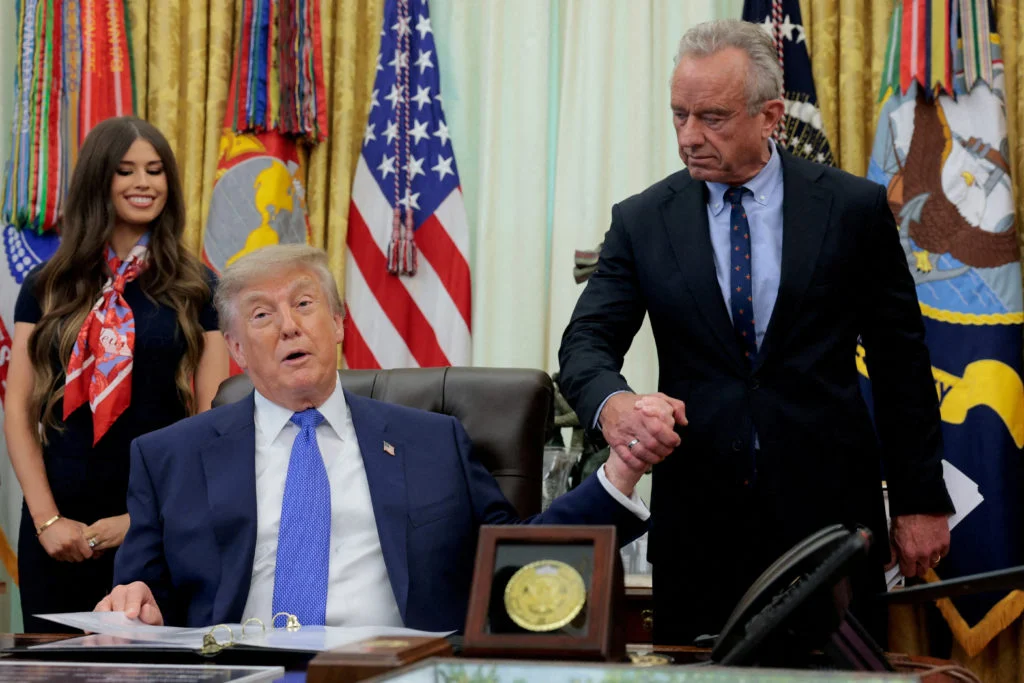
NEW YORK — President Donald Trump has thrust the nation’s immunization policies back into the center of the political arena, signing a sweeping executive order this week that mandates a significant restructuring of the federal childhood vaccination schedule. The directive, which instructs the Department of Health and Human Services (HHS) to explore the viability of spacing out childhood immunizations and specifically calls for the decoupling of the combination measles, mumps, and rubella (MMR) vaccine, has ignited a firestorm of debate between the administration’s supporters and the mainstream scientific community.
The order marks a definitive, if controversial, attempt by the Trump administration to solidify its standing with the “Make America Healthy Again” (MAHA) movement—a diverse and vocal coalition that proved instrumental in his 2024 electoral victory. However, the move has simultaneously provided political ammunition for Democratic challengers heading into the November midterm elections, raising fundamental questions about the intersection of public health policy, political pandering, and the role of scientific consensus in government.
The Chronology of Skepticism: From Social Media to the White House
The origins of this executive order trace back well over a decade, predating the current administration’s tenure. President Trump’s skepticism regarding the standard immunization cadence is well-documented, beginning as early as 2014 when he utilized social media to propagate the debunked claim that combination vaccines are linked to autism—a theory that has been repeatedly and exhaustively refuted by major medical organizations globally.
Throughout his political ascent, Trump has maintained a paradoxical stance on vaccines. While he frequently championed the rapid development of COVID-19 inoculations under the “Operation Warp Speed” initiative and has expressed personal support for the polio vaccine, he has consistently lobbied for a departure from the established pediatric immunization schedule.
By September of the previous year, the rhetoric evolved into policy intent. During a public appearance, the President stated, “This is based on what I feel,” while calling for the splitting of the MMR vaccine into three distinct, single-disease shots. His administration’s recent action formally tasks federal health agencies with the development of this option, despite the fact that such a product does not currently exist in the U.S. pharmaceutical market. Public health experts warn that the transition to a fragmented schedule—requiring more frequent doctor visits—could create significant gaps in immunity, leaving children vulnerable to preventable diseases during the intervals between doses.
Supporting Data: Public Health vs. Political Priorities
The tension between the administration’s objectives and scientific consensus is stark. According to data from the Kaiser Family Foundation (KFF), while the MAHA movement is highly motivated by issues of health freedom and vaccine safety, their policy preferences are not necessarily aligned with the priorities of the general electorate.
Polling indicates that only 10% of MAHA supporters rank the reevaluation of vaccine safety as their top federal priority. Conversely, 42% of that same cohort prioritize lowering healthcare costs, and 21% are focused on the restriction of chemical additives in the food supply. When viewed through the lens of the broader American public, the divergence is even more pronounced. A significant majority of Americans continue to view childhood vaccinations as a prerequisite for school attendance and a foundational element of public health.
Political strategists, including the President’s own internal polling advisor, Tony Fabrizio, have suggested that the focus on vaccine schedules may lack broad-based electoral appeal. Frank Luntz, a veteran pollster, noted that for the average American voter, economic survival currently eclipses all other concerns. "Nothing in America matters more than affordability," Luntz stated. "And anytime the administration or Republicans deviate from the conversation of affordability, they risk losing the attention of voters who are struggling with the price of groceries, gas, and healthcare."
Official Responses and Administrative Rationale
The White House has defended the move as a fulfillment of a longstanding presidential campaign pledge. An anonymous administration official emphasized that the executive order is part of a broader, multi-faceted health agenda designed to address the concerns of families who feel the current system is overly rigid.
In an effort to balance the vaccine directive with broader health initiatives, the administration simultaneously announced a new transparency mandate from the Food and Drug Administration (FDA). This policy will require food manufacturers to disclose new ingredients and additives, a direct nod to the MAHA movement’s advocacy for “cleaner” food supplies. Furthermore, the administration continues to highlight its ongoing efforts to curb drug pricing and investigate fraud within federal health programs as evidence of its commitment to taxpayer advocacy.
However, the medical establishment remains largely critical. Organizations such as the American Medical Association (AMA) have condemned the order, reiterating that the current vaccine schedule is the product of decades of clinical trials and data-driven analysis. They argue that altering established protocols based on personal intuition rather than evidence-based medicine sets a dangerous precedent for future public health management.
The Political Calculus: Implications for the Midterms
The announcement has already begun to reshape the landscape of the upcoming midterm elections. For candidates aligned with the Trump administration, the order serves as a tangible signal that the President is listening to his base. Jayme Franklin, a prominent conservative activist, described the move as a victory for “MAHA moms” across the country, suggesting it will significantly bolster voter enthusiasm.
Conversely, the Democratic Party is moving to frame the issue as a litmus test for scientific integrity. Shaughnessy Naughton, president of the PAC 314 Action—which specializes in electing scientists and doctors to office—described the order as a clear political opening. “Our organization and our candidates are going to hammer that message home,” Naughton said. “If you want healthcare that is accessible and affordable, and if you want medical advice that is rooted in peer-reviewed science, we need accountability in Washington.”
Democratic candidates are leaning into this strategy with high visibility. Dr. Richard Pan, a physician-turned-candidate for the U.S. House, has made the defense of evidence-based health policy a pillar of his campaign. Similarly, Dr. Annie Andrews, a pediatrician running for the U.S. Senate in South Carolina, has utilized social media to urge voters to support candidates who prioritize clinical expertise. "I cannot think of a more urgent time for us to have a pediatrician in the room where these conversations are happening," Andrews stated in a recent digital campaign video.
A Nation at a Crossroads: Conclusion
The divide over the vaccination schedule is emblematic of a larger, systemic rift in American politics: the struggle to define the role of the federal government in personal health decisions. While the Trump administration views the executive order as a necessary correction to increase flexibility and responsiveness to parental concerns, critics view it as a politicization of public health that ignores the dangers of vaccine hesitancy.
As the midterm elections approach, both parties are testing whether the issue of vaccine policy will resonate with the average voter. Will the administration’s focus on the MAHA platform be enough to mobilize the base and secure a legislative victory, or will the Democratic focus on "science-based" leadership prove more persuasive to a public burdened by economic uncertainty?
For now, the policy remains in its nascent stages, with the HHS tasked to navigate the complex logistics of implementing a split-dose schedule. As the debate continues, the scientific community waits with bated breath, concerned that the long-term impacts of these policy shifts could undermine the gains made in infectious disease control over the last century. Ultimately, the outcome of this clash will likely serve as a defining moment for the future of federal health policy in the United States.