











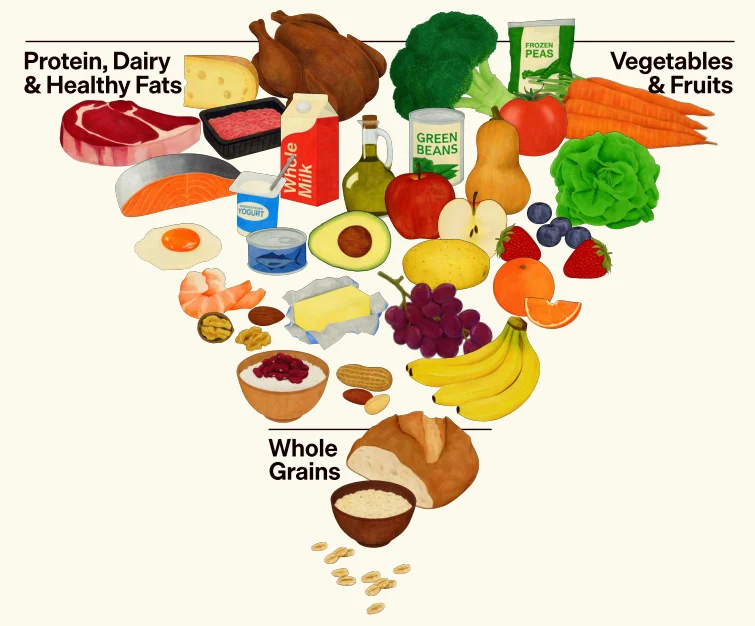
The release of the 2025–2030 Dietary Guidelines for Americans (DGAs) was met with high anticipation, arriving with a concise, consumer-friendly tagline: "Eat Real Food." Yet, beneath this seemingly straightforward directive lies a document that has ignited a firestorm of debate among nutrition scientists, public health advocates, and policymakers. While the guidelines take a decisive stand against the modern scourge of ultra-processed foods and added sugars, they simultaneously introduce a visual hierarchy—a "New Food Pyramid"—that appears to contradict the very science the government claims to uphold.
As the nation grapples with record-high rates of diet-related chronic illnesses, the publication of these guidelines serves as the cornerstone for federal nutrition policy. However, the 2025–2030 edition stands out for its unorthodox creation process, its visual mixed messaging, and a shift in tone that has left many experts questioning whether the document is truly designed for public health or heavily influenced by industrial interests.
The Core Mandates: A Positive Shift Against Processed Foods
For the first time in the history of the DGAs, there is an explicit, overarching call to limit "highly processed" foods. This represents a significant evolution from previous editions, which focused primarily on individual nutrients like sodium or saturated fat. The new guidelines categorize sugar-sweetened beverages, ready-to-eat packaged snacks, and refined carbohydrates—such as white bread and pastries—as categories to be minimized.
This pivot acknowledges a growing body of evidence suggesting that the degree of food processing is just as critical to health as the macronutrient profile. By advising consumers to prioritize whole, fiber-rich grains and steer clear of industrial formulations, the guidelines align themselves with modern nutritional epidemiology.
Furthermore, the guidelines have adopted a more stringent stance on added sugars. The previous threshold—limiting added sugars to 10% of daily caloric intake—has been bolstered by a qualitative recommendation: that no amount of added sugar or non-nutritive sweetener should be considered a "healthy" component of a diet. In a notable shift, the guidelines now urge parents to eliminate added sugars entirely from children’s diets until the age of 10, a significant increase from the previous recommendation of age two.
Chronology of a Controversial Development
To understand the current tension surrounding the 2025–2030 DGAs, one must look at the path taken to reach their final form. Historically, the guidelines are informed by a rigorous, transparent process led by an independent Dietary Guidelines Advisory Committee (DGAC), composed of top-tier nutrition scientists. This committee spends two years reviewing the latest scientific literature, culminating in a comprehensive Scientific Report.
However, the 2025 cycle took a sharp turn. The administration rejected the original report generated by the expert DGAC. In an unprecedented move, the government opted to rely on a "supplemental scientific analysis" conducted by a group of individuals selected via a federal contracting process.
This deviation from the standard scientific protocol has sparked significant criticism. Dr. Deirdre Tobias, an assistant professor in the Department of Nutrition at the Harvard T.H. Chan School of Public Health and a member of the 2025–2030 Advisory Committee, has been vocal about the lack of transparency. "There is no transparency in the methodology and rigor that was employed," Tobias noted. "The reviews themselves, as well as their overall presentation and integration, deviate significantly from the rigorous process that the HHS developed."
Compounding these concerns, investigative reports have highlighted that several reviewers involved in the supplemental analysis held disclosed financial ties to the beef and dairy industries—an irony not lost on critics who noted the prominent placement of these products in the new visual materials.
Supporting Data: The "Saturated Fat Math" Problem
The most glaring point of contention is the visual representation of the "New Food Pyramid." While the written text retains the long-standing scientific consensus—that saturated fat intake should be capped at 10% of daily calories—the visual hierarchy of the pyramid tells a different story.
The graphic places steak, full-fat cheese, butter, and whole milk in prominent positions, suggesting a level of daily consumption that makes the 10% limit nearly impossible to maintain. Consider the math for a standard 2,000-calorie diet:
- The Limit: 10% of 2,000 calories is roughly 22 grams of saturated fat per day.
- The Reality: The guidelines recommend three daily servings of dairy. If a consumer follows the "full-fat" suggestions often implied by the imagery, one cup of whole milk (5g), three-quarters cup of full-fat Greek yogurt (6g), and one ounce of cheddar cheese (6g) already total 17 grams of saturated fat.
- The Tipping Point: A single tablespoon of butter (7g) used for cooking immediately pushes the individual over the 22-gram limit, even before accounting for other dietary sources of fat throughout the day.
Dr. Frank Hu, chair of the Department of Nutrition at Harvard, emphasizes the danger of this "mixed messaging." He points out that while the guidelines mention olive oil, they fail to adequately distinguish between healthy unsaturated fats and the saturated fats found in animal products. "The mixed messages surrounding saturated-fat-rich foods such as red meat, butter, and beef tallow may lead to confusion and potentially higher intake of saturated fat and increased LDL cholesterol," Dr. Hu warns.
Protein: Quantity vs. Quality
The new guidelines also recommend a substantial increase in protein intake, suggesting between 1.2 and 1.6 grams per kilogram of body weight—a 50% to 100% increase over previous minimum intake recommendations.
While protein is essential for muscle maintenance and metabolic health, nutritionists caution against a "blanket" increase in consumption. The "protein package"—the accompanying fats, sodium, and fiber—is what truly dictates health outcomes. The guidelines stop short of prioritizing plant-based proteins, such as legumes and nuts, over red meat. By failing to differentiate between the health outcomes of plant-derived protein versus processed or red-meat-heavy sources, the guidelines miss a vital opportunity to guide Americans toward heart-healthy eating patterns.
The Omission of Sustainability
A final, defining feature of the 2025–2030 DGAs is the continued exclusion of environmental and socioeconomic sustainability factors. As global food systems face the pressures of climate change and shifting agricultural viability, many peer nations have integrated sustainability into their national dietary recommendations.
The U.S. government has once again declined to address how food choices affect the planet. This silence is particularly striking given the strong scientific link between high-meat diets and greenhouse gas emissions. For many experts, this omission represents a failure to view the American diet within the context of the global environment, further distancing the U.S. from the modern, holistic approach to nutrition.
Implications for Public Health
The release of these guidelines leaves the American public in a precarious position. While the message to "eat real food" is undeniably sound, the implementation details provided by the government—through the contradictory pyramid and the lack of guidance on fat quality—create a significant barrier to healthy behavior change.
If history is any indicator, the effectiveness of the DGAs is already limited; recent data from the CDC suggests that the majority of Americans do not follow existing guidelines. By introducing a document that appears to cater to industry influence while muddling the science of saturated fats, the government risks further eroding public trust.
Moving Forward: How to Interpret the Noise
For those seeking to navigate this landscape, health professionals recommend looking past the flashy government graphics. The Harvard T.H. Chan School of Public Health continues to advocate for the "Healthy Eating Plate," a model that emphasizes plant-based variety, healthy oils, and whole grains, while keeping red meat and processed foods to a minimum.
Ultimately, the 2025–2030 Dietary Guidelines serve as a reminder that nutrition is not merely a scientific endeavor; it is a political one. As the gap between independent scientific consensus and federal policy widens, the responsibility for personal health literacy falls more heavily than ever upon the consumer. When in doubt, experts suggest consulting a registered dietitian who can provide personalized, evidence-based guidance that cuts through the noise of conflicting federal messaging.