











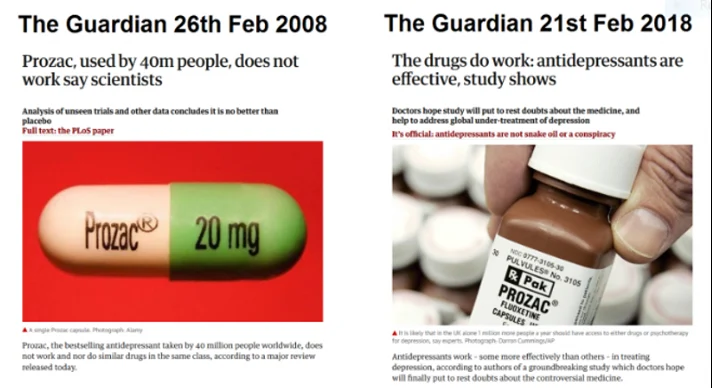
The medical establishment has long maintained that antidepressants are a cornerstone of modern mental health care—a life-saving intervention for millions suffering from clinical depression. However, a growing body of researchers and whistleblowers, led by prominent figures such as Dr. Peter C. Gøtzsche, are challenging this narrative. They contend that the perceived benefits of these drugs are largely the result of statistical manipulation, unblinding bias, and industry-funded "hype" that obscures a more troubling reality: that antidepressants may cause more harm than good.
Main Facts: The Disconnect Between Clinical Reports and Patient Experience
The central point of contention in the debate over Selective Serotonin Reuptake Inhibitors (SSRIs) and other antidepressants is the discrepancy between "statistical significance" and "clinical relevance." While many clinical trials show that antidepressants perform better than placebos, the margin of improvement is often remarkably slim.
The gold standard for measuring depression is the Hamilton Depression Rating Scale (HAM-D), which ranges from 0 to 52. Meta-analyses of trials involving adults suggest that the average difference between an antidepressant and a placebo is approximately 2 points. However, clinical experts generally agree that a change must be at least 5 to 6 points to be perceptible to the patient or to represent a meaningful clinical shift.
Furthermore, there is a consistent "reporting gap" between doctors and patients. In pediatric trials, for instance, psychiatrists have reported effect sizes of 0.25 (a modest positive effect), while the patients themselves reported effect sizes as low as 0.05—essentially zero. Critics argue that this suggests the "benefits" are often in the eye of the beholder—specifically, the psychiatrist who may be influenced by industry ties or the desire to see a positive outcome.
Chronology: From the Rise of Prozac to the STAR*D Scandal
The modern era of antidepressants began in December 1987 with the FDA approval of fluoxetine, marketed as Prozac. While it became a cultural phenomenon, its entry into the market was not without skepticism. German regulators initially found the drug "totally unsuitable" for depression, noting that patient self-ratings showed little to no response.
Despite these early warnings, the 1990s and 2000s saw a massive expansion in the use of SSRIs, fueled by the "chemical imbalance" theory—a concept that has since been largely debunked by the scientific community.

In 2008, a landmark meta-analysis by Irving Kirsch used Freedom of Information Act requests to access unpublished FDA data, revealing that for most patients, the difference between drug and placebo was negligible. This sparked a decade of controversy.
In 2018, the debate reached a fever pitch with the publication of a massive meta-analysis in The Lancet by Andrea Cipriani and colleagues. The study, which reviewed 21 antidepressants, was hailed by the BBC and the Royal College of Psychiatrists as the "final answer" proving that the drugs work. However, critics like Gøtzsche pointed out that the effect sizes remained at the same clinically insignificant levels (0.30) as previous studies, and accused the authors of "statistical alchemy."
The timeline of skepticism reached a new milestone in 2023 and 2024 with the re-analysis of the STARD study. Originally touted as the largest and most expensive ($35 million) study on depression ever funded by the U.S. National Institute of Mental Health (NIMH), STARD claimed a 70% remission rate. New independent reviews of the raw data, however, allege that the study was fraudulent, with researchers violating protocols to inflate success rates.
Supporting Data: Bias, Blinding, and the "Suicide Paradox"
The argument against antidepressants rests on several pillars of data that question the validity of clinical trials:
1. Unblinding Bias
True "blinding" in a trial means neither the doctor nor the patient knows who is receiving the drug. However, antidepressants have conspicuous side effects (nausea, dry mouth, sexual dysfunction). Patients who experience these side effects often realize they are in the "active" group, creating a powerful placebo effect. When trials use an "active placebo" (a substance like atropine that mimics side effects but has no antidepressant properties), the "drug effect" almost entirely vanishes.
2. The Number Needed to Treat (NNT) Illusion
Psychiatrists often cite a "Number Needed to Treat" of around 3 to 10, suggesting that for every few people treated, one is significantly helped. Critics argue this is a mathematical illusion. NNT only counts those who improve past a certain threshold; it does not subtract those who deteriorate. If a drug makes a condition more variable—meaning some get much better while others get much worse—the NNT will look impressive even if the drug is, on average, useless or harmful.
3. Adverse Outcomes and Mortality
The most severe criticism involves the safety profile of these medications. Research indicates that antidepressants:

- Double the risk of suicide in both adults and children compared to placebo.
- Cause sexual dysfunction in approximately 50% of users, which in some cases becomes Post-SSRI Sexual Dysfunction (PSSD)—a permanent condition.
- Induce severe withdrawal in half of those who attempt to quit, often leading to a "relapse" that is actually a withdrawal symptom misinterpreted as the return of depression.
- Increase the risk of falls and hip fractures in the elderly, leading to a significant increase in all-cause mortality. Some researchers argue that psychiatric drugs are the third leading cause of death after heart disease and cancer.
Official Responses: The Institutional Defense
The psychiatric establishment, including the Royal College of Psychiatrists and the American Psychiatric Association (APA), maintains that antidepressants are essential tools. Their response to critics generally follows three lines of reasoning:
- The Severity Argument: Proponents argue that while the drugs may not work for mild depression, they are highly effective for "severe" cases. Critics counter this by pointing to mathematical artifacts in the data, arguing that the apparent benefit in severe cases is a result of "regression to the mean" and illegitimate statistical analysis rather than drug efficacy.
- The Clinical Experience Defense: Many doctors argue that they see patients improve in their daily practice. Skeptics point out that depression is often a self-limiting condition that improves with time, and that "clinical experience" is exactly what randomized controlled trials are meant to replace because human observation is prone to confirmation bias.
- The Risk-Benefit Balance: Regulatory bodies like the FDA acknowledge risks like suicidal ideation (hence the "Black Box" warnings) but argue that the risk of untreated depression is greater. Critics respond that this is a false dichotomy, as the drugs themselves may be driving the very outcomes they are meant to prevent.
Implications: A Crisis of Legitimacy in Psychiatry
The allegations of fraud in studies like STAR*D and the critiques of meta-analyses like Cipriani’s suggest a deep-seated crisis in psychiatric science. If the drugs are indeed as ineffective as the raw data suggests, the implications are staggering.
Medical Ethics and Informed Consent
Currently, millions of patients are prescribed antidepressants without being told that the "chemical imbalance" theory is unproven or that the statistical benefit of the drug may be imperceptible. True informed consent would require disclosing the risk of permanent sexual dysfunction and the high probability of severe withdrawal.
The Economic Cost
Billions of dollars are spent annually on antidepressant prescriptions and the management of their side effects. If these resources were redirected toward social interventions, exercise, or psychotherapy—all of which have shown efficacy without the risk of PSSD or increased suicidality—the public health landscape could shift dramatically.
The Future of the Specialty
Dr. Gøtzsche has gone so far as to call psychiatry a "medical specialty that survives on lies," suggesting that the profession’s survival is tied to its alliance with the pharmaceutical industry. Whether one agrees with this extreme view or not, the calls for a "paradigm shift" in mental health are becoming harder to ignore.
The debate over antidepressants is no longer just about a pill; it is a debate about the integrity of medical research, the influence of corporate funding on public health, and the fundamental way we understand human suffering. As the evidence continues to mount, the medical community may soon face a reckoning regarding the "Prozac Era" and the millions of lives it has touched.