










Reviewed by Brian St. Pierre, MS, RD
In the mid-2010s, the fitness industry operated under a relatively straightforward set of assumptions: Weight loss was a product of caloric deficit, consistency, and willpower. When GLP-1 medications—such as semaglutide (Ozempic)—first reached the mass market in 2017, they were largely viewed by health and fitness coaches as a distant, theoretical disruption. For years, the conversation remained speculative.
By 2026, however, the landscape has been fundamentally altered. With over one in ten U.S. adults now utilizing GLP-1 receptor agonists, the medication has moved from the periphery to the center of the wellness conversation. For coaches, the initial anxiety of "Will this drug steal my job?" has evolved into a more nuanced understanding: they are no longer in the "weight loss" business, but in the "GLP-1 support" business.
The Chronology of a Medical Disruption
The rise of GLP-1s was not an overnight explosion, but a steady climb that caught many in the health sector off guard.
- 2017–2020: The Theoretical Phase. GLP-1s gained initial traction, but prescription rates remained low. Coaches largely dismissed them as niche treatments for type 2 diabetes.
- 2021–2023: The Awareness Phase. As off-label use for weight management surged, coaches began encountering clients who were "secretly" on the medication. Concerns about muscle atrophy and "cheating" the process became common industry gossip.
- 2024–2025: The Integration Phase. Public perception shifted. The stigma surrounding weight-loss drugs softened, and the sheer volume of users made it impossible for the fitness industry to ignore.
- 2026 and Beyond: The Support Phase. The industry has largely accepted that the medication is here to stay. The focus has pivoted toward how to effectively coach, guide, and protect clients who are navigating this new medical reality.
Supporting the Modern Client: A Taxonomy of Readiness
"As a coach, you’re not in the GLP-1 world; you’re in the GLP-1 support world," says Kate Solovieva, Director of Community at Precision Nutrition. The most critical realization for today’s fitness professional is that you cannot—and should not—attempt to coach every person taking these medications. Success lies in identifying the "ready, willing, and able" subset of users who recognize that a chemical intervention is only one piece of the puzzle.
Coaches must assess clients dynamically, as their readiness fluctuates. Here are the seven primary types of GLP-1 clients currently seen in the field:
1. The Honeymooner
These clients are experiencing the initial "high" of effortless weight loss. They feel great and often see no reason to change their lifestyle.
- Coaching Move: Resist the "righting reflex." Do not lecture them on the risks of muscle loss, as this will likely alienate them. Instead, celebrate their success and remain a resource for when they eventually reach a plateau or begin to experience side effects.
2. The Ambivalent Candidate
These individuals are often paralyzed by the decision to start medication. They struggle with the morality of the choice—wondering if taking the drug is a sign of "weakness."
- Coaching Move: Facilitate clarity through tools like the "4 Crazy Questions" exercise. Help them weigh the risks of starting versus the risks of remaining in their current health state. Remember: The decision to medicate is a medical one; the decision to adopt healthy habits is the coaching one.
3. The Ready-to-Quitter
Despite weight loss, these clients suffer from debilitating nausea, fatigue, and malaise. They feel "broken" because the drug is physically punishing.
- Coaching Move: Normalize their experience. Educate them on the prevalence of side effects. Suggest small, controlled experiments—such as smaller, more frequent meals—and encourage them to consult their physician about dosage adjustments.
4. The Muscle-Loss Risk
The scale is dropping, but the body composition is shifting in the wrong direction. These clients are often sedentary and fail to consume adequate protein, leading to significant lean mass loss.
- Coaching Move: Introduce objective data. If possible, use DEXA scans to highlight the difference between fat loss and muscle loss. Prioritize protein intake and simple, scalable resistance training to protect their metabolic foundation.
5. The Under-Fueler
The drug has suppressed their appetite so effectively that they are bordering on malnutrition. They may not even realize how few calories they are consuming.

- Coaching Move: This is a high-priority, "red flag" scenario. If an eating disorder is suspected, refer out immediately. If not, focus on establishing an "eating schedule." They must learn to eat by the clock rather than by appetite cues.
6. The Graduate
These clients have reached their goal and are choosing to wean off the medication. They are often vulnerable to rapid weight regain.
- Coaching Move: Temper expectations. View the weaning period as an endurance test. The focus must be on the habits they built while on the medication. The "ruts" they cut into their daily routine during the medication phase must be deep enough to sustain them once the chemical support is removed.
7. The Priced-Out
These clients are forced off the medication due to insurance changes or cost. They are often grieving the loss of a tool that finally "worked" for them.
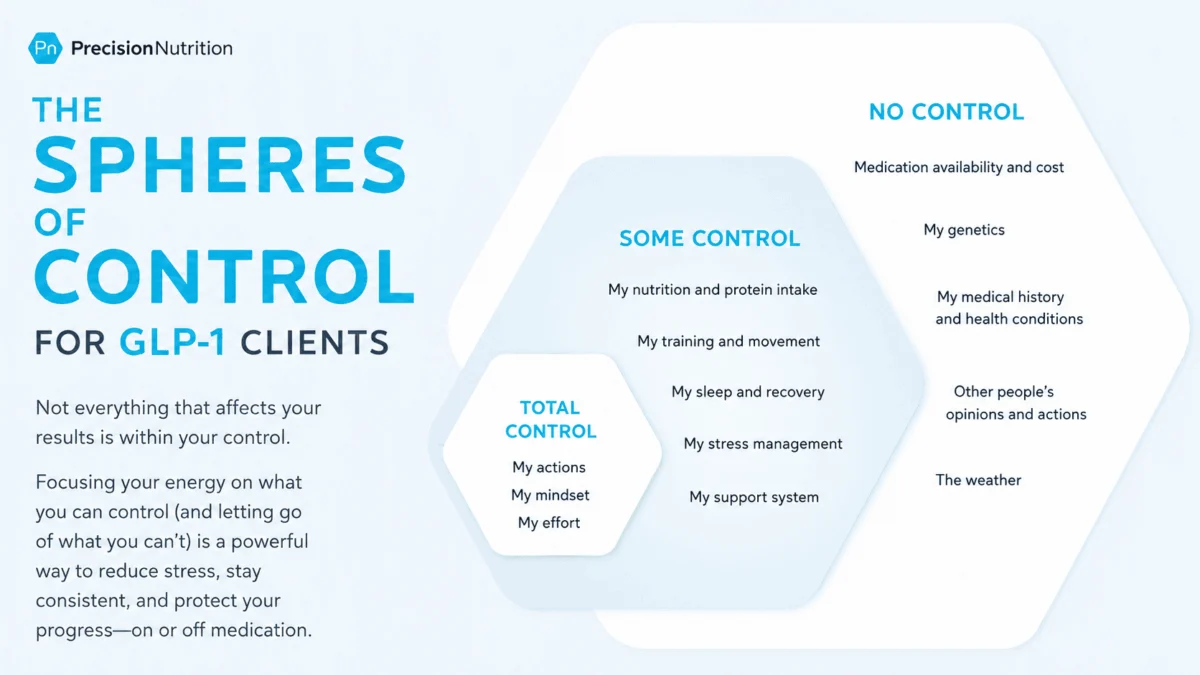
- Coaching Move: Focus on the "Spheres of Control." Validate their frustration with the healthcare system, then shift the focus to the factors they can control: sleep, protein intake, stress management, and movement.
Supporting Data and Medical Realities
The concerns surrounding GLP-1s are not merely aesthetic; they are physiological. Research indicates that without protective interventions, up to 40 percent of weight lost via GLP-1 medications can stem from lean mass. This "skinny fat" outcome leaves individuals with a lower metabolic rate and decreased functional strength.
Furthermore, studies show that users who do not integrate lifestyle behaviors during the medication phase are almost guaranteed to regain weight once the medication is stopped. Conversely, those who treat the medication period as a "training ground" for permanent behavioral change are four times more likely to maintain a 10 percent or greater weight loss once they transition off the drug.
The Coach’s Role: Redefining Success
The industry has moved away from the idea that a coach can "cure" obesity, just as they have moved away from the idea that a pill is a magic bullet. The new paradigm is one of synergy.
"I can’t promise anyone they’ll lose a specific amount of weight," notes Toni Bauer, Director of Coaching and Education Operations at Precision Nutrition. "What I can tell you is that the habits we build while the medication is doing its work are the ones that will still stand when it isn’t."
Implications for the Future of Coaching
The professional coach of 2026 must be an expert in communication, habit formation, and collaborative care. They must know when to refer a client to a doctor and when to step in to provide the accountability that medication cannot.
The "Oregon Trail" analogy serves as the ultimate guide for the modern coach: The medication creates the initial path, but the client’s daily habits are the wheels that must traverse that path repeatedly. If a coach can help a client build those "ruts" deep enough—through resistance training, protein prioritization, and mindful nutrition—they provide a safety net that survives long after the prescription runs out.
Conclusion: A New Identity
The most successful clients are those who stop viewing themselves as "people on a drug" and start identifying as "people who value their long-term health." They are the ones who wake up, move their bodies, prioritize their protein, and focus on the metrics that don’t appear on a scale.
The GLP-1 revolution hasn’t replaced the coach; it has elevated the requirement for what a coach must be. By shifting the focus from weight loss to life-long habit maintenance, the coaching industry is securing its place as an essential component of the modern healthcare ecosystem.