











For twenty years, a fierce ideological and statistical war has been waged within the pages of medical journals and the columns of mainstream media. At the center of this conflict is the U.S. Food and Drug Administration’s (FDA) 2004 "black box" warning—the agency’s most stringent alert—notifying the public that antidepressants (SSRIs) increase the risk of suicidal thoughts and behaviors in children and adolescents.
The narrative favored by much of the psychiatric establishment and the pharmaceutical industry is one of "unintended consequences." This narrative asserts that the 2004 warning scared doctors away from prescribing life-saving medication, leading to an undertreatment of depression and a subsequent spike in youth suicides. However, a growing body of evidence, bolstered by a recent "stinging rebuke" from former FDA medical officers, suggests that this narrative is not only flawed but factually inverted.
Main Facts: The Statistical Rebuttal
The core of the controversy lies in the correlation between antidepressant prescription rates and suicide statistics. Proponents of the "unintended consequences" theory, such as Dr. Robert Gibbons and more recently Dr. Arif Khan, argue that the warning caused a decline in prescriptions which directly led to more deaths.
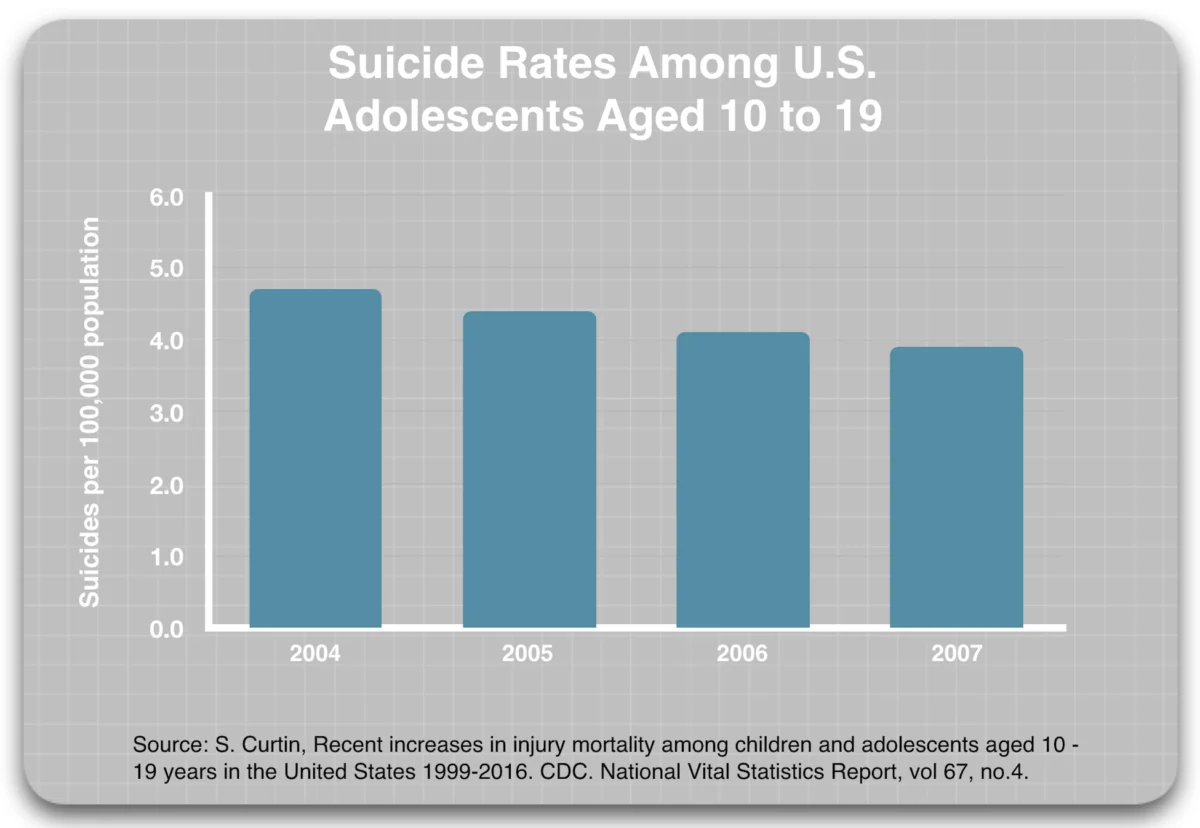
However, the empirical data tells a different story. When the black box warning was issued in late 2004, prescribing rates for youth did indeed decline between 2005 and 2007. During this exact window, suicide rates among youth aged 10 to 19 also declined. The upward trend in youth suicides did not begin in earnest until 2008—the same year that antidepressant prescribing rates began to climb again.
Furthermore, the original FDA analysis that prompted the warning was not "inconclusive," as critics often claim. A meta-analysis of pediatric trials found a relative risk of 1.95 for suicidal behavior in those taking antidepressants compared to a placebo. In simpler terms, children on the drugs were nearly twice as likely to experience suicidal ideation or attempts. Despite this, a "pro-prescribing" narrative has dominated the mainstream discourse, often aided by what critics call "statistical sleight of hand."

Chronology: Two Decades of Disputed Data
2004: The Warning is Issued
Following a series of harrowing reports and clinical trial reviews, the FDA mandated the black box warning for all antidepressant medications regarding their use in pediatric patients. The decision was based on 24 trials involving over 4,400 patients, which showed an increased risk of suicidality during the first few months of treatment.
2007: The "Sleight of Hand" Begins
The "unintended consequences" narrative gained its first major foothold with a paper published in the American Journal of Psychiatry by Robert Gibbons, Director of the Center for Health Statistics at the University of Chicago. Gibbons claimed that a 22% drop in SSRI prescriptions was linked to a 14% increase in youth suicides.
However, critics quickly pointed out a temporal mismatch: Gibbons had compared the suicide increase of 2003–2004 (which occurred before or during the warning’s issuance) with the prescription decline of 2004–2005. He ignored the 2005–2007 period, where both prescriptions and suicides fell simultaneously. Despite these methodological flaws, the mainstream media, including the Chicago Tribune, widely reported Gibbons’ findings as definitive.
2012–2018: Strengthening the Narrative
Gibbons continued to publish papers asserting the safety and efficacy of antidepressants in youth, often appearing as an expert witness for pharmaceutical giants like Wyeth and Pfizer. In 2012, he told NPR that the black box warning had created a "real epidemic of suicide."
In 2018, the narrative was refreshed by Stephen Soumerai (Harvard Medical School) and Ross Koppel (University of Pennsylvania) in a high-profile opinion piece for STAT News. They presented trend lines suggesting a steady rise in suicides caused by the warning. Critics, including Mad in America, noted that if one looked at the individual data points rather than the smoothed trend lines, the "smoking gun" vanished: suicides had actually dipped when prescriptions were at their lowest post-warning levels.

2024: The Khan Article and the FDA Rebuttal
The latest flashpoint occurred in the spring of 2024, when psychiatrist Arif Khan published an article in Regulation, a Cato Institute journal. Khan claimed the warning had led to the "excess deaths" of nearly 6,000 children and young adults by discouraging drug use. This prompted an unprecedented response from three former FDA medical officers—Marc Stone, Andrew Mosholder, and Tarek Hammad—who published a detailed refutation, accusing Khan of presenting "factually inaccurate" data.
Supporting Data: Prescribing Rates vs. Suicide Trends
To understand why the "unintended consequences" narrative is viewed as "bad science" by its critics, one must look at the specific year-by-year correlation between drug sales and mortality.
The 2005–2007 Window
Following the FDA warning, there was a measurable "chilling effect" on prescriptions.
- Prescribing: Declined by approximately 20% for youth.
- Suicide Rates: For girls aged 10–14, the suicide rate decreased by 46%; for girls aged 15–19, it fell by 30%. For boys, the declines were 29% and 13%, respectively.
This period provides a natural experiment: when the drugs were used less, the very outcome they were supposed to prevent (suicide) actually decreased.
The 2008–2017 Resurgence
Starting in 2008, the "black box" warning began to be effectively neutralized by the steady drumbeat of industry-funded studies and media reports.

- Prescribing: By 2011, prescription rates had returned to 2004 levels. By 2017, they reached record highs.
- Suicide Rates: In tandem with the increase in prescribing, youth suicide rates began a steady, tragic climb that has continued for over a decade.
The RCT Evidence
The FDA’s 2004 meta-analysis of 372 double-blind randomized controlled trials (RCTs) remains the gold standard of evidence. It found that for those under age 25, the risk of a suicide attempt was 2.3 times higher for those on antidepressants than for those on a placebo. This suggests that the biological effect of the drug itself, rather than the lack of it, is a significant risk factor for young people.
Official Responses and the Academic "Gag"
The battle over this data has not been a fair fight in the academic arena. When critics like Mickey Nardo (a psychoanalyst) and David Healy (a psychiatrist and historian) attempted to publish rebuttals to the "Gibbons Narrative," they faced significant hurdles.
Nardo’s critique of Gibbons’ methodology, which cited "deceitful presentation" and "obvious arithmetic errors," was refused publication in the print edition of the Archives of General Psychiatry. Instead, it was relegated to an online "Reader’s Reply," a move that ensured the critique would not be indexed in PubMed. This effectively "buried" the dissent, allowing the original, flawed study to remain the primary reference for AI algorithms and medical students alike.
The most recent response from former FDA officers Stone, Mosholder, and Hammad is significant because it comes from the very individuals who oversaw the data at the regulatory level. They noted that they had even provided Arif Khan with a draft critique of his work before he published it, pointing out his errors. Khan reportedly ignored the feedback, choosing to publish the uncorrected data anyway.
Implications: The Human Cost of a False Narrative
The persistence of the "unintended consequences" theory has profound implications for public health policy and clinical practice.

1. The Erosion of Informed Consent
If the public and prescribers are led to believe that the black box warning is a mistake that "causes" suicide, the warning’s purpose—to ensure close monitoring of patients for drug-induced agitation and suicidality—is undermined. Parents may not be told to look for the "activation syndrome" (insomnia, agitation, and impulsivity) that often precedes a suicide attempt on SSRIs.
2. The Proliferation of "Excess Deaths"
Arif Khan’s article used the term "excess deaths" to blame the FDA warning for lives lost. However, if the correlation holds that more prescriptions equal more suicides, then the "excess deaths" are actually a result of the failure to heed the warning. By delegitimizing the FDA’s safety alerts, proponents of the narrative may have inadvertently encouraged the very prescribing patterns that led to the current youth suicide crisis.
3. The AI Misinformation Loop
The article highlights a modern danger: AI-generated medical advice. When asked if the black box warning led to more suicides, most AI models (trained on the indexed, uncorrected papers in PubMed) will confidently state "Yes." This creates a feedback loop where bad science from 2007 becomes the "established fact" of 2024, despite being debunked by the raw data and former FDA officials.
4. The Need for Journalistic Accountability
The controversy serves as a cautionary tale for health journalism. Outlets like STAT News and the Chicago Tribune played a pivotal role in cementing a narrative that favored pharmaceutical interests over patient safety. Moving forward, there is an urgent need for journalists to look past "trend lines" and "statistical sleights of hand" to examine the raw, correlational data that impacts millions of young lives.
In the final analysis, the "Defense of the Black Box Warning" by Stone and his colleagues is more than an academic debate; it is a call for a return to empirical integrity. As youth suicide rates continue to rise alongside soaring antidepressant use, the medical community must confront the possibility that the warning was never the problem—the refusal to listen to it was.