










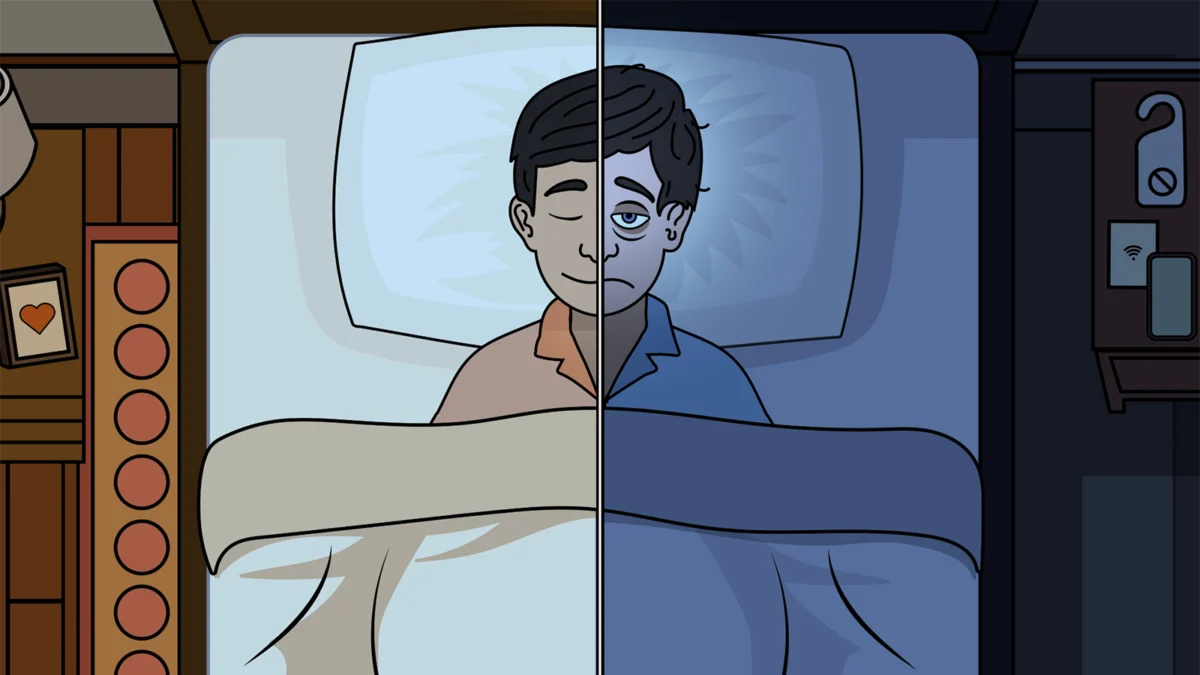
For Robinson Leoni, a tech sales director who traverses the globe for business, the ritual is as predictable as it is frustrating. Upon checking into a hotel room—regardless of the thread count of the linens, the efficacy of his earplugs, or the blackout quality of the curtains—his internal clock seems to recoil. At home, Leoni comfortably logs seven hours of restorative sleep. On his first night in a new city, however, his smartwatch tracking data consistently paints a starkly different picture: five hours of fitful, fragmented rest.
"I feel normal—no stress, no pre-travel jitters—but I notice I wake up continuously," Leoni says. His experience is not an anomaly of his personal biology; rather, it is a universal, evolutionary quirk known to sleep scientists as the "first-night effect."
The Evolutionary Watchman: Why We Stay Alert
The first-night effect describes the phenomenon where individuals experience poor, shallow, or insufficient sleep during their initial night in an unfamiliar environment. While it may feel like a modern-day inconvenience for the frequent traveler, experts suggest it is an ancient, hardwired survival mechanism.
Dr. Anna Wick, a senior sleep researcher at the University of Fribourg in Switzerland, explains that the phenomenon is essentially an adaptation response. "The sleeping brain remains vigilant in this unfamiliar environment," she notes. In the context of human evolution, a new location was historically a potential threat—a place where predators might lurk or environmental hazards might remain unseen. Consequently, the brain adopted a "sentinel" strategy, maintaining a higher level of alertness to ensure survival during the vulnerable hours of slumber.
This vigilance persists even in the sanitized, climate-controlled comfort of a five-star hotel. "It doesn’t matter if it’s a Marriott hotel or the savanna," says Dr. Ahmad Mayeli, a psychiatry professor and sleep researcher at the University of Pittsburgh. "Your brain hasn’t gotten the memo that this place is completely safe."
The Neuroscience of Partial Wakefulness
The mechanics of the first-night effect are grounded in neurological activity. Dr. Mayeli’s research has utilized advanced imaging to track brain function during this state of "new-environment sleep." His team discovered that the frontal lobe—an area crucial for executive function and associated with the deepest, most restorative stages of sleep—exhibits heightened activity during the first night in a new place.
"They are saying that, like in dolphins, part of the brain is awake when you are sleeping," Mayeli explains. While he clarifies that humans are not biologically identical to cetaceans, the analogy holds: the brain is essentially segmenting its recovery. One hemisphere or specific regions of the brain remain "on guard," processing ambient sounds and subtle environmental changes that would normally be filtered out at home.
This results in a measurable deficit. On average, people sleep 20 to 30 minutes less in a new environment, but the impact is qualitative as well as quantitative. The sleep is less deep, leading to a diminished sense of restoration.
Demographic Vulnerabilities
Age appears to be a significant variable in how the brain handles this transition. Research indicates that the first-night effect is most pronounced in children, adolescents, and the elderly. Conversely, those in their 20s appear to be the most resilient. "Maybe it’s the sweet spot," Dr. Mayeli suggests, noting that as cognitive flexibility declines with age, the brain may become less capable of "letting go" in unfamiliar surroundings, thus exacerbating the effect.
Environmental and Psychological Triggers
While the evolutionary "vigilance" hypothesis provides the baseline explanation for this phenomenon, it does not act in a vacuum. Lisa Strauss, PhD, a psychologist specializing in the cognitive behavioral treatment of sleep disorders, emphasizes that the modern traveler faces a "perfect storm" of triggers.
Beyond Evolutionary Roots: The Modern Context
- Environmental Friction: Hotel rooms are rife with sensory inputs that the home environment lacks. A flickering LED on a smoke detector, the hum of a distant HVAC system, or the unfamiliar texture of hotel-grade linens can act as "novelty cues" that trigger the brain’s alertness centers.
- Relational Tension: Travel often involves visiting family or attending high-stakes professional events. Psychological stressors—such as an upcoming presentation or the social performance required when staying with distant relatives—can keep the mind in a state of high arousal.
- The Self-Fulfilling Prophecy: Perhaps the most insidious factor is the "anticipatory anxiety" of the sleep-deprived. Individuals who have struggled with sleep in the past often arrive at their destination already expecting a poor night’s rest. This cycle of worry creates a self-fulfilling prophecy; the effort to "force" sleep causes the very physiological arousal that prevents it.
Strategies for Mitigation
While the first-night effect is a biological reality, sleep hygiene experts emphasize that it can be managed. Dr. Strauss suggests that the key lies in bridging the gap between the "familiar" and the "novel."
Practical Adjustments for Better Rest
- Replicate the Ritual: Maintain a strict nighttime routine regardless of time zone. Turning off screens, dimming lights, and engaging in a pre-sleep activity—such as reading or light stretching—signals to the brain that the transition to sleep is beginning, regardless of the physical location.
- Personalize the Space: Spend time in the room before the actual bedtime. By sitting in the bed or reading in the room for an hour, the brain begins to catalog the space as "familiar" rather than "new." Bringing a familiar item, such as a personal pillowcase or a specific blanket, can provide sensory anchors that soothe the brain’s vigilance.
- The Power of Visualization: For the chronically anxious, Dr. Strauss recommends cognitive grounding techniques. Visualizing a safe, neutral space—such as a favorite forest trail or a beach—can help displace the brain’s focus from the unfamiliarity of the room to a known, safe mental map. Repeating phrases like, "May you know that you are safe; may you be at peace," can assist in de-escalating the sympathetic nervous system.
The "Day-Early" Strategy
For those traveling for professional milestones, Dr. Mayeli offers a pragmatic solution: "If tomorrow matters, get there a night early."
By arriving 24 hours before a major event, the traveler allows the brain to complete its "first-night" cycle without the pressure of a looming deadline. By the second night, the brain’s sentinel function typically relaxes, and the quality of sleep usually rebounds significantly.
Implications for the Modern Traveler
The first-night effect is not a disorder; it is a feature of the human condition. It serves as a reminder that despite our reliance on technology and our efforts to conquer distance, our biology remains tethered to a primal past.
For the millions of individuals who navigate the globe annually—from corporate executives to vacationers—understanding that this sleep deficit is normal can, in itself, be the cure. When we stop fighting the phenomenon and accept it as a momentary biological hiccup, the anxiety surrounding it dissipates.
As Dr. Mayeli concludes, "The first-night effect is not really anything to worry about." While we may lose an hour or two of rest on that first evening, the body is remarkably resilient. By practicing proper hygiene, managing expectations, and allowing the brain the space to acclimate, we can turn the "first-night effect" from a source of frustration into a manageable part of the travel experience.
In an increasingly globalized world, learning to sleep well in a strange bed is no longer just a luxury; it is a necessary skill for the modern era. By respecting the brain’s need for safety, we can ensure that even when we are far from home, we wake up feeling ready for the day ahead.