











The modern bedroom, once a sanctuary of rest and restoration, is increasingly under siege. As global temperatures climb, the cooling of our domestic environments has become a critical health challenge. While climate change is often discussed in terms of melting ice caps and extreme weather events, a more intimate, nightly crisis is unfolding: the systematic loss of human sleep. Experts warn that as nighttime temperatures rise, the fundamental biological processes required for restorative rest are being disrupted, leading to a mounting public health burden that affects productivity, cognitive function, and long-term well-being.
The Physiology of Cooling: Why Sleep Requires a Drop in Temperature
To understand the crisis, one must first understand the biology of sleep. Sleep is not merely a "shutting down" of the body; it is a highly regulated physiological state that relies on precise internal temperature management. Under normal conditions, the human body undergoes a natural thermoregulatory process as evening approaches. The circadian rhythm signals the body to release heat, causing the core body temperature to drop, which acts as a key trigger for the onset of sleep.
This cooling process continues throughout the night, reaching its nadir during the deepest stages of rest. When the ambient temperature of a bedroom remains elevated, this essential cooling mechanism is inhibited. If the air around you is too warm, the body struggles to shed heat, leading to increased wakefulness, reduced time in deep sleep stages, and a fragmented sleep architecture. Consequently, even if an individual feels they have spent enough time in bed, the quality of that rest is significantly diminished.
Chronology: A Half-Century of Warming Nights
The escalation of heat-related sleep loss is not a sudden phenomenon but a trend that has been accelerating for decades. Analysis of climate data reveals that the correlation between rising nighttime lows and sleep deprivation has doubled since the early 1970s.
During the 1970s and 80s, while global temperatures were rising, the frequency of "tropical nights"—where temperatures remain above 20°C (68°F)—was significantly lower in many temperate regions. By the early 2000s, however, the stabilization of greenhouse gas concentrations and the subsequent warming trend began to shift this baseline.
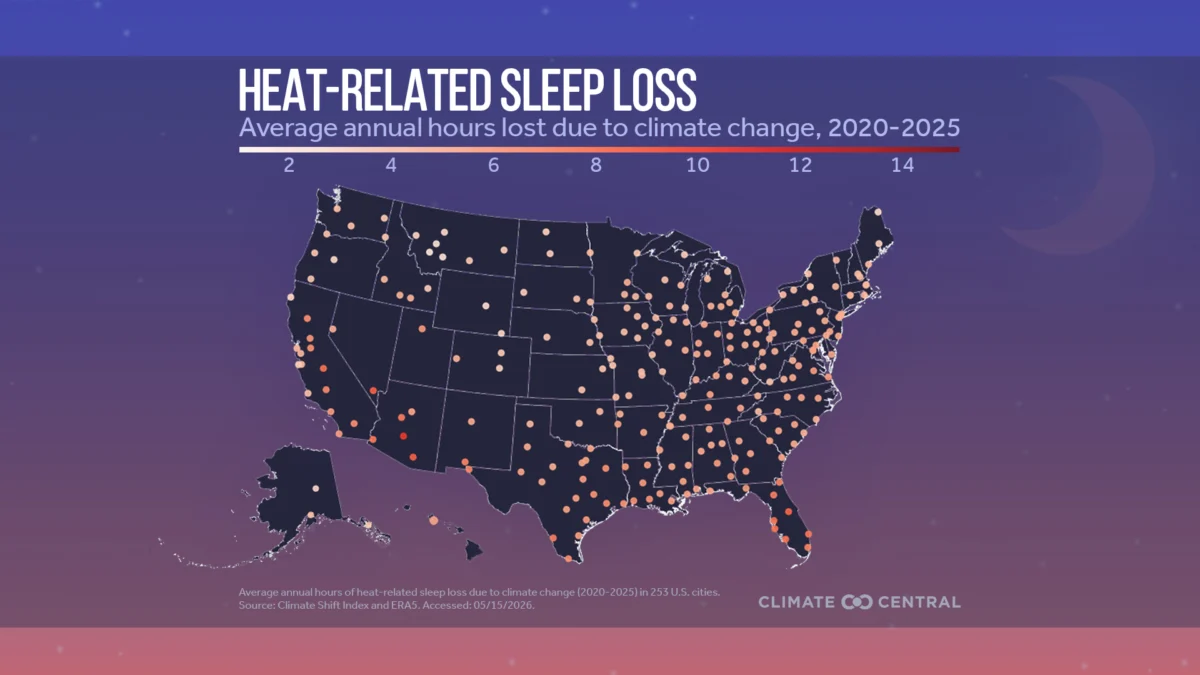
The most recent data from 2020–2025 serves as a sobering milestone. Research conducted by Climate Central indicates that, on a global scale, the average person has lost nearly 56 hours of sleep per year due to the inability of their environment to cool down sufficiently. This trend is not uniform, but it is pervasive. In the United States alone, residents across 253 surveyed cities lost an average of 36 hours of sleep annually during this five-year period. Regions in Arizona, California, Florida, and Nevada have been hit particularly hard, with some residents losing between seven and nine hours of sleep per year specifically linked to climate-warmed nights.
Supporting Data: The Quantitative Cost of Heat
The evidence linking temperature to sleep loss is both broad and granular. A landmark study published in the journal One Earth analyzed more than 7 million sleep records alongside local weather data. The findings were unambiguous: higher nighttime temperatures consistently correlate with reduced sleep duration and quality.
Key metrics from the study reveal the following:
- The 86°F Threshold: On nights where temperatures exceed 86°F (30°C), average sleep duration drops by approximately 14 minutes.
- The 77°F Threshold: When temperatures rise above 77°F (25°C), the probability of an individual getting less than seven hours of sleep increases significantly.
- Lack of Acclimatization: Perhaps most concerning for researchers is the lack of evidence suggesting that humans are naturally adapting to these higher temperatures. Unlike other physiological stressors, the body’s requirement for a cool environment for sleep appears fixed, suggesting that as the planet continues to warm, the human population will remain acutely vulnerable.
The impact is global, yet disproportionately felt. Areas that were already near the upper limits of human thermal tolerance—including parts of the Middle East, Southeast Asia, southern India, and West Africa—are experiencing the most severe disruptions. In these regions, the lack of widespread access to modern cooling technology exacerbates the physiological toll, turning nights into periods of heat stress rather than recovery.
Real-World Implications: The "Next-Day" Penalty
The ramifications of a hot night extend far beyond the morning alarm. A study conducted by PLOS Medicine during a 2016 heat wave in the Boston area highlighted the cognitive "hangover" associated with sleep-deprived, hot nights. Researchers tracked 44 young adults living in university dormitories, comparing those with air conditioning to those without.

The results were stark: students living in rooms without cooling mechanisms not only struggled with sleep quality but demonstrated measurable deficits in cognitive performance the following day. These deficits included slower processing speeds, reduced attention spans, and diminished working memory. While the study focused on students, the implications for the broader workforce—ranging from emergency responders to heavy machinery operators and office professionals—are significant. When a population is consistently sleep-deprived due to ambient heat, collective economic productivity and public safety are at risk.
Official Responses and Socio-Economic Vulnerability
Public health organizations, including the American Academy of Sleep Medicine (AASM), are increasingly treating climate-linked sleep loss as a public health concern rather than a personal inconvenience. The consensus among climate scientists and medical professionals is that while air conditioning is an immediate "fix," it is an incomplete solution.
Access to climate-controlled environments is deeply tied to socio-economic status. Low-income households, residents of "urban heat islands" (densely packed city areas with little vegetation), and the elderly are disproportionately affected. In many urban centers, concrete and asphalt trap heat during the day and radiate it back at night, causing temperatures to remain elevated long after the sun has set. This "Urban Heat Island Effect" means that even when the surrounding countryside cools, city dwellers may remain trapped in a cycle of heat-induced wakefulness.
Furthermore, there is the issue of energy poverty. Even for those who possess air conditioning, the rising costs of electricity during heat waves may lead to "energy rationing," where families turn off cooling systems to save money, directly trading their physical health for financial stability.
Mitigation Strategies: Navigating the Heat
While the broader climate trajectory is a global policy challenge, individuals can adopt specific strategies to mitigate the effects of heat on their sleep. Experts recommend a "cool, dark, and quiet" environment as the gold standard for sleep hygiene, though achieving "cool" in a warming world requires proactive measures:
- Passive Cooling: During the day, keep blinds and curtains closed to prevent solar heat gain. Open windows only at night if the outside temperature drops below the indoor temperature.
- Bedding Choices: Utilize moisture-wicking fabrics and breathable linens. Natural fibers like cotton or bamboo are superior to synthetics for heat dissipation.
- Strategic Cooling: Use fans to promote air circulation, and consider "spot cooling" methods, such as placing a cool damp cloth on the back of the neck or using cooling mattress pads.
- Temperature Management: A warm shower or bath about an hour before bed can actually help the body cool down; the evaporation of water from the skin and the dilation of blood vessels aid in shedding core heat.
When to Seek Professional Intervention
It is important to distinguish between occasional discomfort and chronic sleep pathology. While everyone experiences a poor night of sleep occasionally, persistent difficulty falling or staying asleep is a medical concern. If sleep disruption begins to impact work performance, mood regulation, safety, or overall health, it is time to consult a medical professional.
An AASM-accredited sleep center can provide clinical assessments to determine if there are underlying conditions, such as sleep apnea or insomnia, that may be exacerbated by environmental heat. Chronic sleep deprivation is linked to a host of health issues, including cardiovascular disease, metabolic disorders, and weakened immune function. Treating sleep as a pillar of health—not a luxury—is essential as we navigate the challenges of a warming world.
Conclusion: The Bottom Line
The data is clear: the climate crisis is entering our bedrooms. As temperatures continue to rise, the silent, nightly erosion of sleep quality poses a significant threat to global health. While technological solutions like air conditioning provide a temporary buffer for some, they do not resolve the underlying issue of our changing climate.
Addressing this problem requires a dual approach: long-term climate action to stabilize the planet’s temperature and immediate, practical adjustments to our sleep environments to protect our health. By prioritizing sleep hygiene and acknowledging the role of the environment in our physiological rest, we can better protect ourselves against the heat—both during the day and, perhaps more crucially, throughout the night. As we look toward the future, the ability to secure a full night’s rest may well become one of the most vital markers of our resilience in a warming world.