








In an era where modern medicine often reduces the human body to a collection of biochemical reactions and isolated organ systems, the ancient discipline of Ayurveda offers a radically different perspective. Ayurveda, often translated as the "science of life," does not merely treat symptoms; it views the human being as a localized expression of the entire cosmos. By understanding the body through the lens of the Pancha Maha Bhuta—the five great elements—Ayurveda provides a comprehensive map of how consciousness condenses into matter and how we can achieve true health by aligning ourselves with the fundamental laws of nature.
Main Facts: The Five Great Elements as States of Being
To understand Ayurveda, one must move past the periodic table and reconsider matter as a spectrum of density. The Pancha Maha Bhuta—ether, air, fire, water, and earth—are not just "elements" in the chemical sense; they are states of manifestation.
- Ether (Akasha): The most subtle element, representing the field of potential and the space in which matter appears.
- Air (Vayu): The state of movement and gaseous energy.
- Fire (Agni): The transformative principle that provides heat, radiance, and metabolic change.
- Water (Jala): The cohesive force that allows for liquidity, fluidity, and binding.
- Earth (Prithvi): The most "gross" or solid state, providing structure and stability.
In the Ayurvedic paradigm, these elements are stages in the evolution of creation. Everything in the universe, from a blade of grass to the human anatomy, is a unique configuration of these five elements. Health, therefore, is not the absence of disease, but the harmonious balance of these elements within the individual vessel.
Chronology: From Singularity to the Material World
The evolution of the cosmos, as described in the Sankhya philosophy—the metaphysical backbone of Ayurveda—mirrors the journey from the infinite to the finite. This ancient progression offers a profound explanation of existence that parallels both the "Logos" of the Gospel of John and the "Singularity" of modern theoretical physics.
The Primordial Vibration
Before time and space existed, there was a point of infinite density and zero dimension. In Sankhya, this is the unmanifested state. The manifestation begins with a primordial vibration—the "Om" or the "Logos"—which acts as the trigger for the expansion of space-time.
The Three Qualities (Gunas)
As consciousness begins to condense, it assumes three fundamental qualities or Gunas:
- Sattva (Transparency): The state of being, intelligence, and clarity.
- Rajas (Movement): The active, passionate force that facilitates change and interaction.
- Tamas (Inertia): The objective, material world characterized by density and stability.
The Emergence of Ego (Ahamkara)
Through the interaction of these Gunas, the ego, or Ahamkara, emerges. This is a biological necessity; it allows consciousness to identify as an "individual," creating the diversity of lifeforms we see today. Without this sense of "I," the observer could not interact with the observed world.
Supporting Data: The Practical Application of Elemental Health
Ayurveda operates on the principle that "like increases like and opposites balance." This is not a philosophical abstraction; it is a clinical methodology used to restore health.
The Case of the Cucumber
Consider the cucumber. It is composed of the earth and water elements, yielding qualities that are cold, liquid, heavy, and unctuous.
- Clinical Application: For an individual experiencing "burning" sensations (excess fire) during the summer, consuming cucumber provides the "cooling" and "heavy" qualities required to pacify that heat.
- Clinical Contraindication: For a person suffering from a runny nose or congestion in winter (excess water/earth), the same cucumber would be detrimental, as it would increase the already heavy, cold, and liquid qualities in their system.
Classification of Substances
Ayurveda classifies all substances based on six tastes (rasas): sweet, sour, salty, pungent, bitter, and astringent. Each taste is a combination of two elements and carries a specific energetic potency (virya). By understanding the inherent qualities of a substance—its taste, its post-digestive effect, and its specific elemental composition—practitioners can prescribe diet and lifestyle changes with surgical precision.
The Journey of Consciousness into Matter: A Sensory Map
The human experience is defined by our ability to interact with the five elements through the five cognitive senses. This is facilitated by the Tanmatras, or the subtle objects of the senses.
| Element | Sense | Subtle Object (Tanmatra) | Attribute |
|---|---|---|---|
| Ether | Hearing | Sound | Expansive/Immeasurable |
| Air | Touch | Vibration/Tactile | Mobile/Dry |
| Fire | Vision | Radiance/Light | Sharp/Hot |
| Water | Taste | Fluidity/Liquefaction | Cool/Oily |
| Earth | Smell | Solid/Density | Heavy/Static |
As the elements evolve, they incorporate the attributes of their predecessors. Earth, the most complex element, contains all five sensory potentials, making it the most complete manifestation of consciousness in the material world. This explains why the sense of smell is deeply linked to our survival and our grounding in the physical realm.
Implications: Swasthya and the Goal of Human Life
The ultimate aim of Ayurveda is not merely longevity, but Swasthya—a term often translated as health, but which literally means "being situated in the self."
The Mirror of Reality
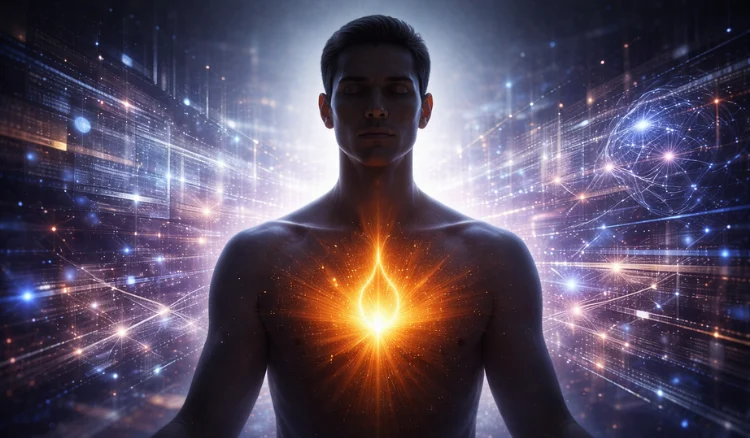
According to the Ayurvedic view, the human body is a mirror of the singularity. Just as a droplet of water merges with the ocean and loses its individual boundary, the human mind—when fully active yet emptied of content—can merge with the substratum of silence. This state is often referred to as liberation or enlightenment.
When the mind stops its fluctuations, it becomes a perfect reflection of the underlying unity of the universe. In this state, the practitioner recognizes that the individual "self" is not a separate entity, but a localized expression of the divine play (Lila) of creation.
Implications for Modern Medicine
The integration of these principles into modern life suggests a shift in how we approach chronic disease. Modern science excels at analyzing the "gross" matter of the body, but it often misses the "subtle" energetic imbalances that precede physical decay. By monitoring the quality of our food, our environment, and our thoughts, we can influence our elemental balance before it manifests as pathology.
As we navigate the complexities of modern life, the wisdom of the Pancha Maha Bhuta serves as a reminder of our interconnectedness. We are made of the same stardust that forms the stars, the same water that flows in the rivers, and the same silence that underlies all sound.
Conclusion
The Ayurvedic system is a profound invitation to recognize our place in the cosmic order. By cultivating a deep, sensory awareness of the elements—by hearing the space around us, feeling the air upon our skin, seeing the radiance of fire, tasting the nourishment of water, and grounding ourselves in the earth—we move toward a state of profound clarity.
Gratitude for the "Great Mother" in the form of these five elements is not just a spiritual practice; it is a clinical necessity. When we align our daily habits with the laws of nature, we are not just living; we are participating in the unfolding of consciousness itself. As we move through the cycle of creation, preservation, and dissolution, Ayurveda stands as a beacon, guiding us back to our true nature: a state of pure being, pure intelligence, and pure bliss.