










As we move deeper into 2026, the global landscape of healthcare stands at a precarious, yet exhilarating, crossroads. On one side of the ledger, we see the meteoric rise of Artificial Intelligence—a technology capable of diagnosing complex symptoms in milliseconds, drafting impeccable legal and clinical briefs, and simulating the nuance of human conversation. On the other side, we face a silent, burgeoning epidemic of alienation: record levels of loneliness, chronic stress, and a profound, collective hunger for authentic human connection.
For practitioners of the healing arts, this tension poses an existential question: Is there still a place for the human touch, or will the machine eventually eclipse the healer?
The answer, according to the veteran educators at The Ayurvedic Institute, is not a retreat, but an evolution. With over four decades of experience as the "Gold Standard" of Ayurvedic education in the West, the Institute—under the guidance of Vasant Lad, BAM&S, MASc—suggests that the AI revolution is not a threat to the clinical career. Rather, it is a clarion call to reclaim the very essence of what it means to be a healer.
The Relatable Struggle: From "Doing-Being" to "Human-Being"
For the better part of the last century, the modern professional world has demanded that individuals function like high-efficiency machines. We were conditioned to prioritize the memorization of data, the adherence to linear logic, and the exaltation of "productivity" above presence. We became "doing-beings," measured by our output rather than our resonance.
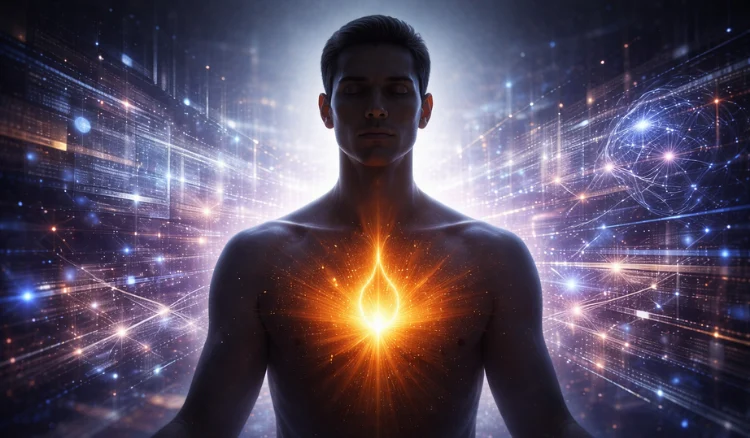
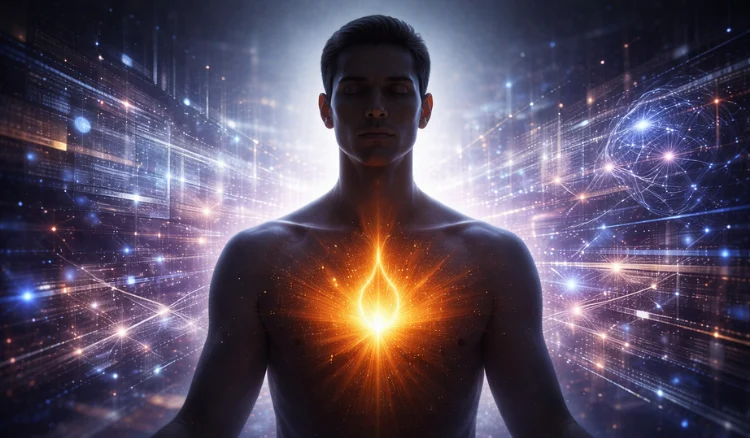
Now, as machines arrive to automate the mechanical tasks of data retrieval and pattern recognition, many practitioners feel an acute sense of vulnerability. However, this is a miscalculation of value. The very traits the industrial era attempted to train out of us—our intuition, our empathy, our spiritual resonance, and our capacity for deep presence—are now our most irreplaceable assets. The goal for the future clinician is no longer to be a more efficient computer; it is to be a more profound human.
PART 1: The Concept of Qualia—The Unreplicable Essence
Central to this paradigm shift is the philosophical concept of Qualia. In the study of consciousness, Qualia refers to the individual, subjective instances of experience. It is the "redness" of a rose, the specific, comforting warmth of a hand placed on a shoulder, or the tangible shift in the atmosphere of a room when a master healer enters.
AI can analyze the chemical composition of a rose; it can quantify the pressure applied by a hand; it can measure the ambient temperature of a room. Yet, it cannot experience the rose, the touch, or the atmosphere.
For the healer, this distinction is everything. We can establish a new formula for the future of clinical practice:
Clinical Information (AI) + Human Qualia (The Practitioner) = True Healing.
If a practitioner offers only information, they are essentially a commodity, easily replaced by a search engine. If, however, they offer Qualia—the shared resonance of two souls meeting in a space of intentionality—they become indispensable.
PART 2: The Three Pillars of Heart-Centered Practice
To thrive in 2026, the professional must shift the center of gravity from the Buddhi (Intellect) to the Hridaya (Heart). This transition relies on three core pillars that define the integration of clinical mastery and spiritual sovereignty.
Pillar 1: Nervous System Co-Regulation
We are biological, social creatures. Scientific evidence continues to demonstrate that a human touch creates a physiological response—a hormonal and neurological shift—that a robotic arm cannot replicate, even if the pressure and temperature are perfectly calibrated. The practitioner acts as a stabilizer for the client’s nervous system, a process of "co-regulation" that facilitates safety, which is the necessary prerequisite for any deep healing.
Pillar 2: The Art of Sravana (Deep Listening)
In the annals of Ayurvedic wisdom, Dr. Vasant Lad has long spoken of the practitioner as a "clear mirror." This is the art of Sravana, or deep, receptive listening. It is the ability to hold space so completely that the client can hear their own truth. While an AI can transcribe a conversation, it cannot listen with the intent to understand the unspoken burdens of the heart.
Pillar 3: Spiritual Sovereignty
Health is not merely the absence of disease; it is the presence of alignment. Spiritual sovereignty is the acknowledgment that there is a dimension of health that lies beyond the scope of blood tests and diagnostic scans. It is the cultivation of faith—not necessarily in a religious sense, but in the intelligence of life itself.
PART 3: The "Gold Standard" Framework for 2026
To understand the evolution of the profession, we must distinguish between the "Technician" and the "Master Healer."
| Feature | The AI Technician | The Heart-Centered Master |
|---|---|---|
| Tool | Algorithms & Data | Pulse, Presence, & Prana |
| Focus | Symptom Suppression | Root Cause & Soul Purpose |
| Vibe | Accurate but Cold | Grounded, Airy, & Inspiring |
| Result | Temporary Relief | Lasting Transformation |
By the end of 2026, "accurate information" will be a free, ubiquitous commodity. The premium will be placed entirely on the experience of being seen, known, and held in a sacred space.
PART 4: Addressing the Professional Objections
A common fear among students is the belief that they are not "spiritual" enough to lead a heart-centered practice. To this, the response is simple: Spirituality is not about detachment on a mountain; it is about radical honesty and presence. If you can stay present with a client’s pain, you are practicing high-level spiritual work.
Furthermore, the fear that AI is "better" at the clinical work is a misunderstanding of the profession’s goal. Let AI handle the scheduling, the drug-interaction checks, and the data entry. This "unshackles" the clinician, providing them the freedom to engage in the one task that defines the healer: being fully present.
PART 5: Your "Sattva Reset"—A 3-Step Daily Protocol
To maintain clarity (Sattva) and vitality (Ojas) in a high-tech world, practitioners must adopt a daily ritual of protection:
- Digital Sunset: Establish a firm boundary between the machine world and the biological world.
- Pulse and Presence: Begin each morning by connecting to one’s own pulse or breath, grounding the energy before the day’s tasks.
- The "Human-First" Check-in: Before engaging with technology, spend five minutes in silence to remember the "why" behind your clinical practice.
Implications: A Renaissance of the Heart
The AI revolution is not an uprising intended to replace the healer; it is a catalyst designed to highlight our necessity. We are entering a "Renaissance of the Heart." The most successful practices in the coming years will not be those with the most sophisticated apps; they will be the ones that function as an oasis—a space where the air is light, and the practitioner looks not at a screen, but into the soul of the seeker.
As the "deck of jobs" is reshuffled, the most secure path is the one that demands we be more human. The Ayurvedic Institute remains dedicated to this mission, forging "Ancient Wisdom Keepers" who possess both the mind of a scientist and the heart of a sage.
In the final assessment, only human beings can perform human-being things. It is time to stop acting like a machine and start resting into the depth of your own wisdom. The world is hungry for it.