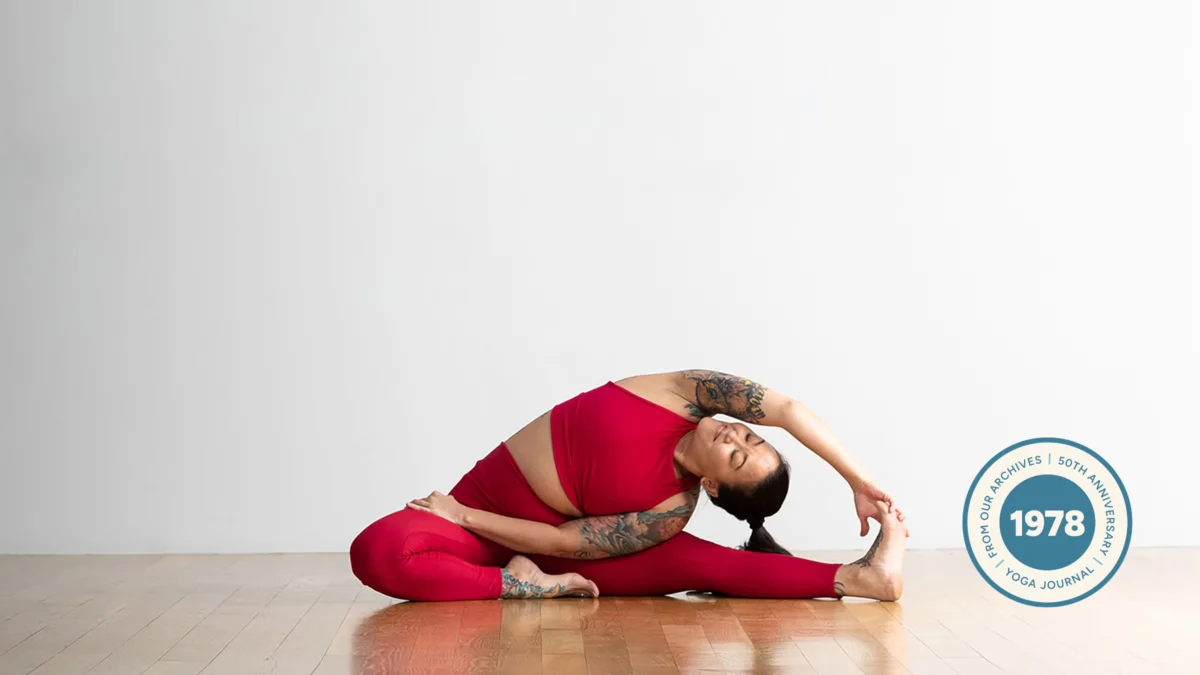
In the vast lexicon of Hatha Yoga, few postures command the same level of reverence—and demand the same degree of technical precision—as Parivritta Janu Shirsasana, or Revolved Head-to-Knee Pose. Often described by seasoned practitioners as a "stretching Swiss-army knife," this seated posture is a masterclass in duality. It bridges the gap between the internal surrender of a deep forward fold and the expansive, upward-reaching grace of a spinal twist.
As part of Yoga Journal’s ongoing Archives series, which revisits the intellectual and physical foundations of yoga practice since 1975, we delve back into the January-February 1978 issue to explore the enduring significance of this complex asana. By examining the intersection of anatomical science and ancient philosophy, we can better understand why this pose remains a cornerstone of the seated series nearly half a century later.
Main Facts: Defining the Revolved Head-to-Knee Pose
At its core, Parivritta Janu Shirsasana is a sophisticated variation of the foundational Janu Sirsasana (Head-to-Knee Pose). While the standard forward bend focuses on drawing the chest toward a straight leg with one knee folded, the revolved variation introduces a lateral rotation of the torso. In this iteration, the head does not merely rest at the knee; it travels down the shin as the ribcage spirals toward the ceiling.
The pose functions as a physical metaphor for the yogic journey. In the initial phase, the practitioner performs an act of surrender—a forward bend reminiscent of a prayerful obeisance. In the second phase, as the body rotates, that "prayer" is directed toward the heavens. By opening the heart region—the center of love and shared consciousness—the practitioner symbolizes the search for higher awareness. It is this transition from grounding to opening that distinguishes the pose from static stretches.
Chronology: A Legacy of Practice
The evolution of Parivritta Janu Shirsasana is deeply tied to the codification of yoga asanas in the 20th century. While the pose has been practiced for generations, its technical refinement gained global prominence through the teachings of B.K.S. Iyengar.
- Pre-1970s: The pose was largely transmitted through oral lineages and traditional Hatha texts, emphasizing the flexibility of the spine.
- 1978: Yoga Journal documented the pose with an emphasis on the "connective tissue" awareness that modern practitioners often overlook. This period marked a transition where yoga began to be viewed through an anatomical lens alongside spiritual development.
- 1980s–2000s: The rise of "alignment-based" yoga brought the biomechanical risks and benefits of the revolved spine to the forefront of teacher training programs.
- 2026: Today, the pose remains a benchmark for intermediate to advanced practitioners, serving as a litmus test for both physical mobility and the ability to maintain equanimity under the "pressure" of a deep, asymmetrical stretch.
Supporting Data: The Anatomy of a Twist
The physiological benefits of Parivritta Janu Shirsasana are as vast as its philosophical implications. Anatomically, the pose is a complex interplay of lengthening and compression.
The Abdominal Massage
B.K.S. Iyengar, in his seminal work Light on Yoga, emphasized the active massage provided to the abdominal organs. As the torso rotates, the internal organs are gently compressed and then released, which is believed to stimulate peristalsis and blood flow to the digestive tract.
The Latisimus Dorsi and Fascial Engagement
Perhaps the most invigorated area in this pose is the back. The latissimus dorsi—a large, fan-shaped muscle spanning from the pelvic brim to the lumbar and thoracic vertebrae—is heavily engaged. Because the arms are used as levers to pull the torso toward the extended foot, the "lats" undergo a significant eccentric stretch.
Critically, practitioners often confuse muscular stretch with the deeper, more biting sensation of fascial release. The fascia covering the lower back and waist is put under tension in a way few other poses can replicate. Recognizing this difference is a prerequisite for the meditative state; by identifying the quality of sensation (the deep muscle vs. the superficial connective tissue), the student cultivates dharana—a focused, one-pointed awareness of the body in space.
Official Perspectives: Navigating Spinal Safety
While the benefits are profound, the posture carries inherent risks. The vertebral column is placed in a position of simultaneous flexion (forward bending) and rotation (twisting).
The Expert Consensus on Spinal Integrity
The human spine is most vulnerable when these two movements are combined improperly. In this state, the small facet joints of the spinal column are not "close-packed"—meaning they are not in their most stable, supported position. Sudden, forceful, or uncoordinated movement in this configuration can lead to strain or ligamentous injury.
To mitigate these risks, the consensus among traditionalist instructors remains consistent:
- Prioritize the Twist: Rather than attempting to fold and twist simultaneously, the student should initiate the rotation first, establishing the spinal alignment before deepening the forward bend.
- Mindful Exit: Coming out of the pose is as critical as entering it. One must "unrotate" the spine fully before attempting to lift the torso back to a neutral, seated position.
- Breath Synchronization: A specific rhythm is advised—inhale to initiate the twist, exhale to surrender into the forward fold, and inhale to return to center. This breathing pattern ensures that the intercostal muscles remain engaged, protecting the ribcage and spine throughout the movement.
Implications: The Philosophy of Discomfort
Beyond the physical mechanics, Parivritta Janu Shirsasana serves as a laboratory for the mind. Yoga philosophy posits that human suffering (dukkha) originates from a fundamental misunderstanding of the true Self. We are caught in prakriti—the material world of the senses—and fail to recognize our essence as purusha, or pure spirit.
The Faculty of Buddhi
The practice of holding an uncomfortable pose allows the buddhi (subtle intelligence) to observe our reaction to adversity. Often, our minds are so desperate for comfort that we create a "rushed" environment to escape the present moment. By intentionally choosing to remain in a pose that creates physical sensation, the student confronts the artificiality of their own discomfort.
The Dvandvas (The Dualities)
Parivritta Janu Shirsasana forces a confrontation with the dvandvas—the opposing conditions of pleasure and pain. In the intensity of the stretch, the brain may signal a desire to flee. By remaining tranquil, the student learns that these states are transient.
This is the ultimate goal of the asana: to remain equally conscious and equanimous regardless of the external circumstances. If a student can observe their reaction to the "failure" of not being able to reach their foot, or the "success" of achieving a deep twist, they begin to transcend the dualities that govern everyday life.
Conclusion: A Tool for Conscious Living
Revolved Head-to-Knee Pose is more than a mere gymnastic feat. It is a rigorous training ground for the soul. By balancing the need for physical caution with the philosophical requirement for deep inquiry, the practitioner transforms a simple stretch into a meditation.
As we look back at the 1978 archives, the message remains strikingly modern: the discomfort we experience on the mat is not created by the pose; it is merely revealed by it. By learning to navigate the stretch, the twist, and the breath, we learn to navigate the complexities of our own consciousness. Whether you are a novice attempting your first rotation or a seasoned yogi refining your practice, remember that the true destination of Parivritta Janu Shirsasana is not the foot—it is the quiet, undisturbed awareness of the Self residing within the movement.