By Editorial Staff
The serene, rugged peaks of the Himalayas, often viewed as the "roof of the world," have become the site of a harrowing humanitarian crisis. A sudden, violent surge of glacial melt, mud, and debris has torn through the border regions of Nepal and the Tibet Autonomous Region of China, claiming at least 160 lives and leaving hundreds more unaccounted for. The disaster, which unfolded with almost zero warning, has flattened infrastructure, erased entire market districts, and triggered a massive, high-altitude search-and-rescue operation that is currently battling both time and treacherous terrain.
The Anatomy of the Disaster: Main Facts
The disaster began when torrential rains, compounded by a catastrophic glacial event, sent a wall of sediment-heavy water cascading down the steep Himalayan valleys. Unlike typical monsoon flooding, which allows for some degree of predictive modeling, this event was characterized by its suddenness and brute force.
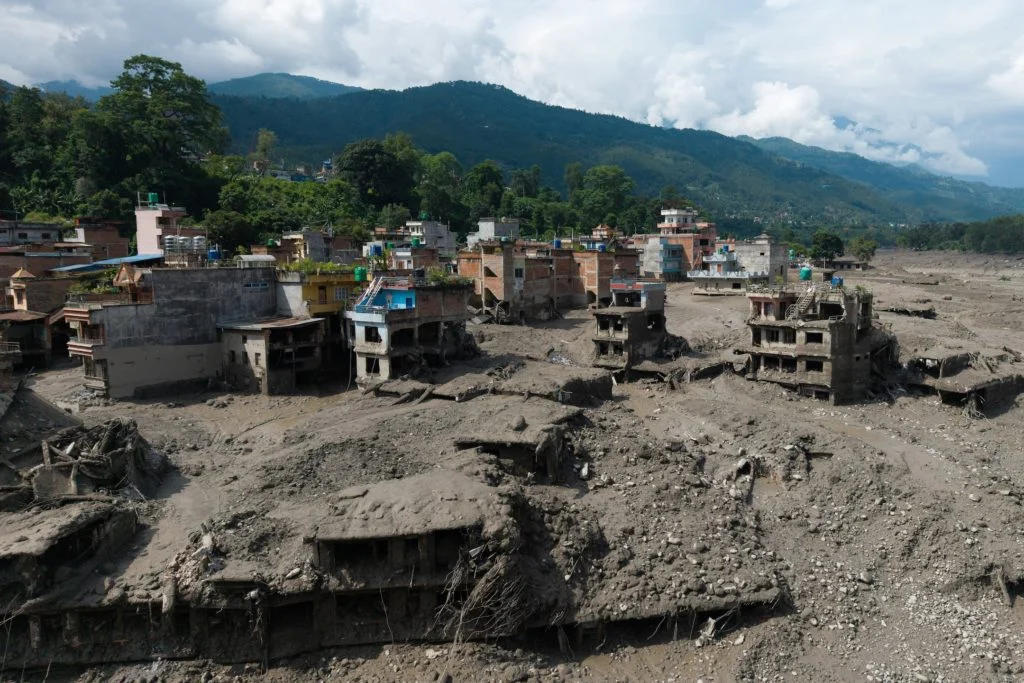
Security camera footage recovered from a border crossing serves as a grim testament to the event’s intensity. The footage shows civilians in the path of the torrent sprinting for safety, mere seconds before a massive, dark wall of mud and boulders obliterated the area. The physical power of the flood was such that it tossed heavy transport buses as if they were playthings, pulverizing multi-story buildings and erasing parking structures that had stood for years.
The current death toll, confirmed at 160, is widely expected to rise as rescue crews reach more remote villages cut off by the destruction of roads and bridges. Among the missing are hundreds of individuals, including a significant number of foreign nationals—among them, dozens of American citizens—who were traveling through the region at the time of the deluge.
Chronology of the Torrent
The tragedy unfolded in a series of rapid, devastating phases that caught local populations off-guard:
- The Precursor: High-altitude weather stations in the Himalayas had recorded persistent rainfall in the days leading up to the event, saturating the steep mountain slopes.
- The Glacial Breach: Scientists currently analyzing satellite imagery hypothesize that a massive section of ice broke away from a high-altitude glacier. This ice-fall likely destabilized the terrain above, triggering a GLOF (Glacial Lake Outburst Flood) or a catastrophic landslide.
- The Surge: The resulting slurry of water, ice, and debris accelerated down the narrow, steep valleys. By the time the surge hit the Nuwakot district in Nepal and the border transit points, it had gained enough kinetic energy to destroy everything in its path.
- The Immediate Aftermath: Survivors in the Nuwakot district reported having as little as 30 minutes between the first signs of the flood and the total destruction of their local market. Residents fled to higher ground, often losing all belongings in the process.
- Search and Rescue (Ongoing): Following the initial impact, local authorities, bolstered by regional support, initiated search-and-rescue efforts. Survivors were seen linking arms to navigate waist-deep, viscous mud, while rescuers pulled survivors from the wreckage to transport them to makeshift medical facilities.
Supporting Data and Scientific Context
The geological scale of this disaster has been mapped by satellite technology, which reveals that the landscape has been fundamentally altered. Entire stretches of once-navigable valley floors are now buried under meters of silt, rock, and ice.
The Climate Connection
Glaciologists note that the Himalayas are warming at a rate significantly faster than the global average. As temperatures rise, glaciers become increasingly unstable. When heavy, unseasonal rain falls on these high-altitude ice fields, the risk of "cascading failures"—where ice melt triggers landslides—increases exponentially. The transformation of these landscapes is not merely a localized event but a symptom of a broader, systemic shift in mountain ecosystems.
Impact on Infrastructure
The economic cost of the disaster is already mounting. Key transit corridors between China and Nepal, essential for regional trade and tourism, have been severed. The loss of roads and communication towers has created "black zones" where the true extent of the casualties remains unknown. Aerial surveillance indicates that the floodwaters surged south toward the Kathmandu region, threatening downstream settlements that were not directly in the path of the initial slide but are now vulnerable to secondary flooding and soil instability.
Official Responses and Humanitarian Efforts
The international response has been swift, though hampered by the extreme geography of the region.
The Chinese Response
Chinese President Xi Jinping has formally ordered an "all-out effort" regarding search and rescue operations. State media outlets have been directed to prioritize the coordination of resources to the Tibetan border zones. Beijing has deployed specialized mountain rescue units, though the instability of the mud-covered terrain continues to pose a significant risk to the rescuers themselves.
The Nepalese Response
The government of Nepal has declared a state of emergency in the affected districts. Local officials, speaking through interpreters, have expressed despair over the scale of the tragedy. Shoyam Rajbhandari, a resident of Nuwakot, captured the sentiment of the survivors: "When I reached the bazaar, in half-an-hour, the flood came and damaged all of the market. People were preparing to go to the office then. How many people are missing or dead? We don’t know."
International and U.S. Involvement
The United States Department of State has confirmed that it is actively tracking the status of American citizens affected by the flooding. The U.S. embassy is currently coordinating with local Nepalese authorities to facilitate rescue and evacuation efforts. In an official statement, the State Department noted that the U.S. stands ready to provide further humanitarian assistance, including medical supplies and search-and-rescue technical support, should it be requested by the Nepalese government.
Implications: A Future of Increased Risk
The disaster at the Nepal-Tibet border serves as a grim case study for the risks inherent in high-altitude living in a changing climate.
Infrastructure Vulnerability
The destruction of "permanent" structures highlights a critical need for re-evaluating building codes in the Himalayas. Traditional construction methods and even modern reinforced concrete were shown to be no match for the sheer mass of a glacial-fed mudslide. Engineers are now calling for a comprehensive mapping of "high-risk zones" where settlement should be restricted.
The Human Toll of Migration and Tourism
With dozens of foreign nationals and hundreds of local citizens missing, the disaster underscores the vulnerability of the growing tourism and trade sectors in the Himalayas. As more people travel through these mountain passes, the necessity for a real-time, cross-border early warning system becomes paramount. Currently, the lack of data sharing between meteorological agencies in the region leaves thousands in the path of potential future surges.
Long-term Recovery
The immediate concern is, of course, the search for survivors. However, the long-term implications are equally daunting. The loss of agricultural land, the destruction of market centers, and the displacement of entire communities will likely lead to a significant humanitarian crisis in the coming months. The recovery will require not only the clearing of massive amounts of debris but the psychological and economic rehabilitation of thousands of survivors who have lost their livelihoods overnight.
As the sun sets over the Himalayas tonight, the rescue efforts continue under floodlights. The silence of the mountains has been replaced by the drone of helicopters and the heavy work of shovels hitting stone. For the families waiting for news, the hours are excruciating, and for the governments involved, the tragedy is a stark reminder that in the face of nature’s raw power, coordination and preparedness are the only shields against total catastrophe.