











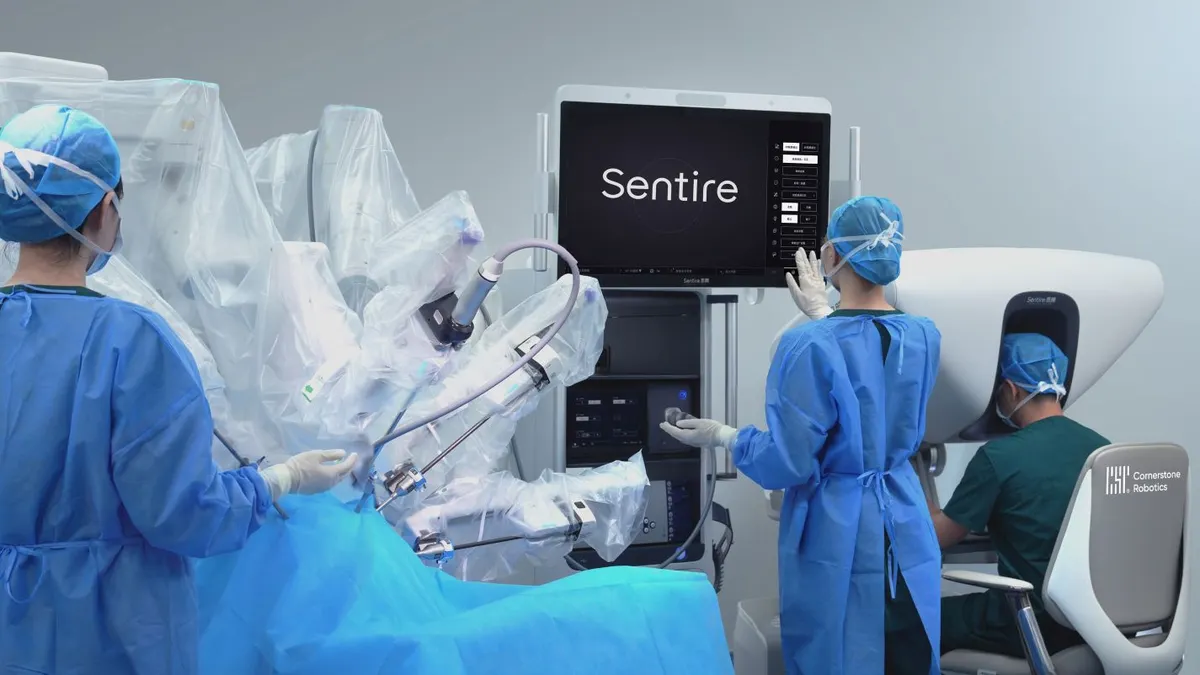
In a move that signals a major intensification in the global robotic surgery arms race, medical technology giant Medtronic has announced a strategic partnership with Hong Kong-based Cornerstone Robotics. Under the terms of the agreement, Medtronic will secure distribution rights for Cornerstone’s innovative "Sentire" surgical robotic system in select markets outside of the United States.
This collaboration is not merely a distribution deal; it represents a tactical broadening of Medtronic’s portfolio. By integrating Sentire alongside its flagship Hugo™ robotic-assisted surgery system, Medtronic aims to capture a larger share of the global market, providing hospital systems with diverse clinical options tailored to varying economic needs and procedural requirements.
The Strategic Logic: A Multi-Pronged Approach
The surgical robotics landscape has historically been dominated by Intuitive Surgical and its ubiquitous da Vinci systems. However, the last twelve months have seen a seismic shift as Medtronic and other heavyweights, such as Johnson & Johnson, have moved to challenge that hegemony.
Medtronic’s decision to add Sentire to its arsenal is a calculated hedge against a one-size-fits-all model. While the Hugo system is designed to provide high-end, scalable robotic surgery for large-scale hospital networks, the Sentire system—which received regulatory approval in China in 2024—offers a complementary footprint.
"Sentire will be a strong complement to Hugo," a Medtronic spokesperson noted, emphasizing that the dual-platform strategy allows the company to offer "meaningful flexibility across clinical settings, procedural needs, and economic models." By diversifying, Medtronic ensures it can meet hospitals where they are, whether they require the advanced capabilities of the Hugo system or the specific advantages offered by the Sentire platform.
Chronology of an Expanding Portfolio
To understand the weight of this partnership, one must examine the rapid succession of milestones Medtronic has achieved in the robotic space over the past year:
- Q3 2024 (U.S. Breakthrough): Medtronic secured pivotal FDA clearance for the Hugo system for use in urologic procedures. This served as a watershed moment, marking the first time a major medtech player successfully challenged the established market leaders in the U.S. with a comprehensive soft-tissue robotic solution.
- July 2024 (Industry Shift): The competitive landscape grew more crowded when Johnson & Johnson received FDA authorization for its Ottava robotic surgery system, signaling that the "robotics era" of surgery had truly arrived for all major players.
- Late 2024 (Expanding Scope): Beyond hardware, Medtronic aggressively pursued software integration. The company submitted 510(k) filings to broaden Hugo’s indications to include general surgery and gynecology, effectively widening its addressable market.
- Recent Developments: Medtronic successfully obtained FDA clearance for AI-enhanced software that assists surgeons with real-time decision-making during robotic procedures.
- Current Date: The formalization of the Cornerstone Robotics partnership, marking a new chapter in global expansion.
Data-Driven Growth: The Numbers Behind the Move
Medtronic’s aggressive expansion into robotics is driven by the realization that the sector remains one of the most underserved segments of modern healthcare. During a recent earnings call, Medtronic CEO Geoff Martha provided a candid assessment of the market’s potential.
"Robotic surgery is one of the most compelling growth opportunities in healthcare," Martha stated. Despite the buzz surrounding the technology, global penetration remains in the "single digits." In emerging markets, that figure drops to a mere 1%. This massive gap between clinical demand and technology adoption represents the "significant runway" that Medtronic intends to capitalize on.
The performance metrics for the Hugo system underscore this optimism. Medtronic reported that:
- Global Reach: The Hugo system is currently active in 35 countries.
- Growth Velocity: Procedure growth using the Hugo system is currently tracking at more than twice the growth rate of the overall robotic surgery market.
- Installation Targets: The company projects a global install base of 250 units by the end of its fiscal year, with total procedures expected to exceed 50,000.
These figures illustrate that while Intuitive Surgical remains the incumbent, Medtronic is rapidly gaining market share through a combination of aggressive regulatory filings, software innovation, and strategic international partnerships.
Addressing Skepticism: CEO Geoff Martha’s Defense
During the company’s recent earnings call, analysts probed whether the investment in Cornerstone Robotics signaled a lack of confidence in the proprietary Hugo platform. CEO Geoff Martha was quick to dismiss the notion, reframing the partnership as an offensive maneuver rather than a defensive pivot.
"It’s just the opposite," Martha asserted. "We’re very excited about the progress that we’re making in Hugo."
Martha’s argument is rooted in the philosophy of "portfolio optimization." In a complex global economy, hospital administrators are increasingly sensitive to capital expenditure (CapEx) and operating expenses (OpEx). By offering both Hugo and Sentire, Medtronic is positioning itself as a "total solution provider." If a smaller community hospital or a clinic in an emerging market finds the Hugo system outside its current budget or footprint, the Sentire system provides a viable, Medtronic-backed alternative. This strategy prevents the company from losing a potential customer to a competitor.
Implications for the Future of Surgery
The partnership with Cornerstone Robotics carries significant implications for the future of the medical technology industry:

1. The Rise of the "Robot-First" Surgeon
As robotic systems become more accessible and diverse, the barrier to entry for surgeons is lowering. AI-integrated systems, like those Medtronic is currently rolling out, reduce the learning curve for complex procedures, effectively democratizing access to high-precision surgery.
2. Emerging Market Dominance
The 1% penetration rate in emerging markets is a massive opportunity. By partnering with a company like Cornerstone, which has already navigated the regulatory landscape in China, Medtronic is signaling that it intends to localize its technology to specific regional requirements. This is a savvy geopolitical move that allows Medtronic to bypass the friction often associated with importing Western-centric technology into rapidly developing healthcare markets.
3. The Commoditization of Hardware
As more companies enter the space—J&J, Medtronic, and others—the hardware itself may eventually face pressure to commoditize. The real differentiator moving forward will be software, data analytics, and AI-driven clinical support. By diversifying its hardware portfolio now, Medtronic is essentially building a "platform" of platforms, where the common denominator is the data ecosystem that supports the surgeon.
4. Continued Pressure on Intuitive Surgical
The arrival of Medtronic’s Hugo and J&J’s Ottava, bolstered by strategic partnerships, ensures that the price of robotic systems will likely become more competitive. For hospitals, this is a win-win, as increased competition typically leads to better pricing models and more frequent software upgrades.
Conclusion: A Long-Term Vision
Medtronic’s partnership with Cornerstone Robotics is a clear message to the market: the company is playing the long game. By combining the internal innovation of the Hugo system with the external versatility of the Sentire platform, Medtronic is constructing a robust infrastructure designed to dominate the surgical suite for decades to come.
As the company works toward its goal of 50,000 procedures and beyond, the narrative is no longer just about building a robot; it is about building a comprehensive ecosystem that addresses the needs of patients, surgeons, and hospital administrators alike. With global robotic surgery penetration still in its infancy, Medtronic’s aggressive expansion suggests that the "robotic surgery era" has only just begun. The company’s ability to execute this multi-platform strategy will be the defining factor in its attempt to lead the next generation of medical technology.