









Introduction
Nearly five years have passed since the Taliban reclaimed control of Afghanistan, effectively dismantling the infrastructure of progress that had been built for women over the previous two decades. In the wake of their return, one of the first and most devastating decrees was the systemic ban on secondary and higher education for girls over the age of 12. What began as a shuttering of classrooms has metastasized into a pervasive regime of gender-based erasure. Yet, in the shadows of Kabul and the embattled streets of Herat, a clandestine resistance is unfolding.
In an exclusive investigation, special correspondent Leila Molana-Allen and videographer Eric O’Connor gained rare access to the underground networks of educators and students risking their lives to keep the flame of knowledge alive. This report examines the grim reality of a country where the simple act of reading is treated as an act of treason.
The Chronology of Erasure: From Classroom to Confinement
The Taliban’s war on female education was not a singular event but a calculated, incremental dismantling of autonomy.
- August 2021: Following the withdrawal of U.S. and coalition forces, the Taliban swept into Kabul. Initial promises of a "moderate" government were quickly undermined.
- September 2021: The de facto authorities barred girls from attending secondary school, claiming the closure was "temporary" while they aligned the curriculum with Sharia law. That "temporary" closure has now lasted nearly five years.
- December 2022: The ban was expanded to include university education, effectively closing the door on professional advancement for millions of Afghan women.
- 2023–2024: A series of decrees followed, restricting women’s movement, access to public parks, employment in NGOs, and even the right to speak or sing in public spaces.
- June 2024 to Present: The "Morality Police"—the Ministry for the Propagation of Virtue and Prevention of Vice—intensified patrols, enforcing strict dress codes and conducting house-to-house searches for dissenters.
Inside the Basement: The Secret Classrooms
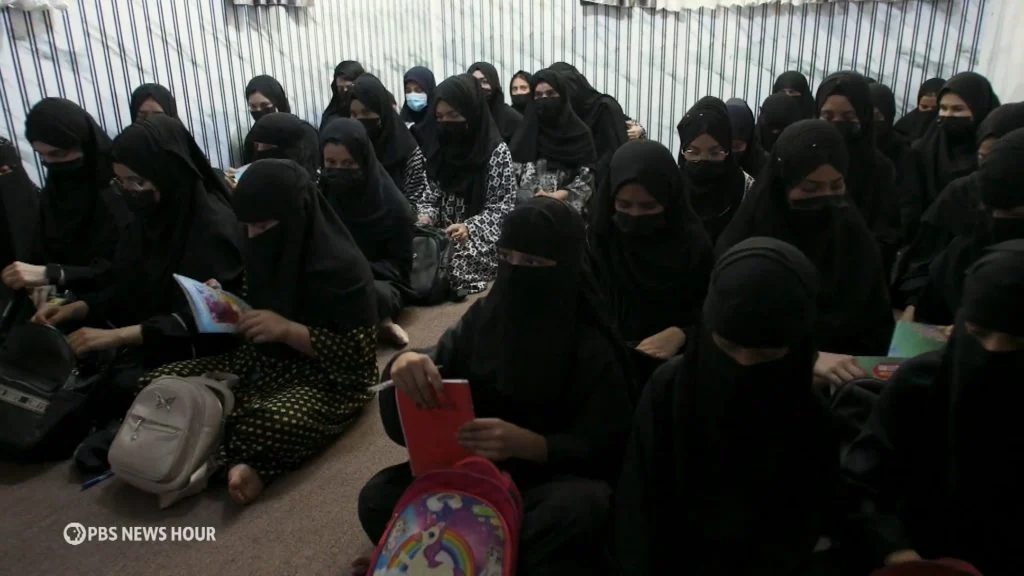
In a quiet, unremarkable Kabul neighborhood, a routine plays out each dawn. Dozens of teenage girls slip through an unmarked door, descending into a stiflingly hot basement shielded by heavy curtains. This is not a state-sanctioned school; it is an act of profound defiance.
"From the very beginning, we unexpectedly had hundreds of students," says Farimah, the founder and lead teacher of one such facility. "Everyone was so happy because it was the first door of hope for them after a long time."
For Farimah, the decision to open her home was a reaction to despair. When the ban was announced, she felt her purpose as an educator had been extinguished. Today, her school operates entirely through word of mouth. There is no signage, no advertisement, and no public record—only a tight-knit community bound by the shared goal of survival through intellect.
The students, ranging from early teens to young adults, describe their previous years of isolation as a form of "living death." Noosha, an 18-year-old student, recalls the months she spent in a mental health crisis, unable to breathe or see a future. "I felt like I was trapped in a very small prison," she says. "But when I came to this school… I told myself, I must study, I must succeed."
Supporting Data: The Human Cost of Policy
The consequences of these bans extend far beyond the loss of academic credit. Data from local activists and human rights observers indicates a direct correlation between the closure of schools and the surge in forced, underage marriages.
- The Marriage Trap: With no path to a career, many families—driven by poverty and the belief that a girl without an education is a burden—are marrying off daughters as young as 14 to significantly older men.
- The Case of Maya: A teenager whose story represents thousands, Maya was in her penultimate year of high school when the Taliban returned. Her dreams of university vanished, and she was forced into a marriage with a stranger. The psychological and physical toll was immediate; she became pregnant while still a child herself, only to suffer a traumatic miscarriage. "I don’t have much hope for the future," she admits, her voice trembling over the phone to avoid detection by her in-laws.
- The Scale of Resistance: Despite the danger, the appetite for learning is immense. Ms. Mubariz, an activist and founder of a clandestine online schooling network, reports that her platform currently educates 12,000 teenage girls across the country.
The Frontlines of Herat: A City Under Siege
If Kabul is the center of the secret school movement, Herat—traditionally the most liberal and culturally diverse province in Afghanistan—has become the testing ground for the Taliban’s most draconian crackdowns.
The Ministry for the Propagation of Virtue and Prevention of Vice has targeted Herat to prove a point: if they can force women in this cosmopolitan city to cover their faces and bodies entirely, they can enforce the law anywhere. The result has been a campaign of terror. Women are regularly beaten in public for "improper" attire, and the presence of morality patrols has effectively confined many to their homes.
When a group of women took to the streets in June to protest these restrictions, chanting "Education, work, freedom," the response was immediate and violent. Security forces, armed with armored vehicles, opened fire on the protesters. At least two women were killed, and many others were arrested.
"They were checking home by home to find those people," Ms. Mubariz recounts. "They even went to hospitals to arrest the injured." The trauma is so severe that those released from custody are often left physically shaking, unable to speak about the interrogations they endured.
Implications: A Generation at Risk
The international community remains largely paralyzed by the geopolitical complexities of engaging with the Taliban. While NGOs and some foreign governments provide humanitarian aid, there is no formal mechanism to restore the fundamental rights of Afghan women.
The implications are dire. By systematically denying education, the Taliban is not just suppressing current opposition; they are attempting to lobotomize the intellectual future of the nation. As Dima, one of the Herat protesters, explains, the cost of inaction is too high.
"We have to [resist], because we tell ourselves it’s either death or victory," Dima says. "I believe one generation has to make sacrifices so the other can live."
Official Responses and the Path Forward
The Taliban leadership maintains that these restrictions are internal matters of governance and religious interpretation. They have largely ignored calls from the United Nations and various international bodies to reopen secondary schools, often citing the need for "appropriate environments" for girls—a condition that international observers argue is a stalling tactic.
For the women inside the basements and behind the screens of online schools, the wait for international policy shifts is a luxury they cannot afford. They are operating under the constant threat of the "knock on the door"—the moment their clandestine lives are discovered, leading to imprisonment or worse.
Despite the risk, the movement grows. The women interviewed for this report share a singular, haunting resolve: they are not fighting for a return to the past, but for the right to exist in the future. As Farimah notes, "We want to show the world that this is not the end for us."
In the face of an regime that treats their minds as a threat, the women of Afghanistan are choosing to educate themselves in the dark, betting everything on the hope that when the light finally returns, they will be ready to lead.