









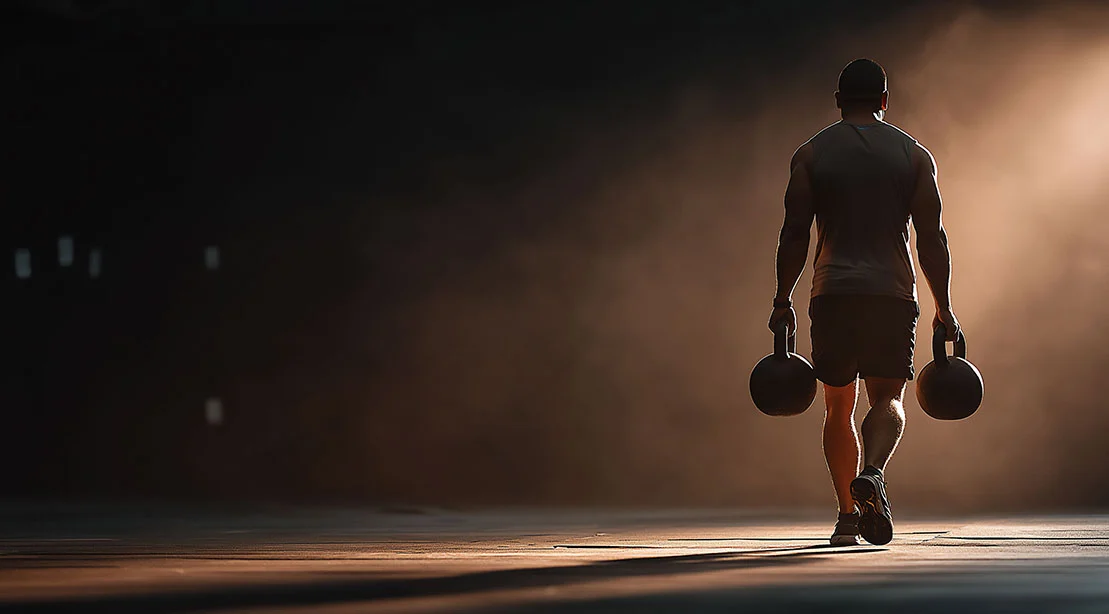
In the landscape of modern functional fitness, the "loaded carry" is often hailed as the king of movement-based strength training. For decades, athletes have picked up heavy dumbbells or kettlebells, braced their cores, and walked to build total-body durability. It is simple, effective, and predictable. But in the world of high-performance training, predictability is often the enemy of progress. Enter the Chaos Suitcase Carry—a sophisticated variation that transforms a standard strength move into an intense test of proprioception, reactive core strength, and grip endurance.
By suspending a kettlebell or weight plate from a looped resistance band, the athlete introduces a dynamic, oscillating element to the movement. Every step initiates a rhythmic bounce, sway, and tug that forces the body to calibrate its position in real-time. This article explores the mechanics, benefits, and implementation of this potent exercise.
The Mechanics: What Is the Chaos Suitcase Carry?
The Chaos Suitcase Carry is a unilateral loaded carry that leverages the principles of reactive instability. Unlike a standard suitcase carry—where the weight remains static relative to the hand—the Chaos variant utilizes a resistance band to create a "pendulum" effect.
When you grasp the band, you are essentially holding a dynamic, shifting load. As you walk, the kettlebell creates a low-frequency oscillation. Your body must constantly counteract these shifts, not just to maintain a straight line of travel, but to keep the torso from tilting. While a regular suitcase carry challenges your ability to resist gravity, the Chaos version challenges your ability to resist unpredictability. It forces the core to switch from a "bracing" mindset to a "reactive" one.
The Chronology of Development
The evolution of the Chaos Carry tracks with the rise of "instability training" in the early 2010s. Coaches began looking for ways to bridge the gap between heavy, static lifting (like deadlifts) and the erratic demands of field sports. The realization was that while absolute strength is vital, the ability to stabilize that strength while moving through space—often referred to as "dynamic stability"—is what prevents injuries and improves athletic longevity. The Chaos Carry became the primary tool for this, moving from niche physical therapy clinics into the mainstream of performance gym culture.
Why Instability Matters: Supporting Data
The efficacy of the Chaos Suitcase Carry is rooted in its ability to recruit stabilizer muscles that are often bypassed during traditional, fixed-load training. Research into instability training suggests that when a load is allowed to oscillate, the central nervous system must increase its firing rate to the core musculature to prevent structural compromise.
The Anatomy of the Core
When performing this exercise, you are targeting the "anti-lateral flexion" mechanism of the spine. The primary muscles involved include:
- The Obliques: These muscles work overtime to prevent the torso from collapsing toward the weighted side.
- The Quadratus Lumborum (QL): A deep abdominal muscle that acts as a stabilizer for the lower spine.
- The Gluteus Medius: Crucial for pelvic stability; it prevents the hips from "dumping" or shifting during the gait cycle.
- The Rotator Cuff and Scapular Stabilizers: Because the hand is gripping a band, the shoulder must stabilize the weight dynamically, engaging the small muscles surrounding the shoulder blade.
Professional Insights: Expert Perspectives
"The beauty of the Chaos Carry lies in the feedback loop," notes strength coach Julian Thorne. "When you hold a static dumbbell, your body gets ‘lazy’ once it finds a stable position. With a band-suspended kettlebell, that position is moving every millisecond. You aren’t just training strength; you are training your brain’s ability to interpret space and load."
From a biomechanical standpoint, experts emphasize that this movement teaches the body to "stiffen" the core reflexively. In sports, an athlete rarely has time to brace before impact. By training with an unstable load, the nervous system learns to trigger that bracing response faster and more efficiently, leading to better posture and reduced risk of lumbar strain during heavy lifting or daily activities.
How to Execute the Chaos Suitcase Carry
Proper form is non-negotiable. Because this is an instability exercise, going too heavy or using poor technique will result in a loss of core control.
Step-by-Step Execution
- Preparation: Loop a resistance band through the handle of a kettlebell or the center hole of a weight plate.
- The Grip: Grab the band firmly. The length of the band should be short enough that the weight does not hit the ground, but long enough to allow for movement.
- The Set-Up: Stand tall with your feet hip-width apart. Draw your shoulder blades back and down. Ensure your head, rib cage, and pelvis are stacked in a straight vertical line.
- The Gait: Take slow, controlled steps. Do not rush. With each foot strike, the weight will begin to bounce. Your goal is to keep the torso perfectly still while your legs do the moving.
- The Finish: Maintain your posture until the set is complete. If the oscillation becomes too violent to control, stop and reset.
Ensuring Quality: How to Know You’re Doing It Right
To reap the benefits, you must distinguish between "controlled chaos" and "losing control."
Visual Checkpoints:
- The "Zipper" Test: Imagine the zipper on your shirt. It should face forward throughout the entire movement. If it tilts toward the weighted side, your obliques have failed to stabilize the load.
- Shoulder Height: The loaded shoulder should stay level with the non-loaded shoulder. If the weight pulls your shoulder into a shrug, you are losing structural integrity.
- Gait Symmetry: Your stride length should remain equal on both sides. Avoid limping or widening your stance to compensate for the weight.
What It Should Feel Like:
You should feel a significant "tug" at the bottom of the movement. Your forearm will feel a deep burn due to the constant grip adjustments, and your obliques should feel a persistent, intense engagement—almost like a side plank in motion.
Common Pitfalls and Strategic Fixes
Even experienced lifters encounter issues with this movement. Here is how to correct the most common errors:
- The "Wrecking Ball" Effect: If the weight is swinging wildly, the band is likely too long or the weight is too heavy. Fix: Shorten your grip on the band to reduce the pendulum arc.
- Leaning Away: Often, people instinctively lean to the side opposite the weight to balance the load. This defeats the purpose by providing artificial leverage. Fix: Keep your spine neutral. If you cannot keep your spine straight, reduce the weight immediately.
- Upper Trapezius Tension: If your neck feels tight or your shoulder is creeping toward your ear, you are "hiding" in your traps. Fix: Consciously depress your shoulder blades; keep your neck "long."
Programming and Implications
The Chaos Suitcase Carry is best utilized as a supplemental movement rather than a primary strength builder. Because it is taxing on the grip and the nervous system, it is an ideal "finisher" or a bridge exercise between heavy lifts.
Recommended Programming:
- Volume: 2–3 sets per side.
- Distance: 20–50 yards per set.
- Rest: 60 seconds between sets to allow for grip recovery.
- Context: Integrate this into your core-specific training or as part of a "loaded carry" circuit alongside heavy, static farmer’s walks.
The Broader Implications
The inclusion of chaos-based training in a fitness regimen has significant implications for long-term health. By strengthening the stabilizers of the spine and hips, individuals often report a reduction in chronic lower back pain and improved coordination in daily tasks—such as carrying groceries, luggage, or children. Furthermore, the grip strength gains are significant, which is a well-documented marker for overall longevity and health span.
Conclusion
The Chaos Suitcase Carry is a testament to the idea that simplicity isn’t always the path to performance. By embracing the bounce, the sway, and the unpredictability of a suspended load, you force your body to move beyond the limitations of standard resistance training. It is a humble movement that demands total focus, but for those willing to master it, the payoff is a bulletproof core, a superior grip, and a body that is truly prepared for the chaotic demands of the real world. Stop lifting for the mirror and start training for the movement—embrace the chaos.