










If you have spent any time on social media or in the wellness echo chambers of the internet, you have likely encountered the polarizing figure of billionaire entrepreneur Bryan Johnson. The subject of the recent Netflix documentary Don’t Die, Johnson has become the public face of an aggressive, multi-million dollar pursuit: the quest to reverse his biological age.
Johnson’s regimen is exhaustive, bordering on the clinical. It involves a strict protocol of dozens of daily supplements, weekly acid peels, hyperbaric oxygen therapy, and even controversial plasma infusions. Johnson claims these interventions have successfully reversed his biological clock by over five years. However, the movement is not without its skeptics; investigative reports, including a notable piece from The New York Times, have suggested that when analyzed through different metrics, Johnson’s biological age may have actually increased.
Despite the controversy, the "Don’t Die" crusade is gaining significant traction. From the high-profile podcasts of Peter Attia and Andrew Huberman to the proliferation of direct-to-consumer blood and urine test kits, "bio age testing" has moved from the fringes of Silicon Valley biohacking into the mainstream. But as these tests become more affordable, a pressing question arises: Is there real utility in measuring your biological age, or is it merely another expensive trend?
Understanding the "Bio Age" vs. Chronological Age
To navigate this landscape, one must first distinguish between chronological age and biological age. Chronological age is simple—it is the number of candles on your birthday cake. It is a linear, unchangeable measure of time passed since birth.
Biological age, or "bio age," is far more nuanced. It refers to the functional status of your cells and organ systems. Consider two 50-year-old men: Chang, who works a sedentary desk job, lives in a highly polluted urban environment, relies on processed convenience foods, and smokes; and Jabari, who exercises regularly, eats a nutrient-dense diet, meditates, and maintains a clean living environment. While both share the same chronological age, their biological realities are vastly different. Jabari’s cells, markers of inflammation, and organ efficiency likely reflect a younger physiological state, while Chang’s body is effectively "older" due to cumulative stress and lifestyle-induced damage.
How Science Measures the Clock
Bio age testing relies on the analysis of biomarkers—objective indicators of biological processes. Modern, high-tech tests often focus on two primary mechanisms:
- Telomere Length: Telomeres are the protective caps at the ends of chromosomes. As cells divide, these caps shorten, eventually leading to cellular senescence or death. While clinically useful for detecting specific genetic conditions, the utility of telomere length as a predictor of general aging in healthy individuals remains a subject of intense scientific debate.
- DNA Methylation: This is a chemical process that alters the activity of DNA segments without changing the sequence itself. Because specific patterns of methylation change in a predictable way as we age, scientists like Steve Horvath have developed "clocks" to estimate biological age based on these patterns. Tools like the DunedinPACE clock are currently at the forefront of research into how lifestyle, environment, and pharmacology influence the pace of aging.
The Role of Traditional Biomarkers
While commercial kits lean on epigenetic markers, the most reliable data often comes from standard clinical testing. Your doctor likely already tracks the most vital biomarkers of aging: blood pressure, cholesterol levels (including ApoB), blood glucose, and hemoglobin A1C. These are not merely indicators of heart disease; they are proxies for systemic aging. Chronic elevation of these markers is a reliable predictor of premature mortality, and unlike genetic markers, they are highly responsive to lifestyle interventions within a window of 6 to 12 weeks.
Five Free Ways to Assess Your Biological Fitness
You do not need a billionaire’s budget to get a snapshot of your biological age. Several scientifically validated, "old-school" tests serve as excellent proxies for your functional health.
1. The Sitting-Rising Test (SRT)
This test evaluates core strength, balance, and mobility—all of which are inversely correlated with mortality.
- The Method: Start in a standing position, lower yourself to the floor into a cross-legged position, and stand back up without using your hands, knees, or shins for leverage.
- The Scoring: Starting at 10, deduct one point for every body part used for assistance. A low score is a statistically significant indicator of increased cardiovascular risk.
2. Grip Strength
Handheld dynamometer testing or the simple "tennis ball squeeze" test provides a window into overall muscular health. Research suggests that grip strength is a more accurate predictor of longevity than blood pressure. If your grip fatigues in under 15 seconds, it may suggest a decline in skeletal muscle mass that warrants attention.
3. The One-Leg Balance Test
Balance requires the integration of the visual, vestibular, and proprioceptive systems. An inability to hold a one-legged stance for the duration expected for your age group is a strong warning sign of systemic decline and a major risk factor for falls, which are a leading cause of injury-related death in the elderly.
4. Subjective Fatigability
The Pittsburgh Fatigability Scale helps quantify how much energy you expend on daily tasks. Unlike transient tiredness, persistent "fatiguability" is a clinical red flag. If you find yourself exhausted by moderate activities like leisurely walking or hosting a dinner party, it may indicate underlying metabolic or cardiovascular dysfunction.
5. Tape Measure Body Composition
While DEXA scans are the gold standard for body fat percentage, a simple tape measure remains a powerful, accessible tool. By measuring your waist-to-hip ratio and neck circumference, you can estimate body fat percentage using free online calculators. High levels of visceral fat are strongly associated with insulin resistance, inflammation, and accelerated cellular aging.
The Hierarchy of Commercial Testing
If you choose to pursue commercial tests, it is essential to understand their limitations.
DNA Methylation Tests (e.g., Horvath Clock) provide a snapshot of cellular aging but cannot tell you which specific organs are aging faster. They should be viewed as broad indicators rather than diagnostic tools.
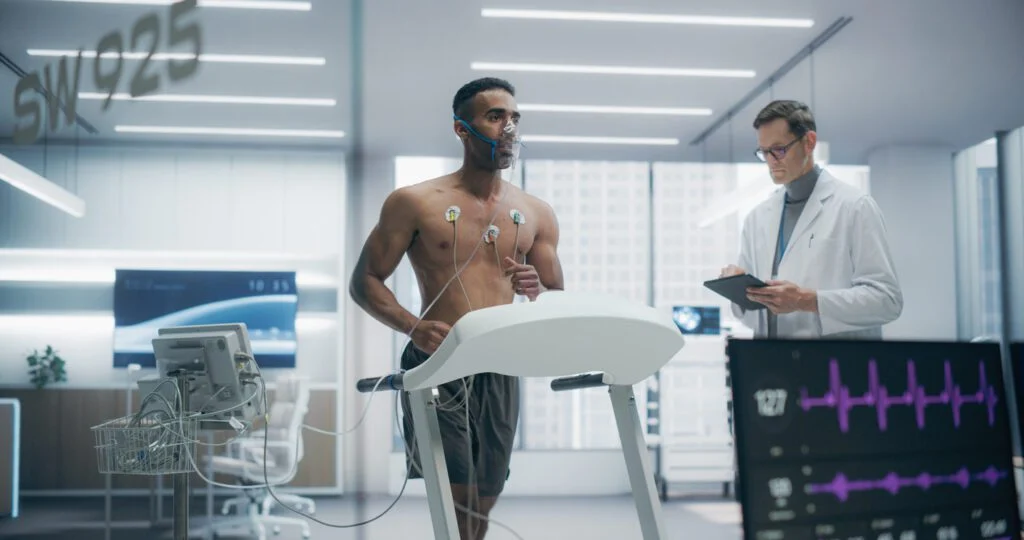
VO2 Max Testing is perhaps the most actionable of the high-tech metrics. It measures the maximum amount of oxygen your body can utilize during intense exercise. A high VO2 max is strongly linked to longevity; every unit increase is associated with a meaningful extension of lifespan. While lab-based metabolic testing is best, you can estimate your VO2 max using the Cooper 12-minute run test or the 1-mile walk test with a heart rate monitor.
The Strategy: Turning Data into Action
The danger in bio age testing lies in the "data-only" trap. Collecting metrics without a corresponding behavioral plan is equivalent to checking your reflection for spinach and failing to remove it.
Avoiding Common Pitfalls
- The "Evergreen" Mistake: Many people chase the latest supplement or peptide while neglecting the fundamentals. No anti-aging intervention—no matter how expensive—can outperform the "big rocks" of longevity: consistent resistance training, high-quality sleep, a diet rich in whole foods, and stress management.
- Lack of Actionability: Data is merely a baseline. If your tests show that your VO2 max is declining or your body fat is increasing, the goal is not to buy a new supplement; it is to adjust your training volume or nutritional habits and then re-test in three months to see if the needle has moved.
Conclusion: A Proactive Approach
The "Don’t Die" movement, while sensational, has successfully shifted the conversation toward proactive health management. However, the true secret to longevity is not found in plasma infusions or proprietary algorithms. It is found in the disciplined, often "boring" application of evidence-based lifestyle changes.
If you are a health professional, the takeaway is clear: your clients do not need more data; they need more support in managing the behavioral changes required to improve that data. By using these assessments as a map rather than a destination, you can guide them toward a longer, more vibrant life—not because they stopped aging, but because they optimized the time they were given.