










In high-stakes industries—where a split-second lapse in judgment can mean the difference between operational success and catastrophic failure—the human element remains the most significant variable. For decades, the primary line of defense against fatigue-related errors has been a combination of subjective self-reporting and manager intuition. However, as the Occupational Safety and Health Administration (OSHA) and historical incident data have repeatedly shown, this "honor system" is dangerously inadequate.
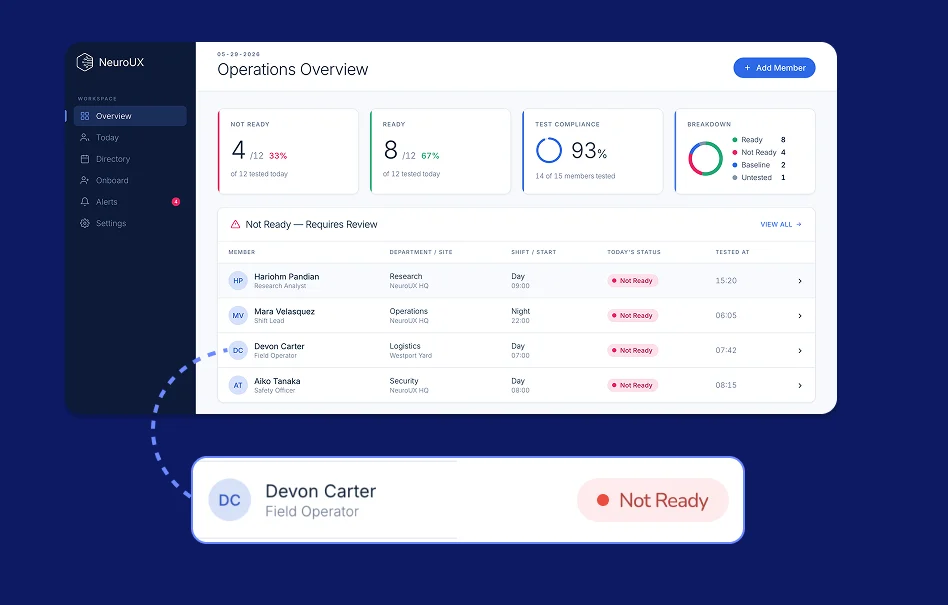
To bridge this critical safety gap, NeuroUX has officially launched its Fatigue Monitoring Platform. By leveraging mobile technology to perform rapid, objective, and personalized alertness assessments, the platform aims to replace guesswork with empirical data, ensuring that workers are truly "fit-for-duty" before they step onto a construction site, enter a cockpit, or begin a surgical shift.
The Silent Killer: Why Subjective Reporting Fails
The history of industrial and operational disasters is littered with the consequences of human fatigue. According to federal data and safety reports, diminished alertness is a primary contributor to some of the most harrowing tragedies of the modern era. From the 2005 BP oil refinery explosion in Texas City and the 2009 Colgan Air crash to the historic nuclear meltdowns at Chernobyl and Three Mile Island, the common thread is often a worker—or a team of workers—whose cognitive capacity had been eroded by sleep loss, shift work, or circadian misalignment.
Despite these clear warnings, many organizations continue to rely on antiquated protocols. A supervisor might ask a driver or a heavy equipment operator, "Are you feeling okay to work?" The worker, often pressured by deadlines, professional pride, or the fear of lost wages, will almost invariably respond with a "yes." This reliance on self-assessment is biologically flawed; research consistently demonstrates that humans are notoriously poor judges of their own cognitive impairment. When a person is sleep-deprived, the brain’s ability to recognize its own diminished capacity is often the first function to fail.
The Science of Precision: The Psychomotor Vigilance Test
At the heart of the NeuroUX platform is the Psychomotor Vigilance Test (PVT). For decades, the PVT has been recognized by sleep researchers as the "gold standard" for measuring the impact of sleep loss on alertness and reaction time.
Unlike subjective surveys, which capture feelings, the PVT measures objective performance. It is a sustained-attention, reaction-timed task that requires a subject to monitor a signal and respond as quickly as possible. The test is highly sensitive to the neurological effects of circadian disruption and sleep deprivation, yet it remains remarkably resistant to the "learning effect"—meaning that even with repeated use, a user cannot "cheat" the test by becoming better at it over time.
By integrating this clinical-grade tool into a mobile interface, NeuroUX has democratized access to a technology that was previously confined to specialized sleep laboratories, bringing it directly into the palms of the frontline workforce.
How It Works: Personalization Over Generic Thresholds
A common pitfall in safety software is the use of "one-size-fits-all" thresholds. NeuroUX differentiates its platform by benchmarking performance against the individual’s personal baseline.
"Our goal is to minimize fatigue-related incidents by giving companies a data-driven way to assess whether workers are alert, ready, and able to perform safety-sensitive tasks," explains Anunay Raj, co-founder of NeuroUX. "Fatigue affects even the most experienced workers. When companies can measure it, they can manage it."
The Workflow:
- The Brief Check: Before starting a shift or high-risk task, the employee completes a short, mobile-based assessment.
- Dynamic Benchmarking: The software does not just look for a global "pass/fail." It compares the current response time against the individual’s historical data, identifying anomalies that suggest a significant departure from their personal "well-rested" state.
- Actionable Intelligence: Results are relayed instantly to supervisors through their preferred communication channels, allowing for real-time adjustments to shift scheduling or job assignments.
This personalized approach accounts for the reality that some individuals are naturally faster or slower in their cognitive processing. By focusing on the change from the individual’s norm, NeuroUX minimizes false positives and ensures that intervention is only triggered when a true impairment is detected.
Implications for High-Risk Industries
The rollout of this platform has immediate applications across several sectors where fatigue management is not just a policy, but a survival necessity.
Aviation and Transportation
In the aviation industry, the "sterile cockpit" rule is meant to prevent distractions, yet fatigue remains a top concern for long-haul crews. By using objective checks, airlines can ensure that flight crews are alert during the most critical phases of flight, such as takeoff and landing. Similar benefits apply to long-haul trucking and rail, where fatigue-related lane drifting or signal oversight can have lethal consequences.
Healthcare and Emergency Services
The "culture of exhaustion" in medicine, particularly among residents and surgeons, has been a topic of debate for decades. A surgeon who has been awake for 24 hours is objectively as impaired as someone under the influence of alcohol. NeuroUX provides hospitals with a transparent, defensible way to assess whether medical staff are fit to perform complex, life-saving procedures, ultimately protecting both the patient and the physician.
Mining, Energy, and Construction
In industrial environments, heavy machinery is constant. The environment is often loud, physically demanding, and subject to extreme weather, all of which accelerate the onset of fatigue. By implementing daily, brief alertness checks, site managers can identify "fatigue hotspots" within their workforce and proactively rotate personnel, thereby reducing the risk of machinery accidents.
Supporting Data and Evidence-Based Pedigree
The technology underpinning the NeuroUX platform is not experimental; it is the result of years of rigorous validation. The underlying measurement technology has already been subjected to extensive peer review and utilized in high-level research settings, including:
- Flight Crew Studies: Measuring cognitive degradation during international, multi-time-zone flights.
- Clinical Applications: Assisting in the diagnostic process for patients suffering from chronic sleep disorders.
- Athletic Performance: Monitoring the cognitive fatigue of professional athletes to prevent overtraining and injury.
This pedigree provides the necessary assurance for industrial safety officers who are often skeptical of new "wellness" software. Because the platform is grounded in established sleep science, it is far more likely to be adopted into standard operating procedures than a generic, proprietary metric.
Addressing the "Culture" of Safety
One of the most significant barriers to fatigue management is the stigma associated with admitting exhaustion. In many "tough" industries, complaining about being tired is viewed as a sign of weakness.
By shifting the process from a human conversation to a data-driven mobile check, NeuroUX removes the personal element. The worker is not "telling" the boss they are tired; the data is indicating that their alertness is below their personal threshold. This depersonalization is crucial. It protects the worker from potential retribution and protects the supervisor from the burden of having to make a subjective—and potentially biased—call.
Future Outlook: A New Standard for Duty of Care
As regulatory bodies worldwide begin to place more emphasis on "Duty of Care" obligations, companies will be under increasing pressure to prove they are actively managing human-factor risks. The adoption of tools like the NeuroUX platform represents a pivot toward a more responsible, data-centric era of occupational health.
The ability to objectively measure, document, and act on fatigue data creates an audit trail that is invaluable in the event of an investigation. It shifts the liability profile of an organization from one of "willful blindness" to one of "active risk management."
Conclusion
Fatigue is an invisible, silent, and pervasive hazard. It cannot be seen with the naked eye, it does not leave a physical trace until it is too late, and it is a fundamental part of the human biological experience. By providing a scalable, scientific, and user-friendly solution to this age-old problem, NeuroUX is setting a new standard.
The era of relying on "how you feel" to decide if you are safe to operate heavy machinery is drawing to a close. In its place, a data-driven, personalized approach to human performance is emerging—one that respects the science of sleep and, more importantly, respects the lives of the workers who keep the world’s essential industries moving. Whether in the depths of a mine or the cockpit of an aircraft, the future of safety is no longer a matter of opinion; it is a matter of measurement.