








In an era defined by the pursuit of radical life extension, the quest for longevity has morphed into a high-stakes, high-cost performance art. From viral social media clips of biohackers consuming dozens of supplements to the complex, data-heavy protocols championed by celebrity health influencers, the message is clear: if you aren’t optimizing, you are falling behind.

But for many, this relentless pursuit of “the perfect health plan” is creating a new set of problems: exhaustion, financial strain, and a paralyzing sense of inadequacy. At Precision Nutrition, after decades of coaching hundreds of thousands of real people, we’ve found that the obsession with “optimal” is not just unrealistic—it’s often unnecessary.

The Myth of the "Perfect" Protocol
The modern longevity movement has been propelled by a constellation of prominent figures—scientists, podcasters, and biohackers—who advocate for extreme protocols. While their intentions are often rooted in the desire for a longer, more vibrant life, the resulting culture has fostered a dangerous misconception: the belief that the "basics" are insufficient.

The reality is starkly different. When we strip away the complex, expensive, and often unproven "cutting-edge" strategies, we find that the foundational pillars of health—regular movement, nutrient-dense eating, restorative sleep, stress management, and genuine social connection—remain the most potent tools we have for longevity.

The problem isn’t that the basics don’t work; it’s that very few people perform them with 80 to 90 percent consistency. True "optimization" isn’t found in a vitamin C infusion or a specific type of ice bath; it is found in the disciplined, unglamorous repetition of the fundamentals.

A Chronology of Health Optimization
The transition from public health to "personal optimization" has been a rapid one:

- The 20th Century (The Era of Public Health): Focus was placed on broad, population-level interventions—vaccinations, sanitation, and the reduction of smoking rates.
- The Early 2000s (The Rise of Fitness): The culture shifted toward gym culture, calorie counting, and the birth of wearable fitness trackers.
- The 2010s to Present (The Biohacking Boom): We entered the age of "measurable self." With the advent of continuous glucose monitors (CGMs), advanced blood panels, and the popularization of longevity podcasts, individuals began managing their biology like engineers.
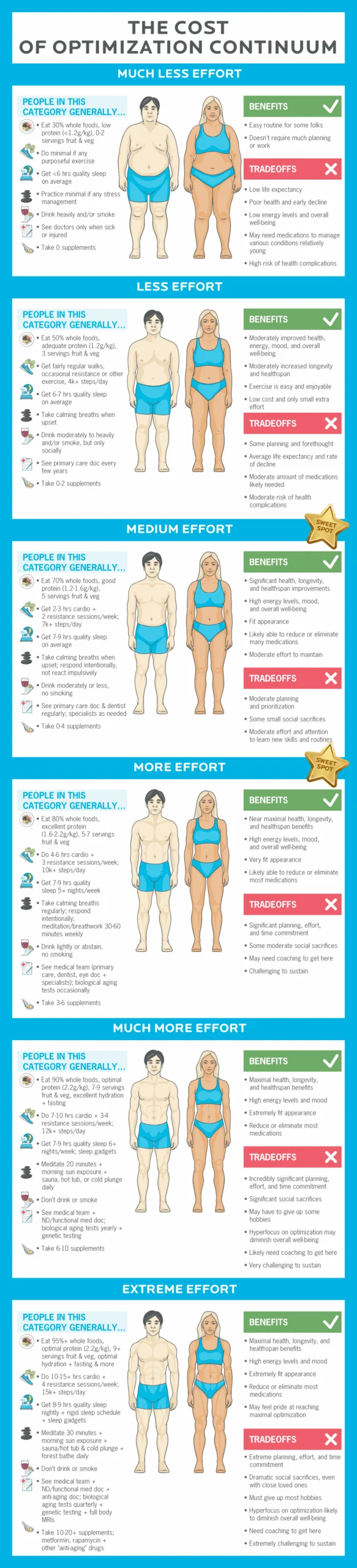
While this data-driven approach has benefits, it has also created a culture of "all or nothing," where those who cannot commit to an hours-long daily health protocol feel they have already failed. Our internal data suggests otherwise: even clients who maintain basic healthy habits at 10 to 49 percent consistency see significant, measurable improvements in weight, waist circumference, and overall body composition.

Supporting Data: Where Effort Meets ROI
A critical look at the science of longevity reveals a "U-shaped curve" for almost every major health behavior. Whether it is exercise, caloric intake, or even social interaction, the greatest gains occur at the move from "sedentary/poor" to "moderate/active." Once a baseline is established, the return on investment (ROI) for additional effort begins to diminish rapidly.

The Exercise Equation
Research on Harvard alumni and broader studies of older adults demonstrate that any physical activity reduces all-cause mortality. The most dramatic drop in mortality risk occurs when an individual accumulates 7.5 to 15 MET-hours (Metabolic Equivalent Hours) per week.

While increasing intensity further reduces risk, the slope of that benefit flattens out. Conversely, the "Extreme Exercise Hypothesis" suggests that at the highest ends of athletic output, there is a risk of heart-related issues, such as atrial fibrillation or coronary artery calcification. Essentially, "underdosing" is a risk, but "overdosing" is a reality for the elite athlete.

The Nutrition Continuum
Data spanning 10 million participants has confirmed that ultra-processed foods (UPFs) are linked to 32 distinct health harms. However, the solution is not to live in fear of food. Consuming 70 to 80 percent of your diet from whole or minimally processed sources provides the vast majority of health benefits. Beyond 90 percent, the marginal health improvements are negligible compared to the potential loss of social enjoyment and dietary flexibility.

Official Perspectives on Longevity
Health authorities, such as the World Health Organization (WHO) and the CDC, maintain that the most effective interventions for long-term health remain standard, non-commercialized habits.

- Smoking: Remains the primary modifiable risk factor for premature death globally.
- Alcohol: While historical studies once suggested "moderate" consumption might be heart-healthy, recent data has shifted. The WHO now emphasizes that no amount of alcohol is strictly "safe" for cancer prevention, though most medical bodies suggest that if one does drink, keeping it under the "moderate" threshold (one drink per day for women, two for men) is the standard for risk mitigation.
- Preventative Care: Routine checkups, screenings, and standard medical maintenance remain vastly more effective at extending lifespan than the most expensive "longevity clinics" currently operating.
Implications: The High Cost of "Optimization"
If you choose to pursue an "optimizer" lifestyle—incorporating exotic supplements, daily sauna/cold plunge cycles, extensive blood testing, and highly restrictive diets—you must be prepared for the hidden costs.

- Financial Burden: A full "optimized" protocol can easily exceed $10,000 to $20,000 annually.
- Time Commitment: Our analysis suggests that an optimized lifestyle requires 3 to 4 times the weekly time investment of a standard "healthy" lifestyle.
- The "Quality of Life" Tax: The most insidious cost is the potential erosion of Deep Health. When your life is dictated by a strict, hour-by-hour protocol, your relational, existential, and mental health can suffer. If the pursuit of a longer life leaves you with no time to actually live that life, have you truly achieved your goal?
Redefining Your Path
To achieve the longevity you desire, you must first clarify your goals. Are you looking to live to 100 with high mobility, or are you looking to optimize every biomarker on a spreadsheet? The former is achievable through the basics; the latter is a full-time job.

Your Action Plan:

- Start with the Basics: Before buying into expensive supplements or fringe therapies, master the 80/20 of health: sleep 7–9 hours, eat whole foods, move daily, and cultivate 3–5 strong social connections.
- Check Your Consistency: If you aren’t doing the basics consistently, do not worry about the cutting-edge.
- Tune Out the Noise: Remember that influencers are not your doctors. They are content creators.
- Value Your Joy: Longevity is not just about the number of years; it is about the richness of your experiences.
Ultimately, the most sustainable health plan is the one you can actually stick to for decades. Great health is not a destination found at the end of an expensive, complex protocol—it is the result of the quiet, consistent choices you make every single day.