











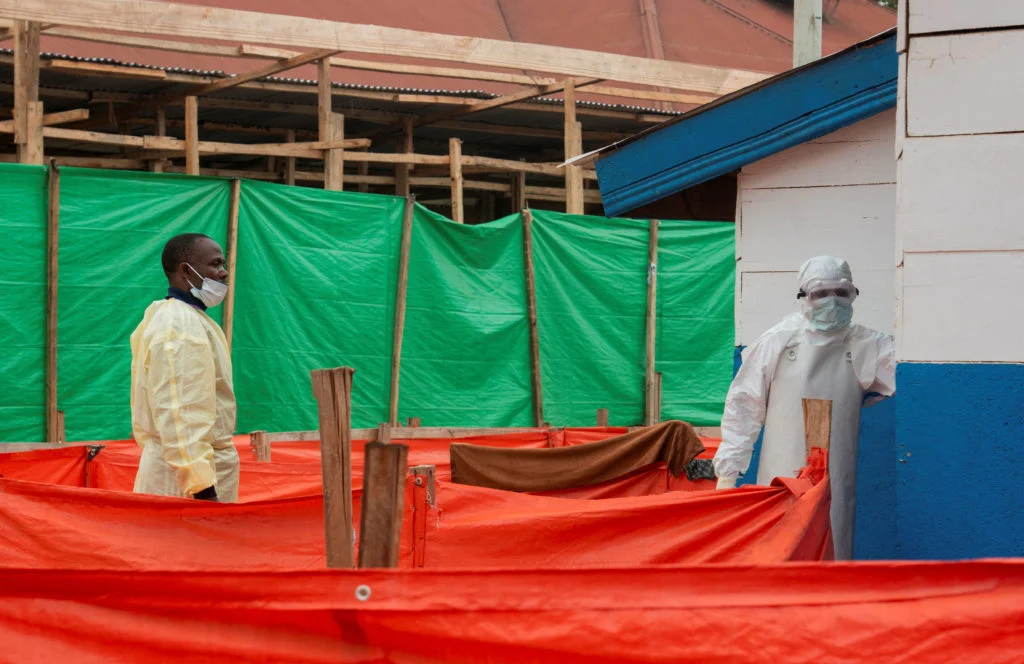
KINSHASA, Congo — The Democratic Republic of Congo (DRC) is currently grappling with what health officials describe as the most formidable Ebola outbreak in the nation’s history. With the virus now confirmed in seven provinces and showing an unrelenting trajectory, the epidemic has transcended regional containment, threatening to spill over into neighboring nations and spark a wider humanitarian catastrophe.
The outbreak, fueled by the rare and virulent Bundibugyo strain of the Ebola virus, has claimed 3,349 lives out of 6,942 reported cases as of this week. As the World Health Organization (WHO) warns that the crisis is on track to surpass the 2014-2016 West Africa epidemic—the deadliest in recorded history—the Congolese government and international partners are struggling to balance medical intervention against a backdrop of deep-seated regional insecurity and logistical hurdles.
The Escalating Geographical Reach
The most alarming development in recent days is the confirmed arrival of the virus in Sud-Ubangi, a province in the northwestern reaches of the country. This discovery marks the first time the outbreak has breached the western part of the DRC, signaling a shift from a contained regional health crisis in the east to a nationwide threat.
Jean-Rene Galekwa Vundawe, the governor of Sud-Ubangi, confirmed that the national research institute identified the Bundibugyo virus in a sample taken from the Bulu health district. This development is particularly unsettling because Sud-Ubangi does not share a border with the six eastern provinces previously identified as hot zones: Ituri, North Kivu, South Kivu, Haut-Uele, Tshopo, and Bas-Uele.
The geographical jump highlights the extreme mobility of the virus, largely driven by human movement across a country roughly the size of Western Europe. Experts fear that the presence of the virus in Sud-Ubangi, which shares borders with Congo-Brazzaville and the Central African Republic, significantly elevates the risk of international transmission.
A Chronology of a Deadly Journey
The story of the latest victim in Sud-Ubangi serves as a stark illustration of how easily the virus can travel. Jean-Jacques Mbungani, a local lawmaker and former health minister, provided a chilling timeline of a 23-year-old man who succumbed to the disease earlier this week in the town of Gwaka.
The patient’s journey began in South Kivu, a province with confirmed cases. Over the course of three weeks, the man traversed a vast portion of the continent, visiting both Rwanda and Uganda. He then traveled to Ituri—the epicenter of the current outbreak—before embarking on a long trek from the country’s northeast to the northwest, passing through Tshopo, Mongala, and finally arriving in Sud-Ubangi.
Upon his arrival, the man exhibited classic, harrowing symptoms: high fever and the internal hemorrhaging that characterizes the final stages of Ebola. Despite medical attention, he passed away on Tuesday. Subsequent testing confirmed his diagnosis, turning a local tragedy into a national alarm.
This mobility pattern mirrors the broader trend of the outbreak, where instability and the displacement of populations have turned bustling transit hubs into potential vectors for the virus.
Supporting Data and Statistical Gravity
The sheer scale of the current outbreak is reflected in the grim statistics released by the Congolese government. With nearly 7,000 cases and a death toll exceeding 3,300, the case-fatality rate remains high, complicating efforts to build public trust in medical facilities.
While the virus has shown signs of slowing in the Ituri epicenter, these gains are being offset by a rapid, dangerous surge in North Kivu and Haut-Uele. The pattern suggests a "whack-a-mole" dynamic, where the virus migrates to new, vulnerable communities faster than health teams can establish surveillance and vaccination protocols.
The WHO’s comparison to the 2014-2016 West Africa crisis is not merely academic; it is a warning. That crisis killed over 11,000 people, devastating the economies and healthcare infrastructures of Guinea, Liberia, and Sierra Leone. The DRC’s current situation is arguably more complex, as the government must manage the outbreak while simultaneously contending with internal armed conflict, economic instability, and a precarious healthcare workforce.
The Battle Against the Virus: Vaccination and Logistics
The logistical challenges of this outbreak cannot be overstated. Health efforts are being hampered by:
- Insecurity: Ongoing conflict in the east prevents aid workers from accessing remote villages.
- Health Worker Strikes: Protests over pay and conditions have left hospitals understaffed at critical junctures.
- Displacement: Overcrowded camps for displaced persons provide the perfect breeding ground for rapid transmission.
In response, the government has launched a complex vaccination campaign. While the Ervebo vaccine, which was highly effective against the Zaire strain in previous outbreaks, is being deployed for front-line workers, its efficacy against the Bundibugyo strain is still being studied.
Placide Mbala Kingebeni, director for research and innovation at Africa CDC, noted that clinical trials for a licensed vaccine specific to the Bundibugyo virus are currently underway. Vaccinations have already begun in Tshopo, Haut-Uele, and Bas-Uele, with expansion into Ituri planned for the coming week. However, the scientific race is neck-and-neck with the virus’s spread.
Official Responses and Regional Implications
The international community remains on high alert. Last month, the WHO explicitly warned of the potential for the virus to migrate into the Central African Republic and South Sudan. The declaration by Uganda—which had reported 20 cases since May—that it was "Ebola-free" as of July provided a brief moment of optimism, but the death of the 23-year-old traveler in Sud-Ubangi has renewed anxieties about cross-border surveillance.
Local officials, including Mbungani, are calling for urgent, coordinated action. "It worries me," Mbungani stated during a recent interview. "We fear it may spread regionally. Our borders are porous, and the movement of people is constant."
The government in Kinshasa is under immense pressure to tighten screening protocols at transit points, but the sheer size of the country and the lack of infrastructure make universal screening an impossibility. The focus remains on contact tracing, isolating the sick, and expanding the vaccination net, yet the resources required are far outpacing current funding and support.
Looking Ahead: A Crisis at a Crossroads
The Ebola outbreak in the Congo is not merely a medical event; it is a test of regional resilience and global health governance. The shift to the west is a critical juncture. If the virus establishes a firm foothold in the more populated, interconnected regions of the west, the containment strategies that have worked (to varying degrees) in the east may prove inadequate.
As clinical trials progress and humanitarian teams fight to reach the most vulnerable, the world watches with bated breath. The lessons learned from previous outbreaks—specifically the importance of community engagement and early, transparent reporting—are being applied in the Congo. However, in a nation where distrust of authority often mirrors the fear of the virus itself, the path forward is fraught with peril.
The international community must now decide whether to escalate its support or risk allowing the Bundibugyo strain to transform from a local scourge into a continental nightmare. For the people of the DRC, the situation is not about statistics or diplomatic warnings; it is about the daily, desperate struggle to prevent a neighbor, a family member, or a child from becoming the next entry in a ledger of loss.
The battle against this invisible enemy continues, and the coming weeks will likely determine whether the outbreak can be brought to heel or if the DRC is destined to endure its most lethal chapter in modern history.