









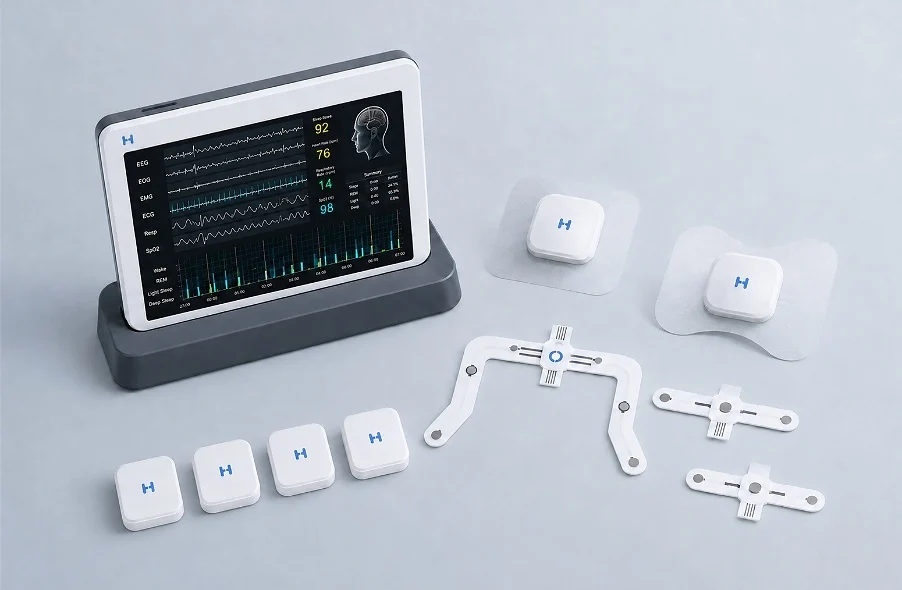
In a significant leap forward for sleep medicine, HoneyNaps has officially unveiled its new Wireless Polysomnography (PSG) system. This cutting-edge platform represents a fundamental shift in how sleep disorders are diagnosed, successfully condensing the traditionally cumbersome, wire-heavy PSG setup—which often requires over 24 leads—into a streamlined, four-patch wearable system. By marrying advanced flexible hardware with high-fidelity artificial intelligence (AI), the system promises to transform the patient experience while providing clinicians with high-precision diagnostic data.
The Evolution of Sleep Diagnostics: From Wires to Wearables
For decades, the "gold standard" for diagnosing complex sleep disorders, such as obstructive sleep apnea (OSA), narcolepsy, and periodic limb movement disorder (PLMD), has been in-laboratory polysomnography. While effective, the traditional method is notoriously intrusive. Patients are typically tethered to a hospital bed via an array of electrodes attached to the scalp, face, chest, and limbs. This "spaghetti" of wires often results in "first-night effect" anxiety, where the discomfort of the equipment itself prevents the patient from achieving natural sleep, potentially skewing the diagnostic results.
HoneyNaps’ new Wireless PSG system addresses these limitations head-on. By consolidating the sensing architecture into four specialized skin patches—positioned on the head, chest, body, and leg—the company has effectively removed the physical barriers to natural sleep monitoring. These patches work in concert to capture a comprehensive suite of physiological signals, including:
- Neurological activity: Electroencephalography (EEG) and electrooculography (EOG).
- Cardiac health: Electrocardiography (ECG).
- Muscular and physical movement: Electromyography (EMG), body position, and physical activity.
- Respiratory metrics: Airflow and blood oxygen saturation (SpO2).
Engineering Sophistication: Under the Hood
The technical achievement behind the HoneyNaps system lies in its miniaturized, multi-layered architecture. Each patch is built upon a six-layer flexible printed circuit board (FPCB) design. This allows the hardware to conform to the curvature of the human body without compromising signal integrity.
Beyond the physical form factor, the engineering team has integrated high-precision analog-to-digital converters and sensor architectures directly onto the patches. To ensure the reliability of the data transmitted wirelessly, the system incorporates advanced noise-reduction technology and electrostatic discharge (ESD) protection. These features are critical, as sleep data is notoriously prone to "artifacting"—interference caused by movement, sweat, or electrical noise. By processing this data locally at the "edge," the system ensures that the information transmitted to the diagnostic software is clean, accurate, and ready for clinical interpretation.
Chronology of Innovation: Building Toward a Wireless Future
The release of this wireless system is not an isolated development but the culmination of a multi-year research and development roadmap. HoneyNaps has long been focused on the intersection of hardware sensing and software analysis.
- Foundational Research: Initial development focused on the creation of high-sensitivity, contactless sleep-sensing pads. These early prototypes demonstrated that sleep quality could be monitored without the need for traditional adhesives, setting the stage for more advanced wearable form factors.
- AI Integration (SOMNUM): Parallel to the hardware development, HoneyNaps invested heavily in their proprietary AI software, SOMNUM. The company achieved a major milestone when SOMNUM v3.0 received FDA clearance, specifically for its ability to classify sleep apnea with clinical accuracy.
- The Convergence: The current Wireless PSG platform represents the convergence of these two pillars. By taking the proven diagnostic power of SOMNUM and pairing it with the new four-patch wearable interface, HoneyNaps has moved from "monitoring" to "comprehensive diagnostic assessment."
- Future Scaling: With the hardware and software now integrated into a single, cohesive ecosystem, the company is shifting its focus toward mass implementation, aiming to bridge the gap between hospital-based sleep centers and the burgeoning market for remote home sleep testing.
The Power of SOMNUM: AI-Driven Clinical Insights
The true brain of the HoneyNaps platform is the SOMNUM AI engine. In traditional sleep studies, a registered polysomnographic technologist (RPSGT) must manually score the sleep data—a time-consuming process that can take hours or even days.
The SOMNUM platform automates this entire workflow. It processes the physiological signals collected by the four patches to automatically identify sleep stages (N1, N2, N3, and REM), detect sleep apnea events, monitor arousals, and quantify periodic limb movements.
The integration of edge-computing technology is particularly noteworthy. By processing large volumes of physiological data in real time, the system minimizes latency and allows for seamless integration with the centralized management systems utilized by hospitals and clinics. This means that a doctor could potentially review a patient’s sleep profile almost immediately after the study concludes, significantly reducing the "time-to-diagnosis" window.
Official Perspective: The Vision for Global Diagnostics
"By bringing patch-based wireless skin sensors and AI-powered analysis together in a single platform, our Wireless PSG system improves both patient convenience and diagnostic efficiency for medical professionals," says Sean Ha, president of HoneyNaps USA.
Ha emphasizes that the system is designed with a dual-purpose strategy: to serve the immediate, high-acuity needs of hospital sleep laboratories while simultaneously laying the groundwork for the future of digital healthcare. "We are laying the foundation for HoneyNaps to expand its presence in the global sleep diagnostics market," Ha notes.
The strategy is clear: as healthcare systems globally face a growing shortage of sleep specialists and an increasing prevalence of sleep disorders, the move toward automated, simplified diagnostic tools is essential. HoneyNaps aims to position its technology as the standard for both clinical settings and the growing remote patient monitoring (RPM) sector.
Clinical and Economic Implications
The implications of this technology are far-reaching. From a clinical perspective, the reduction of wires means that patients are more likely to complete their studies without the need for re-tests due to equipment failure or patient discomfort. This increases the "success rate" of sleep studies and improves the quality of data collected, leading to more accurate treatment plans.
From an economic perspective, the efficiency gains are substantial. For healthcare institutions, the primary cost driver in sleep medicine is the labor-intensive nature of scoring studies. By automating the analysis, hospitals can process a higher volume of patients without needing to increase their staff headcount. Furthermore, the shift toward home-based testing reduces the reliance on expensive, dedicated laboratory space.
However, the transition also brings challenges. The medical community will need to establish standardized protocols for verifying the accuracy of wireless sensors compared to the traditional, gold-standard wired equipment. Regulatory bodies will continue to play a vital role in ensuring that these AI-driven systems maintain their accuracy across diverse patient populations, including those with comorbidities like heart disease or chronic obstructive pulmonary disease (COPD).
Looking Ahead: The Future of Remote Monitoring
As HoneyNaps continues to refine its technology, the scope of the Wireless PSG system is expected to expand. The company’s vision includes a future where sleep data is not just a snapshot taken during a single night in a lab, but a continuous stream of information that can be used to track the long-term efficacy of CPAP therapy, medication adherence, and lifestyle interventions.
By effectively "unplugging" the sleep study, HoneyNaps is helping to move sleep medicine out of the specialized laboratory and into the patient’s home. This democratization of diagnostics is the next logical step in the evolution of healthcare, where the patient is empowered with information, and the physician is provided with the tools to act on that information with speed and precision.
As the industry watches to see how the market adopts this new wireless paradigm, one thing remains clear: the era of the wired, uncomfortable, and time-consuming sleep study is coming to a close, replaced by a future of intelligent, seamless, and patient-centric monitoring.