











The release of the 2025–2030 Dietary Guidelines for Americans (DGAs) was met with significant anticipation, arriving with the bold, consumer-facing tagline: "Eat Real Food." On the surface, the updated federal guidance appears to signal a long-awaited crackdown on the pervasive influence of ultra-processed goods and excessive sugar intake. However, beneath the polished, user-friendly interface lies a complex—and often contradictory—document that has sparked intense debate among nutrition scientists, public health advocates, and policymakers.
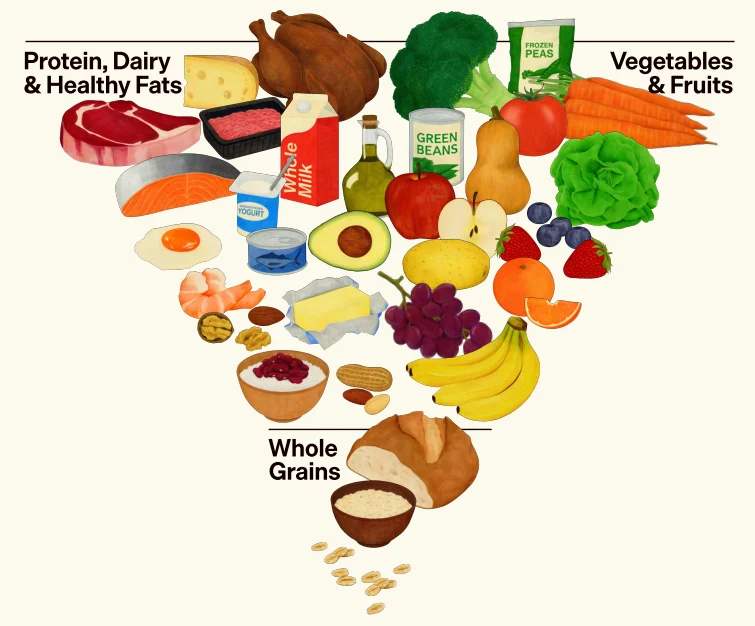
While the guidelines make commendable strides in curbing processed additives, they simultaneously introduce a "New Food Pyramid" that seems to invert conventional wisdom. By placing steak, full-fat dairy, and butter in positions of visual prominence, the document creates a dissonance between its written text and its imagery. As the nation grapples with record rates of diet-related chronic disease, the lack of clarity in these new federal standards may be more than just a stylistic choice—it could have profound implications for the cardiovascular health of millions.
The Evolution of Federal Nutrition: A Chronology of Conflict
To understand the current controversy, one must look at the path taken to arrive at these 2025 standards. Every five years, the U.S. Departments of Agriculture (USDA) and Health and Human Services (HHS) are tasked with updating the DGAs. Historically, this process begins with an independent Dietary Guidelines Advisory Committee (DGAC), a body of vetted scientists who synthesize the current state of nutrition research to provide an evidence-based report.
In this cycle, however, the process deviated from established norms. The Committee’s initial report was rejected by the administration, leading to a supplemental scientific analysis conducted by a group selected through a private federal contracting process. This pivot has raised serious questions regarding transparency. Deirdre Tobias, an assistant professor in the Department of Nutrition at Harvard T.H. Chan School of Public Health and a member of the original advisory committee, has been vocal about the implications. "There has not been transparency in who wrote the new DGAs," Tobias noted. "The reviews themselves… deviate significantly from the rigorous process that the HHS developed… to ensure the evidence base was replicable, unbiased, and free from non-scientific influences."
The result is a document that, while modernized in format, faces scrutiny over its ideological underpinnings, with some critics pointing to the disclosure of financial ties between the supplemental review panel and the beef and dairy industries.
The "Real Food" Paradox: Key Changes and Contradictions
The 2025–2030 DGAs represent the first federal attempt to explicitly categorize and call out "highly processed foods." While nutritional science acknowledges that food processing exists on a spectrum, the guidelines take a firm stance against sugar-sweetened beverages, ready-to-eat snacks, and refined carbohydrates like white bread. This is a welcome shift for many public health experts.
The Sugar Scourge
Perhaps the most stringent update involves added sugars. The new guidelines adopt a "no-amount" philosophy, asserting that added sugars and non-nutritive sweeteners have no place in a healthy diet. The shift is particularly noticeable for the pediatric population; the guidelines now suggest that children avoid added sugars entirely until age 10, a significant increase from the previous threshold of age 2.
Yet, as Frank Hu, chair of the Department of Nutrition at Harvard T.H. Chan, points out, there is a disconnect between these high-level ideals and the practical application for everyday Americans. "The DGAs are clear on avoiding added sugar, but far less clear on how these recommendations can be implemented in everyday life," says Hu. By focusing on a 10-gram-per-meal limit rather than a daily caloric percentage, the guidelines create a metric that most consumers are ill-equipped to track.
The Saturated Fat Conundrum
The most contentious element of the new guidelines is the visual representation of fats. The "New Food Pyramid" presents a starkly different hierarchy than its predecessors. While the written text maintains the longstanding consensus that saturated fat should be limited to 10% of total daily calories, the graphic design prioritizes animal-based saturated fats.
The math, according to current nutrition standards, does not add up. In a 2,000-calorie diet, the 10% limit equates to approximately 22 grams of saturated fat. If a consumer follows the DGAs’ recommendation for three daily servings of dairy—opting for full-fat milk, Greek yogurt, and cheese—they reach 17 grams of saturated fat before consuming any other food. When adding a tablespoon of butter or beef tallow for cooking, they immediately exceed the daily limit. This juxtaposition of "suggested" foods versus "recommended" limits creates a high risk of confusion for the public, potentially leading to increased LDL cholesterol and cardiovascular strain.
The Protein Quantity Debate
The new guidelines have also significantly raised the recommended protein intake, suggesting between 1.2 and 1.6 grams per kilogram of body weight—a 50% to 100% increase over previous minimums. While protein is essential for muscle maintenance and satiety, the guidelines fail to emphasize quality or source.
"Substantially raising overall protein intake without distinguishing between different protein sources may have unintended long-term health implications," Dr. Hu warns. The "protein package"—the fiber, fats, and micronutrients that accompany the protein—is often more important for long-term health than the protein itself. By failing to differentiate between the health benefits of plant-based proteins or fish versus the inflammatory risks associated with high intakes of red and processed meats, the guidelines miss a critical opportunity to steer the American public toward heart-healthy habits.
Socioeconomic and Environmental Omissions
A growing body of research confirms that the health of the population is inextricably linked to the health of the planet. Despite this, the 2025–2030 DGAs remain silent on the environmental impact of food production. Furthermore, the guidelines lack a robust framework for addressing the socioeconomic barriers that prevent many Americans from accessing "real food."
When dietary guidance is disconnected from the realities of food deserts, inflation, and cultural dietary patterns, it risks becoming an aspirational document rather than a functional public health tool. The failure to address sustainability means the guidelines ignore the very systems that sustain our food supply, a major point of criticism from environmental nutritionists.
Implications for Public Health
The 2025–2030 Dietary Guidelines for Americans are undoubtedly a more polished, digital-first product than any of their predecessors. They are shorter, more interactive, and feature an aesthetic that is designed for the modern consumer. However, history suggests that aesthetics are not enough. If Americans have historically struggled to follow less complex guidelines, the confusion generated by the new, contradictory messaging—specifically regarding saturated fats and protein sources—may lead to even lower adherence.
For the average citizen, the mixed messages present a significant challenge. When the government highlights butter and steak as central to a "healthy" pyramid while simultaneously warning against saturated fats, the consumer is left in a state of paralysis.
Recommendations for the Informed Consumer
Given the ambiguity of the new federal guidance, experts recommend looking toward more consistent, evidence-based models. Resources such as the Healthy Eating Plate, developed by nutrition scientists at Harvard, offer a more reliable framework that avoids the industry-influenced contradictions found in the current DGAs.
Ultimately, the 2025–2030 guidelines serve as a reminder that nutrition science is not just about what we eat, but how that information is synthesized and presented. As these guidelines are implemented in federal school lunches, hospital menus, and public health initiatives, the lack of clarity regarding saturated fats and protein quality could have long-term consequences. For now, the most prudent course for the public is to rely on personalized advice from registered dietitians and to look beyond the "New Food Pyramid" toward a more nuanced, evidence-based approach to wellness.