









By Gwendolyn Wu | Sept. 25, 2026
The pharmaceutical landscape is currently defined by a tale of two realities. On one side of the ledger, a titan of industry faces a sobering reckoning as market euphoria gives way to structural headwinds. On the other, a new wave of artificial intelligence-driven startups is capturing the imagination—and the checkbooks—of venture capitalists, signaling a fundamental shift in how the industry views the future of drug discovery.
This installment of the BioPharma Dive data visualization series explores the precipitous decline of Novo Nordisk’s market valuation against the backdrop of an unprecedented "megaround" fundraising environment for AI-focused biotechnology firms.
The Rise and Fall: Novo Nordisk’s GLP-1 Hangover
Two years ago, the narrative surrounding Novo Nordisk was one of unbridled optimism. Driven by the viral success and clinical efficacy of Ozempic and Wegovy, the company’s GLP-1 receptor agonists became global household names. The demand was so acute that the Danish pharmaceutical giant struggled to scale manufacturing fast enough to keep up, leading to a surge in its share price that saw it trading at over $140 by June 2024.
However, the current reality stands in stark contrast. As of late September 2026, Novo’s shares have experienced a dramatic correction, hovering near the $38 mark. This collapse is not the result of a single failure, but rather a convergence of competitive, legal, and clinical pressures.

The Erosion of Market Dominance
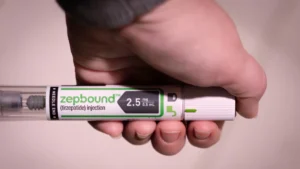
The primary catalyst for Novo’s decline has been the rapid maturation of the obesity drug market. The entry of Eli Lilly’s Zepbound has effectively ended the monopoly once held by Novo’s Wegovy. Furthermore, the rise of drug compounders—entities creating off-brand versions of these GLP-1 medications—has chipped away at Novo’s patient base, particularly in the United States.
Compounding these competitive issues are persistent concerns regarding pricing. As U.S. policymakers and insurers push for lower costs on high-expenditure chronic disease medications, Novo has faced significant margin compression. This pressure is exacerbated by a string of disappointing clinical trial results for its next-generation pipeline, which failed to meet the lofty expectations set by earlier, more successful assets. With key patents on its existing blockbuster portfolio approaching expiration, investors are increasingly questioning the company’s long-term competitive moat.
Chronology: From Peak Valuation to Market Correction
- June 2024: Novo Nordisk reaches its zenith, with shares trading above $140, fueled by global GLP-1 demand.
- Late 2024 – 2025: Rival branded medicines, led by Eli Lilly’s Zepbound, begin to gain significant market share. Patent expiration fears begin to circulate among institutional investors.
- Early 2026: Multiple high-profile clinical trials for Novo’s pipeline candidates yield disappointing results, cooling investor enthusiasm.
- September 2026 (Capital Markets Day): Novo executives outline an ambitious plan to launch five "multi-blockbusters" by 2030, projecting $23 billion in peak annual sales by 2035.
- Post-Presentation: Wall Street reacts with skepticism, triggering an 8% drop in share price as analysts voice concerns over the company’s near-term growth trajectory.
Supporting Data: The Venture Capital Shift to AI
While traditional pharma faces a "wait-and-see" period, the biotech venture capital market is witnessing a renaissance, primarily funneled into companies leveraging artificial intelligence to expedite drug discovery.
Since the beginning of 2024, the sector has seen a flurry of activity, with at least 12 firms securing venture rounds exceeding $100 million. This surge is not merely speculative; it represents a maturation of the technology. According to Megan Scheffel, head of life science and healthcare at Silicon Valley Bank, the market has "moved past wild promises" and into a phase where the tangible utility of protein modeling and AI-designed therapeutics is attracting staggering capital.
Megarounds in the AI Biotech Space
The scale of this funding is exemplified by:

- Isomorphic Labs: The undisputed leader in this space, having secured a massive $2.1 billion financing round.
- Chai Discovery: Another major player that has successfully captured substantial venture interest this year.
- Enveda: A Colorado-based firm that recently closed a $311 million Series E round, demonstrating that appetite for AI-driven platforms remains robust even as the broader market fluctuates.
- Basecamp Research: Secured $140 million to advance its platform, which utilizes AI to map biological data into novel therapeutic candidates.
Official Responses and Strategic Pivot
Novo Nordisk’s leadership remains resolute in the face of current market volatility. During their recent Capital Markets Day, executives emphasized a transition away from a sole reliance on current GLP-1 assets toward a diversified portfolio of "multi-blockbusters."
"We are playing the long game," a company spokesperson suggested during the Q&A session, noting that the firm’s investment in next-generation delivery systems and novel molecular targets is designed to outlast current patent cliffs.
However, the analyst community remains unconvinced. Jefferies analyst Michael Leuchten noted in a client advisory that Novo’s "doubling down on obesity" strategy may be a double-edged sword. "Until the near-term dynamics—specifically pricing stability and competitive differentiation—become clearer, investors are likely to remain on the sidelines," Leuchten wrote.
Implications: The Industry at a Crossroads
The diverging paths of Novo Nordisk and the AI-biotech cohort highlight a significant shift in the pharmaceutical industry’s risk-reward profile.
1. The Death of the "Easy" Blockbuster
Novo’s struggle serves as a warning for the industry: success in one therapeutic area, no matter how revolutionary, creates a target on the company’s back. The rapid erosion of market share due to competition and regulatory scrutiny over pricing is now the industry standard, not the exception.

2. The AI Premise as a New Foundation
The massive inflows of capital into AI drug discovery suggest that the industry views biological complexity as a data problem that can be solved with sufficient compute power. Unlike traditional R&D, which relies on decades of trial-and-error, AI-native firms are promising a "compressed" discovery timeline. If even a fraction of these AI-aided candidates successfully navigate clinical trials, the traditional pharmaceutical model—which relies heavily on high-cost, high-failure internal pipelines—may be forced to undergo a radical restructuring.
3. The Shift in Investor Psychology
Investors are clearly signaling a shift in preference toward "platform" companies over "product" companies. While Novo is a product-heavy entity currently suffering from the lifecycle of its flagship drugs, the AI startups are being valued as platforms. This valuation model suggests that even if one specific drug candidate fails, the underlying engine—the AI model—retains its value, mitigating the catastrophic downside often seen in traditional biotech equity.
Conclusion
As we look toward the remainder of 2026, the contrast is stark. Novo Nordisk must navigate a difficult transition, proving that it can reinvent itself while its core assets face a sunset period. Simultaneously, the AI drug discovery sector must prove that it can transition from "staggering amounts of money" to actual clinical breakthroughs.
For the pharmaceutical industry, the era of relying on established legacies is waning. The future belongs to those who can marry biological discovery with computational speed—a challenge that will likely continue to reshape market valuations for years to come.