









In the wake of the U.S. Supreme Court’s decision to overturn Roe v. Wade, the American electoral landscape has become a patchwork of diverging realities. While some states have moved to codify abortion access, others have enacted near-total bans, setting the stage for a dramatic series of confrontations this November. Among the most closely watched battlegrounds is Idaho, a deeply conservative stronghold where a citizen-led initiative, Proposition 1, is testing the limits of anti-abortion legislation in the American heartland.
The Human Cost of Legislative Rigidity
For many Idahoans, the debate over abortion is no longer abstract; it is a visceral experience of medical uncertainty and personal trauma. Take the case of Abby Nichols, an Idaho resident who, 13 weeks into a deeply desired pregnancy, received the devastating news that her fetus suffered from a severe genetic disorder incompatible with life.
"This is a nonviable pregnancy," her doctor had said, echoing the grim reality of the situation. "What do you want to do?"
In a pre-Dobbs era, the path forward would have been clear. However, under Idaho’s current statutes, medical professionals are constrained by strict prohibitions, fearing legal repercussions if they intervene. Nichols recalls the harrowing moment a doctor checked for a heartbeat—a standard procedure that felt like a finality. "There’s a piece of you that hopes that they can help you," Nichols shared. "But you also have heard of other women who haven’t received care, and you just start to realize that that’s you too."
Ultimately, Nichols and her husband were forced to travel to Seattle to access the care they required. The ordeal, which she describes as profoundly isolating, served as a catalyst, propelling her family into the front lines of the campaign to pass Proposition 1.
Chronology of a Shifting Legal Landscape
The current crisis in Idaho is the culmination of years of legislative maneuvering. Following the dissolution of federal protections for abortion, Idaho’s "trigger law" took effect, criminalizing nearly all abortion care. The law permits exceptions only in cases where an abortion is deemed necessary to prevent the death of the mother, or in instances of rape or incest, provided they are documented by law enforcement.
For critics, these exceptions are functionally useless. The bureaucratic hurdles required to prove rape or incest, combined with the legal jeopardy hanging over physicians, have created a "chilling effect" on the state’s healthcare infrastructure.
Over the past four years, the consequences of this legal environment have materialized in the form of a "brain drain" within the medical community. According to reports, Idaho has lost 94 obstetricians and gynecologists—nearly one-third of the state’s total—as practitioners migrate to states where they can practice medicine without the looming threat of felony charges. Furthermore, three hospitals have shuttered their maternity wards entirely, leaving rural areas of the state in a precarious position regarding maternal health.
Supporting Data: The Erosion of Healthcare Infrastructure
The exodus of medical professionals is not merely a political talking point; it is a measurable decline in public health stability. Melanie Folwell, a prominent advocate with Idahoans United for Women and Families, argues that the current law is inherently unsustainable.
"The tricky thing about Idaho’s ban is, it doesn’t really care about your personal beliefs, your partisanship, or whether you’ve ever considered an abortion," Folwell notes. "It comes for you all the same."
Prop 1, the initiative currently appearing on the ballot, seeks to shift this dynamic by enshrining the right to abortion up to the point of fetal viability—generally recognized as 24 weeks—and in cases where the pregnant individual’s health is at risk. Crucially, the measure also provides legal safe harbors for physicians, preventing the state from punishing doctors for providing standard, medically necessary care.
Official Responses and Political Polarization
The response from the Idaho State Legislature has been one of staunch defiance. State Senator Camille Blaylock, representing a Western suburb of Boise, maintains that the current law is the result of meticulous deliberation.
"Every word in our current law has been precisely thought about, debated, and put there on purpose," Blaylock argued. She warns that voters supporting the initiative are being misled by "one-liners" regarding maternal mortality, suggesting that the public lacks the full context of the legislation. Blaylock has explicitly stated that if the initiative passes, she and other legislators would seek to overturn it in the next session, citing her "moral soul" and a commitment to her constituents’ anti-abortion values.
Conversely, some Republican voices within the state are beginning to express buyer’s remorse. State Senator Jim Woodward, who previously supported the state’s ban, now admits that the legislation has created unforeseen crises. "It didn’t take long to understand the problem that we had created," Woodward remarked. "I don’t support elective abortions, but we need to get our policy back in line with the reality of pregnancy."
Woodward’s attempts to introduce legislation creating broader health exceptions have been repeatedly blocked by his colleagues, highlighting a growing schism within the state’s dominant party.
Grassroots Movements and the Humanization of the Debate
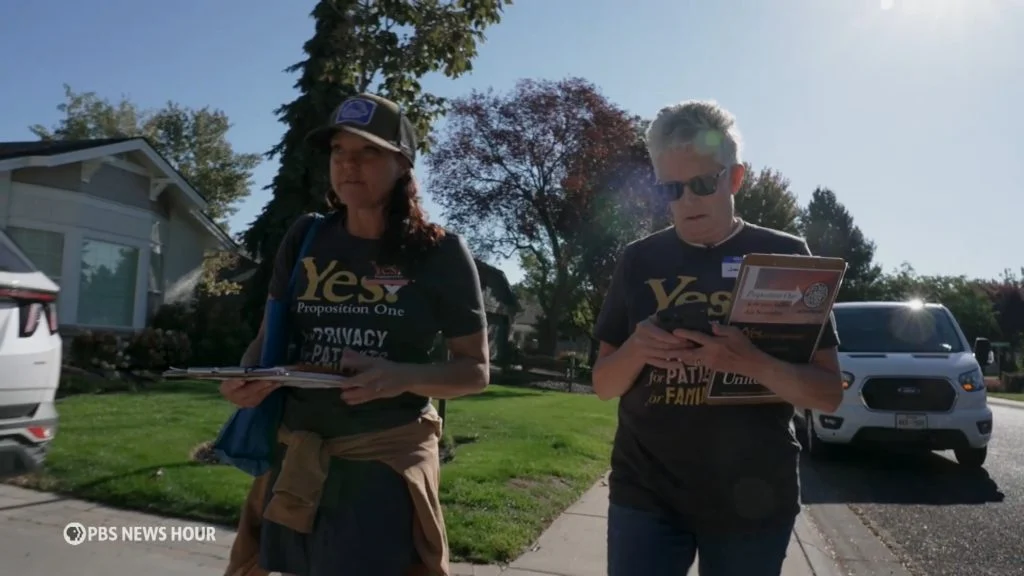
The effort to pass Prop 1 is as much about cultural shift as it is about policy. Suzanne Gallus, a mother of seven and a lifelong Catholic from Northern Idaho, represents the changing demographic of the movement. Previously aligned with the church’s anti-abortion stance, Gallus found her convictions challenged by the lived experiences of her neighbors.
"We just had no idea how important abortion care was," Gallus says. "When you take it out, it’s like the Jenga tower just falls."
Her advocacy involves knocking on doors and listening to stories of women affected by the current ban. For Gallus, the issue has transcended traditional partisan divides, focusing instead on the fundamental question of medical autonomy: "Should it be you and your husband, your doctor, and your God making these decisions, or should it be the government?"
The National Implications
As November approaches, the atmosphere in Idaho is one of intense anticipation. Both sides recognize that the outcome of this vote will send a shockwave through the national conversation on reproductive rights.
For proponents, a victory in one of the reddest states in the nation would serve as a powerful signal that the current legislative trend toward total bans is out of step with the public’s desire for healthcare stability. "Our success in Idaho would send a message that these kinds of bans are deeply unpopular," says Folwell.
However, conservative leaders remain confident that the state’s deep-seated anti-abortion sentiment will carry the day. They argue that the political stakes—and the desire to cast a pro-life vote—will drive turnout among their base, effectively neutralizing the momentum of the initiative.
Regardless of the final tally, the struggle in Idaho underscores a broader, fundamental tension in American democracy: the collision between deeply held moral ideologies and the practical, often life-altering realities of medical necessity. Whether the state moves to restore some access or remains firmly locked in its current prohibitionist stance, the legacy of this election will be a defining chapter in the post-Roe era.