











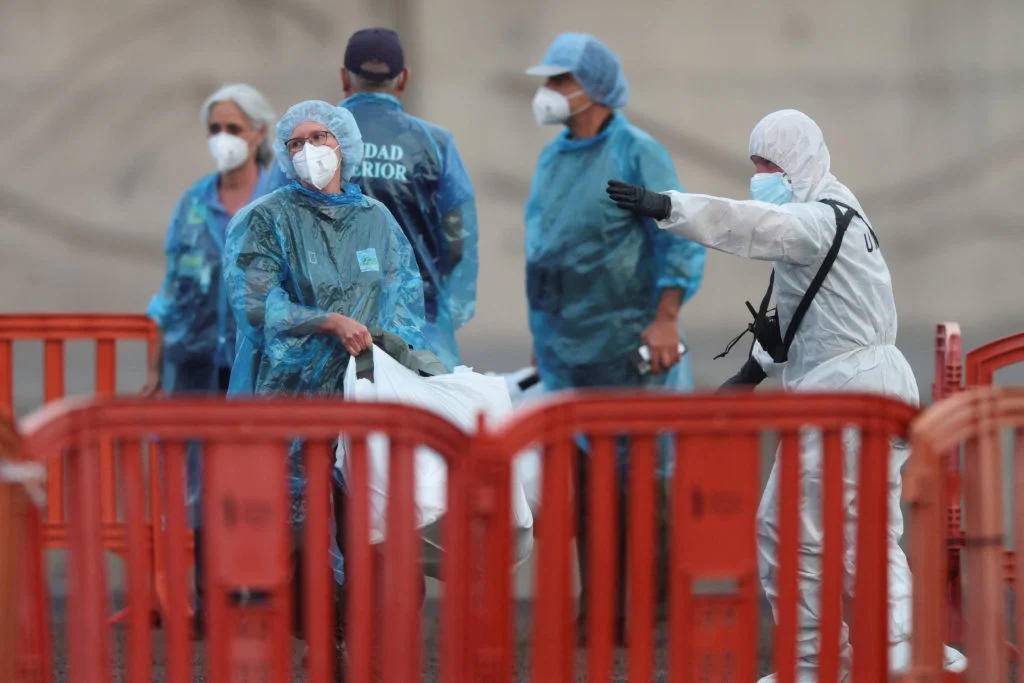
THE HAGUE, Netherlands — A complex, multi-national logistical operation is currently underway in the Canary Islands as authorities scramble to repatriate passengers from the MV Hondius, a cruise ship that has become the epicenter of an unprecedented and deadly outbreak of hantavirus.
As of Monday, the effort to evacuate travelers from more than 20 countries has reached its final stages. With the vessel anchored in Tenerife, personnel clad in full-body protective gear and respirators have been working around the clock to transport passengers from the ship to waiting military and government aircraft. The crisis, which represents the first documented instance of a hantavirus outbreak on a cruise ship, has prompted global health agencies to implement rigorous quarantine protocols to prevent further spread.
Chronology of a Maritime Crisis
The tragedy began in early April when the MV Hondius departed from the southern Argentine port of Ushuaia. For several days, the voyage proceeded without incident. However, the situation took a dark turn on April 11, when a Dutch passenger died on board. At the time, the cause of the death was not immediately linked to a viral pathogen.
It was not until early May that the World Health Organization (WHO) confirmed it was responding to a suspected hantavirus outbreak. By the time the alarm was raised, the ship had drifted far from its point of origin, finding itself off the coast of the West African island nation of Cape Verde. The delay in identification fueled concerns regarding the health of the remaining passengers and crew, who had been confined to the vessel for weeks.
As the ship maneuvered toward the Canary Islands, international pressure mounted to facilitate a safe, controlled disembarkation. On Sunday, the arrival of the ship in Tenerife marked the commencement of the massive repatriation effort. While the majority of passengers are being flown home for specialized monitoring, 32 crew members remain on board as the vessel prepares to return to the Netherlands.
The Viral Threat: Understanding Hantavirus
Hantavirus is typically transmitted to humans through contact with the droppings, urine, or saliva of infected rodents. Human-to-human transmission is generally considered extremely rare, making this particular outbreak a point of intense interest for global epidemiologists.
However, the strain identified in this outbreak—the Andes virus—is known to be one of the few hantaviruses capable of spreading between humans in rare, close-contact settings. This potential for transmission is the primary driver behind the aggressive quarantine measures being enforced by nations receiving the passengers.
Symptoms typically manifest between one and eight weeks after exposure and include fever, chills, and intense muscle aches. Because these symptoms mirror many common illnesses, health authorities are urging heightened vigilance among those recently evacuated.
Official Responses and Global Coordination
The international community has responded with a unified, albeit cautious, approach. WHO Director-General Tedros Adhanom Ghebreyesus held a press briefing on Sunday to address growing public anxiety.
"This is not another COVID," Dr. Tedros stated, emphasizing that the general public is not at risk. "The risk to the public is low. People should not be scared, and they should not panic."
Despite these reassurances, the logistical reality remains daunting. Maria Van Kerkhove, the WHO’s director of epidemic and pandemic preparedness, has recommended that every country involved in the repatriation effort maintain "active monitoring and follow-up." This includes mandatory daily health checks and, in many cases, isolation in specialized medical facilities.
The Situation in France and the United States
The gravity of the situation was underscored on Monday by reports of new cases. In France, Health Minister Stephanie Rist confirmed that a female passenger, who was part of a group of five evacuated on Sunday, tested positive for the virus. Her condition reportedly deteriorated overnight, and she is currently receiving intensive care in a Parisian hospital. According to Minister Rist, the woman began exhibiting symptoms while in transit.
In the United States, health officials are closely monitoring 17 evacuated passengers. Upon arrival at a Nebraska airport early Monday, the passengers were immediately transferred to the University of Nebraska Medical Center. This facility, which houses a federally funded quarantine unit and a biocontainment wing—previously utilized for Ebola and early COVID-19 patients—is uniquely equipped to handle such cases.
Kayla Thomas, a spokesperson for Nebraska Medicine, provided a status update: "One passenger will be transported to the Nebraska Biocontainment Unit upon arrival, while other passengers will go to the National Quarantine Unit for assessment and monitoring. The passenger who is going to the Biocontainment Unit tested positive for the virus but is currently asymptomatic."
A Captain’s Plea for Privacy and Resilience
Amid the chaos, the MV Hondius captain, Jan Dobrogowski, issued a poignant video message on Monday. Speaking to the passengers and his crew, he acknowledged the profound loss of life and the immense psychological toll of the voyage.
"I’ve witnessed your caring, your unity and quiet strength amongst everybody on board—guests and crew alike," Dobrogowski said. "I must commend my crew for the courage and the selfless resolve that they showed time and again in the most difficult moments. I could not imagine sailing through these circumstances with a better group of people."
The captain also addressed the three fatalities, stating that his thoughts remain with the families of the deceased. "Whatever I say will not ease this loss, but I’d like you to know that they are with us every day in our hearts and our thoughts." He concluded by requesting privacy for the passengers and crew as they process the trauma of the past few weeks.
Implications for the Cruise Industry and Public Health
This incident raises significant questions regarding health security protocols within the cruise industry. While ships have long operated under strict sanitation guidelines, the emergence of a rare, potentially human-transmissible virus like the Andes hantavirus presents a unique challenge to established safety frameworks.
Experts suggest that this event will likely lead to a comprehensive review of infectious disease mitigation on cruise vessels. Issues such as rodent control, air filtration systems, and early-detection screening protocols are expected to be at the forefront of the upcoming WHO investigation.
Furthermore, the logistical complexity of the repatriation highlights the gaps in global coordination during health emergencies. While the coordination between Spain, the Netherlands, the United States, and other nations has been lauded, the delay in the ship’s initial response—from the first death on April 11 to the WHO intervention in May—remains a subject of concern.
As the final passengers disembark in Tenerife and the MV Hondius begins its journey back to the Netherlands, the world watches with bated breath. The primary goal remains the containment of the virus and the recovery of the infected. While the immediate risk to the public is low, the incident serves as a stark reminder of the unpredictable nature of infectious diseases in an increasingly interconnected world.
Public health officials continue to stress that for the majority of the passengers, the quarantine period is a precautionary measure. With daily health checks and the support of specialized medical units, authorities hope to prevent any further transmission, effectively closing the book on a harrowing chapter of maritime history.
As the situation evolves, health ministries worldwide continue to provide updates, emphasizing transparency and reliance on evidence-based medicine to guide their next steps. For now, the focus is squarely on the survivors, the families of those who perished, and the rigorous medical observation required to ensure the health and safety of the communities receiving the returning passengers.