











From the high-octane commentary on TikTok to the bestseller lists of health-conscious authors, "seed oils"—commonly referred to as vegetable oils—have become the latest battleground in the nutrition wars. In online discourse, these oils are frequently branded as "toxic sludge," "motor oil," or "the hateful eight," with influencers claiming they are the primary, hidden architects of the modern chronic disease epidemic.
But is there substance behind the vitriol, or are we witnessing the latest iteration of nutritional alarmism? To understand whether your pantry staples are a health hazard or a misunderstood commodity, we must move beyond the memes and analyze the complex interplay of food processing, fatty acid chemistry, and long-term health outcomes.
The Origins of the Anti-Seed Oil Movement
The debate over vegetable oils is not new; it has simmered since these products first entered the mass market in the early 20th century. However, the intensity of the current backlash has been amplified by the rise of the "carnivore diet" and other ancestral-health movements.
The core argument against seed oils is rooted in a narrative of industrial betrayal. Proponents of this view argue that human evolution adapted us to consume animal fats—tallow, lard, and butter—for thousands of years. In contrast, seed oils are seen as "modern inventions" synthesized by profit-driven corporations seeking to monetize cheap, industrial crops like soy, corn, and rapeseed.
Critics argue that these oils were marketed as "heart-healthy" replacements for saturated fats (the "margarine era"), yet they suggest these oils are actually the true culprits behind rising rates of obesity, anxiety, depression, and autoimmune conditions like ulcerative colitis. Conversely, mainstream nutritional science often defends these oils, or at least views them as neutral, arguing that they are demonstrably superior to the high saturated fat content found in butter.
How Seed Oils Are Manufactured: A Multi-Step Process
To understand why these oils are so controversial, one must look at how they are produced compared to "fruit oils" like olive or avocado oil.
The Extraction Gap
Olives and avocados are naturally high in lipids. Historically, one could produce olive oil through simple mechanical pressure—a process that has remained largely unchanged for millennia. Most vegetable oils, however, are derived from seeds with very low natural fat content (e.g., a cup of corn has roughly 2 grams of fat, compared to 20 grams in a cup of olives).
Because the yield is so low, manufacturers must employ an intensive, multi-step industrial process:

- Cleaning and De-hulling: Removing foreign matter and outer seed coats.
- Grinding and Heating: Breaking down the cellular structure.
- Solvent Extraction: Using chemical solvents like hexane to "wash" the remaining oil out of the meal.
- Refining, Bleaching, and Deodorizing (RBD): This final stage removes impurities, color, and scent, resulting in a highly stable but nutritionally stripped end product.
During this intensive processing, natural polyphenols and stabilizing antioxidants are lost. Furthermore, the heat and chemical intervention can induce the formation of trace amounts of trans fatty acids. While the FDA banned the use of partially hydrogenated oils in 2018, the industrial processing of seed oils remains a point of contention for those who advocate for "minimally processed" diets.
Supporting Data: The Case of Extra Virgin Olive Oil (EVOO)
When we compare the evidence for various oils, the data consistently favors minimally processed, fruit-based oils. Extra virgin olive oil (EVOO) stands in a league of its own, backed by the largest body of clinical research.
A landmark study involving 22,892 adults in Southern Italy found that those consuming more than two tablespoons of olive oil daily had a 20 percent lower risk of all-cause mortality over a 13-year period compared to those consuming less than one tablespoon. Furthermore, the Mediterranean diet—rich in EVOO—is robustly associated with reduced risks of:
- Type 2 diabetes
- Cardiovascular disease
- Hypertension
- Cognitive decline
Contrary to old culinary myths, EVOO is remarkably stable. Because of its high concentration of monounsaturated fats and natural polyphenols, it resists oxidation better than many "refined" vegetable oils when subjected to high heat, making it a versatile choice for both salad dressings and sautéing.
The Omega-6/Omega-3 Paradox
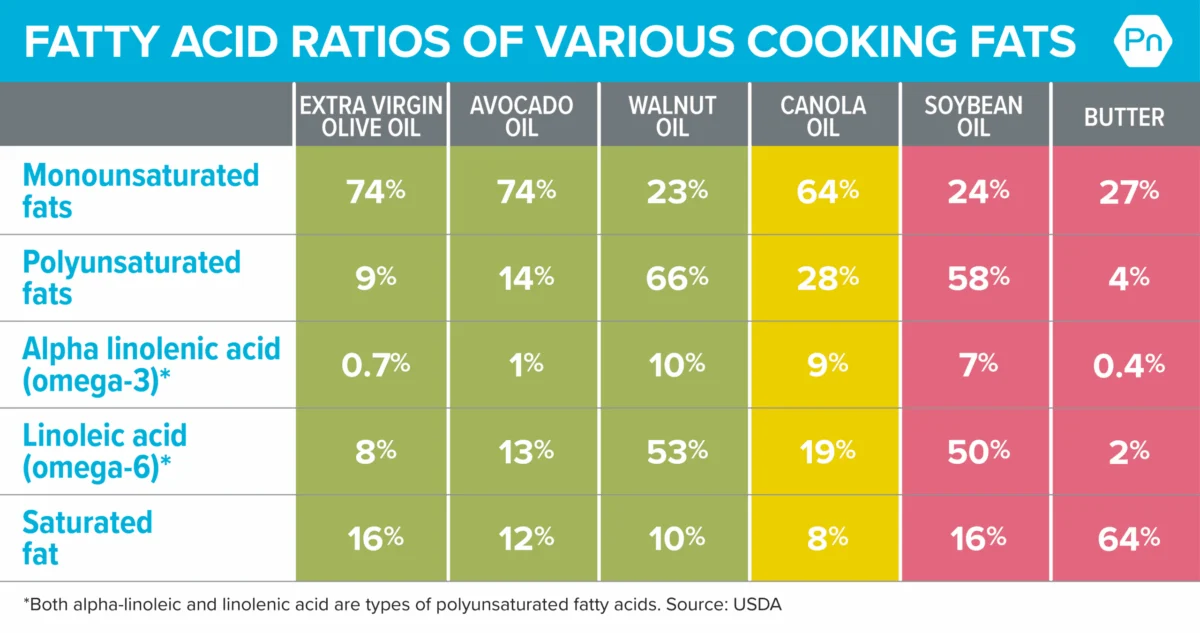
A primary concern regarding seed oils is their high content of omega-6 polyunsaturated fatty acids. Critics argue that the modern Western diet is so skewed toward omega-6s—with an intake ratio of 16:1 or 20:1 compared to omega-3s—that it triggers systemic inflammation.
However, mainstream nutritional organizations, including the American Heart Association, have published data suggesting that the consumption of polyunsaturated fats, including those found in seed oils, is actually linked to a reduced risk of heart disease and stroke. The nuance lies in the "food matrix." Nuts and seeds, which are rich in omega-6s, are associated with positive health outcomes because they come packaged with fiber, protein, and minerals. Refined oils, by contrast, have been stripped of this protective matrix.
The "Refined Oil vs. Butter" Showdown
This is the most contentious matchup in the nutrition space.
The Argument for Butter
Butter advocates correctly point out that the vilification of saturated fat in the 80s and 90s led to a disastrous reliance on trans-fat-laden margarine. They argue that butter is a natural, traditional food. However, scientific consensus remains that excessive saturated fat intake—exceeding 10 percent of total calories—is linked to elevated LDL cholesterol and increased cardiovascular risk. While some dairy components, like the "milk fat globule membrane," may offer protective effects, butter is largely devoid of this structure, making it less heart-healthy than liquid vegetable oils or high-fat dairy like yogurt.

The Argument for Refined Oils
Refined oils are less saturated than butter, which is their main advantage. Yet, their susceptibility to oxidation is a legitimate concern. When these oils are used in ultra-processed foods, they are often repeatedly heated, which further degrades their chemical integrity.
The Verdict: Both refined seed oils and butter should be viewed as ingredients to be used in moderation rather than health-promoting cornerstones. The real issue is that most refined seed oils are consumed within the context of ultra-processed foods—chips, cookies, frozen dinners—which are inherently low in nutrient density and linked to metabolic dysfunction.
Implications for Your Diet
If you are looking to optimize your nutritional intake, the evidence suggests a hierarchy of choices:
- Prioritize Whole Foods: Instead of focusing solely on the oil, prioritize the source. Eating an avocado, a handful of walnuts, or olives provides the fat along with the fiber, antioxidants, and micronutrients that protect the body from oxidative stress.
- The "Eat More" Category: Make extra virgin olive oil and cold-pressed avocado oil your primary cooking fats. They are the most stable and have the strongest backing in scientific literature.
- The "Budget-Friendly" Runner-Up: For those who need a more affordable, neutral-tasting option, expeller-pressed canola oil is a defensible choice. It is far less processed than standard refined oils and maintains a decent omega-3 profile.
- Limit Ultra-Processed Foods: Regardless of the type of oil used, the biggest health risk comes from the total volume of ultra-processed food in the diet. By limiting these foods to 20 percent of your caloric intake, you will naturally reduce your exposure to highly oxidized, refined oils.
Conclusion
The "seed oil" panic is a classic example of nutritional reductionism—taking a complex topic and stripping it down to a "good vs. evil" binary. While it is true that modern industrial processing can strip oils of their health-promoting qualities and that ultra-processed diets are detrimental, the oils themselves are not the singular cause of chronic disease.
The smartest approach is not to hunt for a "perfect" oil, but to focus on a diet centered on whole, minimally processed foods. If you are using a moderate amount of oil to prepare a meal of vegetables and proteins, you are likely on the right track. As with most things in nutrition, context is everything: a splash of canola oil on a roasted vegetable medley is a far cry from the highly oxidized fats found in a deep-fried, ultra-processed snack.
Disclaimer: This article is for educational purposes only and does not constitute medical advice. Always consult with a healthcare professional or registered dietitian before making significant changes to your diet.