








The Democratic Republic of the Congo (DRC) is currently grappling with a public health crisis that has triggered urgent international alarm. In a region already scarred by historical conflict and fragile infrastructure, a new outbreak of the Bundibugyo ebolavirus has rapidly ascended to become the fourth-largest on record. With limited medical countermeasures and no vaccine specifically tailored to this elusive strain, global health authorities are facing a profound ethical and scientific quandary: should they deploy the existing, licensed Zaire-strain vaccine, Ervebo, in the hope of cross-protection, or is the risk of an unproven intervention too great?
The Current Landscape: A Crisis Unfolding
As of this week, the World Health Organization (WHO) has officially classified the escalating outbreak as a public health emergency of international concern. Data provided by the African Centres for Disease Control and Prevention paints a sobering picture: 395 suspected cases and 106 confirmed deaths within the DRC. The virus’s reach has already extended across borders, with two confirmed cases in Uganda—both involving travelers from the epicenter—including one fatality.
The Bundibugyo virus is one of several species of the ebolavirus family capable of infecting humans. First identified in 2007, it has appeared in only two documented outbreaks prior to this one. While historical data suggests a lower case fatality rate than the more infamous Zaire or Sudan strains—hovering around 50%—the virus remains a lethal threat capable of destabilizing entire provinces.
Chronology of the Outbreak and Response
The timeline of the current crisis is one of rapid acceleration, leaving little room for the slow deliberation often afforded to public health policy.
- Late Last Week: The outbreak is confirmed, immediately signaling a high-risk situation due to the region’s history of containment challenges and the ongoing instability of the local security environment.
- Sunday: The WHO formally designates the event as a Public Health Emergency of International Concern (PHEIC), recognizing the potential for regional destabilization and the need for a coordinated, multinational response.
- Monday: The African CDC releases updated figures confirming 395 suspected cases and 106 deaths, as well as the initial detection of cases in Uganda.
- Tuesday (Upcoming): A pivotal meeting of the WHO’s R&D Blueprint advisory group is scheduled. Experts will convene to weigh the clinical evidence for cross-protective vaccination strategies, marking the first formal step toward a potential policy shift regarding the use of Ervebo.
Scientific Foundations: The Question of Cross-Protection
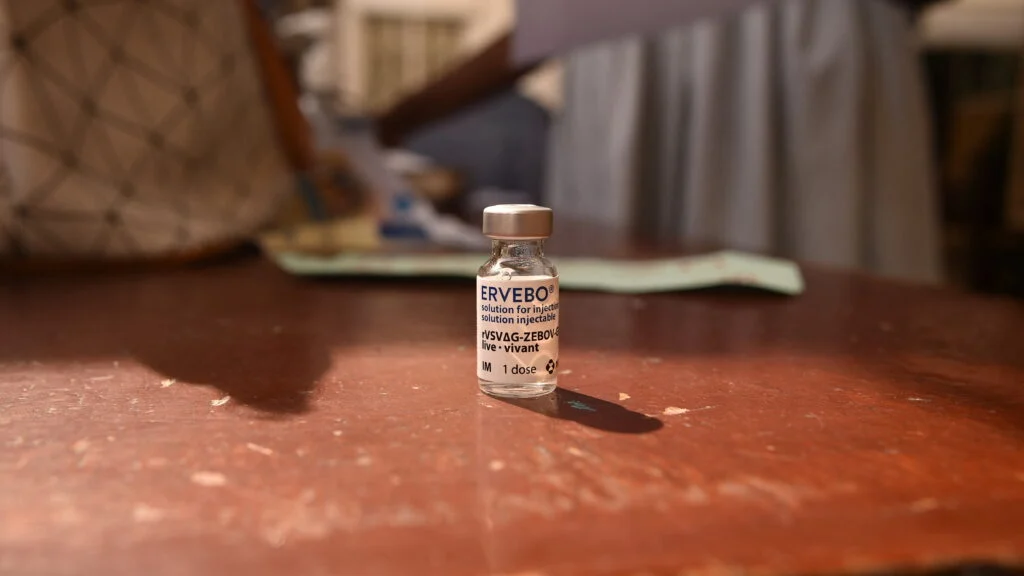
The central scientific debate centers on the Merck-manufactured vaccine, Ervebo. Designed exclusively for the Zaire ebolavirus—the cause of the devastating 2014-2016 West African epidemic—the vaccine is not indicated for the Bundibugyo species. Historically, the scientific consensus held that because the four human-infecting Ebola species are genetically distinct, a vaccine targeting one would be ineffective against another.
However, a 2011 study published in the Journal of Infectious Diseases introduced a glimmer of uncertainty. In this primate trial, researchers found that macaques vaccinated with a precursor to the Ervebo vaccine showed a higher survival rate when exposed to a lethal dose of the Bundibugyo virus compared to unvaccinated controls.
The Primate Evidence
The study, led by virologist Darryl Falzarano of the University of Saskatchewan’s Vaccine and Infectious Disease Organization (VIDO), noted that three out of four vaccinated primates survived exposure, whereas only one of three control animals survived.
While the results were statistically promising, experts remain cautious. Tom Geisbert, an Ebola researcher at the University of Texas Medical Branch and co-author of the 2011 paper, notes that the survival of one control animal complicates the data. "We have to factor in that some of those survivors may have survived without the vaccine," Geisbert explained, suggesting the protective effect might be closer to 50% rather than the perceived 75%.
The small sample size, necessitated by the high cost and ethical constraints of primate research, limits the ability to draw definitive conclusions. Furthermore, while the vaccinated animals in the study survived, they still exhibited clear symptoms of the disease, indicating that the vaccine—if effective—is not a perfect shield.
Official Responses and Ethical Deliberations
The decision to deploy an off-label vaccine is not merely a scientific calculation; it is a profound ethical challenge. According to Vasee Moorthy, the acting lead of the WHO’s R&D Blueprint group, the authority to proceed rests with the national governments of the affected countries.
"Any decision as to next steps will be for the DRC and Uganda, supported by the WHO," Moorthy stated. The deliberation involves complex considerations:
- Clinical Feasibility: Can a controlled clinical trial be safely and ethically managed in a region suffering from active conflict?
- Public Trust: Would residents in the outbreak zone, many of whom are already wary of medical interventions, be willing to participate in a trial for a vaccine that is not explicitly designed for the current virus?
- Risk of "Antibody-Dependent Enhancement" (ADE): Some researchers fear that a mismatched vaccine could theoretically worsen the disease by triggering a suboptimal immune response, though this has not been observed in animal studies.
The "Damned If You Do" Dilemma
For many in the field, the status quo is the most dangerous option. Armand Sprecher, an emergency physician with Doctors Without Borders (MSF) who has extensive experience in Ebola response, advocates for a pragmatic approach.
"You go into the outbreak with the vaccine you have, not the vaccine you wished you had," Sprecher argued. He views the existing primate data as a sufficient, albeit imperfect, justification for action. "The non-human primate study is a reasonable basis for saying, ‘Let’s use this vaccine.’ We know it’s safe, we know the platform works, and the alternative is to do nothing. I don’t think that’s acceptable."
Conversely, others remain hesitant. Dr. Falzarano, while acknowledging the potential benefits, warns of the risks of "going in blind." He suggests that the vaccine could potentially distract the immune system from mounting an effective response to the specific Bundibugyo threat. He maintains that unless a rigorous, well-controlled clinical trial can be established, the risk might outweigh the potential, and largely theoretical, reward.
Implications for Global Health Security
The current debate underscores a critical gap in our global pandemic preparedness: the lack of multi-valent or pan-ebolavirus vaccines. As climate change, human encroachment into remote habitats, and global mobility increase, the frequency of spillover events involving rare or newly identified viruses is expected to rise.
Merck, for its part, has maintained a cautious stance. A spokesperson for the company noted that there is no clinical data on humans regarding Ervebo’s efficacy against Bundibugyo and that research conducted independently of the company remains limited. They have stopped short of endorsing the use of the vaccine in this context, highlighting the legal and regulatory complexities of using a licensed product in an unindicated manner.
Looking Ahead
The upcoming WHO advisory meeting will likely be the most significant development in the containment effort to date. If the experts conclude that the potential benefits of Ervebo outweigh the risks, the path forward will require unprecedented cooperation between the DRC, Uganda, international health agencies, and the vaccine manufacturer.
The outcome of this situation will serve as a bellwether for how the international community handles "orphan" outbreaks—those caused by pathogens that lack the commercial incentive for dedicated vaccine development. As the virus continues to circulate in the border regions of the DRC, the world waits to see whether the lessons learned from the 2011 primate trials will be enough to justify a bold, and potentially life-saving, intervention. For the people on the ground, the debate is not academic—it is a matter of survival.