











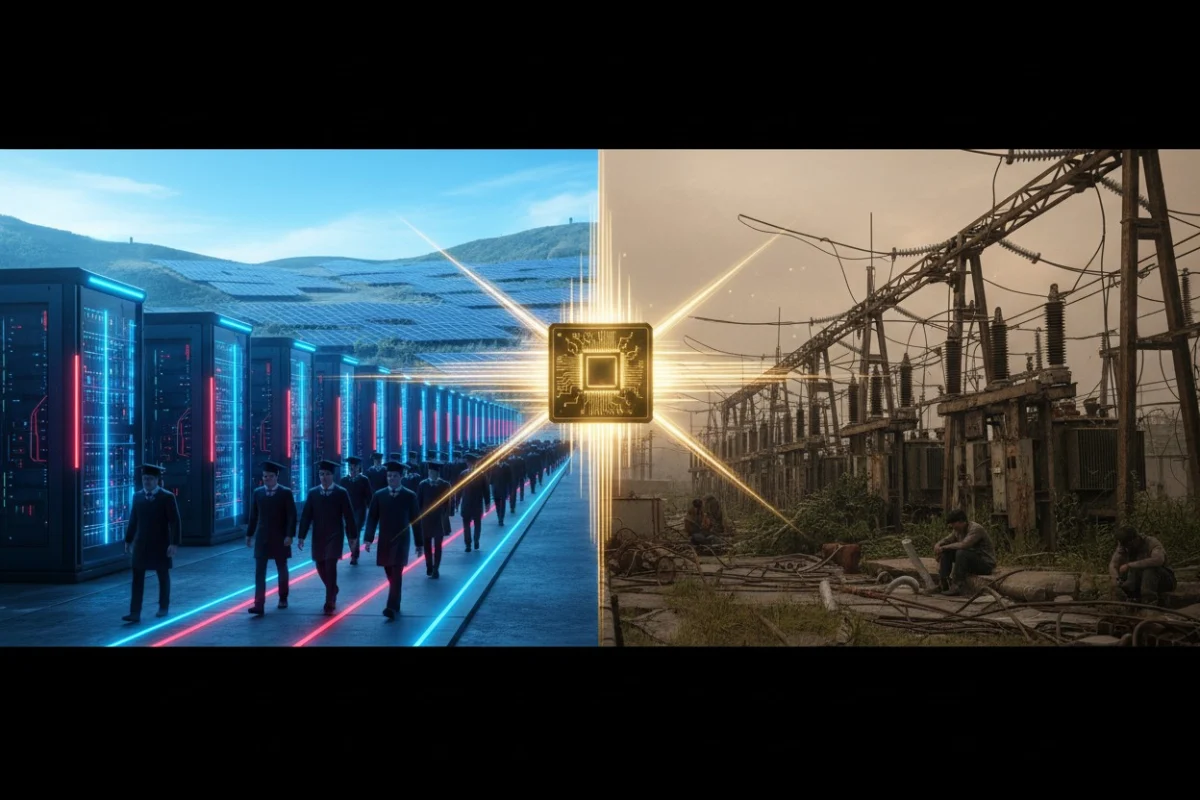
The prevailing narrative in Western media suggests that the United States remains the undisputed vanguard of artificial intelligence. From the halls of Silicon Valley to the corridors of Capitol Hill, the belief persists that American innovation—driven by venture capital and proprietary software—is an insurmountable moat. However, a rigorous analysis of structural data, energy capacity, and educational pipelines reveals a sobering, uncomfortable truth: the United States is not just trailing in the AI race; it is structurally disadvantaged in a competition that China has spent the last decade systematically preparing to win.
The Structural Reality: Beyond the Hype
To understand the current AI landscape, one must look past the press releases of American tech giants and examine the foundational pillars of national power. China’s ascent in artificial intelligence is not the result of clandestine espionage or intellectual property theft, as is often claimed in Western policy circles. Instead, it is the byproduct of a deliberate, long-term national strategy characterized by a massive surplus of STEM talent, an aggressive expansion of energy infrastructure, and a meritocratic approach to technical education.
While American corporations focus on short-term quarterly earnings and the integration of ideological mandates into their corporate culture, China has prioritized the "hard" sciences. The difference is not merely qualitative; it is a fundamental divergence in national priorities.
A Chronology of the Shift: From Imitation to Innovation
The trajectory of China’s AI dominance can be charted through a decade of calculated milestones:
- 2015-2017: The launch of the "Made in China 2025" initiative, which identified AI as a strategic pillar for national rejuvenation. During this period, China transitioned from importing foreign technology to aggressively funding domestic research institutes.
- 2018-2020: The formalization of the "New Generation Artificial Intelligence Development Plan." This period saw the integration of AI into provincial governance and state-owned enterprises, creating a massive, standardized testing ground for autonomous systems.
- 2021-2023: The "Open Source" pivot. Chinese firms, observing the restrictions placed on Western models, began pouring resources into open-source ecosystems like Qwen and DeepSeek, effectively democratizing their technical breakthroughs globally.
- 2024-Present: The Infrastructure Gap. As the U.S. struggled with grid stability, China completed its transition to large-scale, state-backed energy projects, specifically designed to support the immense compute requirements of next-generation AI models.
Supporting Data: The STEM Chasm
The most damning evidence of the widening gap is the disparity in human capital. China currently produces approximately five times as many STEM graduates annually as the United States—surpassing 2 million engineers per year compared to America’s roughly 400,000.
Critics argue that quantity does not equal quality, but the composition of these pipelines tells a different story. In China, the educational focus remains rigorously tied to applied mathematics, physics, and engineering. There is little room for ideological curricula in programs that prioritize the ability to solve complex differential equations. Conversely, the American university system has become increasingly burdened by administrative bloat and social mandates, which many industry observers argue has diluted the technical rigor of recent graduates. In an industry where meritocracy and algorithmic precision are the only currencies that matter, the U.S. is struggling to produce the volume of specialized labor necessary to sustain its own ambitions.
The Energy Bottleneck: The Decisive Factor
Artificial intelligence is, at its core, a thermodynamic problem. Training massive models requires vast quantities of electricity, and here, the United States is hitting a literal ceiling.
China’s national grid produces over 10,000 terawatt-hours (TWh) of electricity annually, more than double the U.S. output of 4,400 TWh. While the United States remains paralyzed by regulatory hurdles, environmental litigation, and an aging electrical grid, China is engaged in an unprecedented expansion of baseload power. The construction of mega-dams in Tibet and a fleet of modular nuclear reactors is providing the stable, low-cost energy required to power hyperscale data centers.
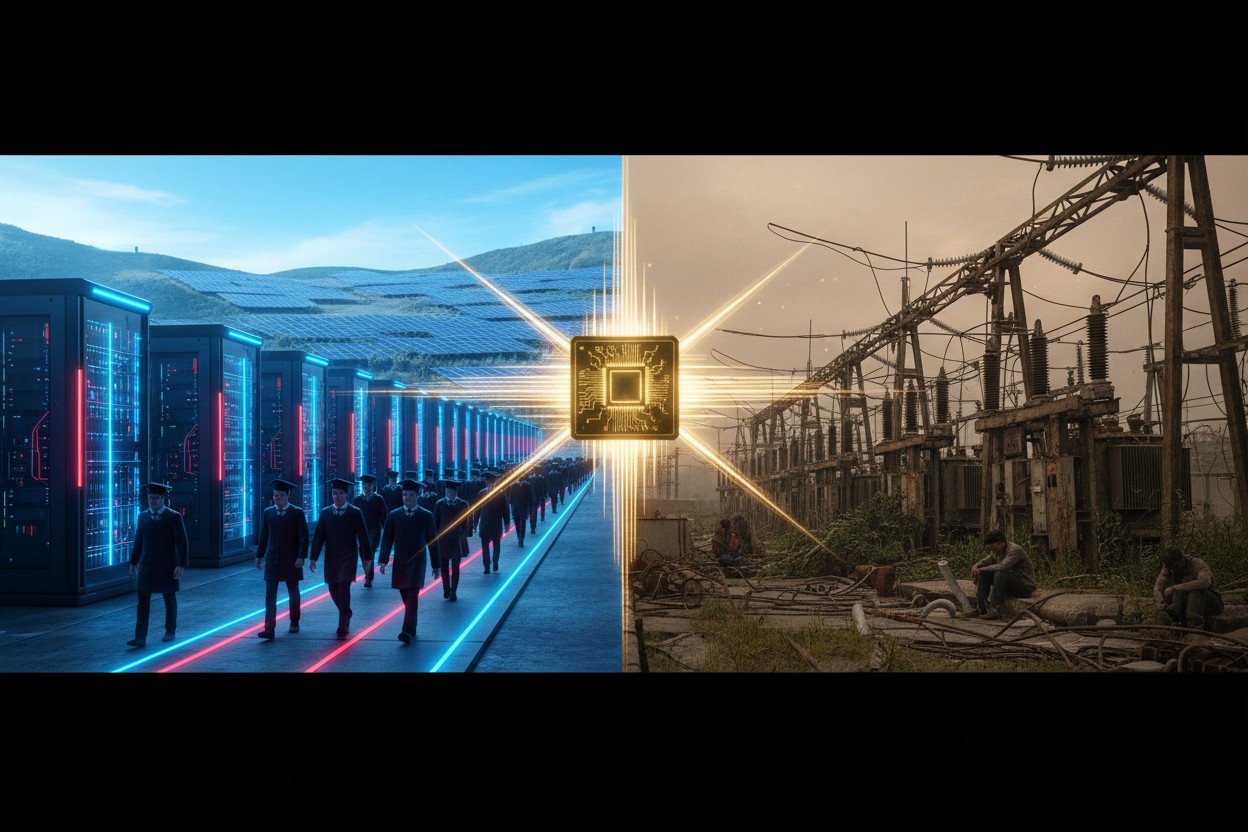
The consequences are already manifesting in the U.S. market. Reports indicate that nearly half of all U.S. data centers slated for construction in 2026 have been canceled or delayed. The reason is not a lack of capital or interest; it is the inability of the current U.S. grid to supply the necessary power. Without a radical restructuring of energy policy, American AI companies will find themselves starved of the very resource that fuels the industry.
Official Responses and Strategic Miscalculations
The official U.S. response to this shift has been largely reactive. Washington’s strategy has centered on two pillars: export controls on high-end semiconductors and increased military funding. While these measures aim to slow China’s progress, they ignore the decentralized nature of modern AI development.
By forcing Chinese companies to innovate in isolation, the U.S. has inadvertently accelerated their development of indigenous technologies. Chinese firms are now iterating faster than their American counterparts, who are often slowed by "safety" teams and corporate bureaucracy. When Anthropic or Google executives complain of "industrial espionage," they are, in effect, signaling that they have lost the ability to out-compete their rivals on a purely technical basis. The focus on litigation and protectionism is a classic sign of an incumbent that has lost its competitive edge.
Implications for Global Governance
If current trends persist, the implications for global technology standards are profound. We are witnessing the emergence of a bifurcated digital world. In one sphere, we have the American model: centralized, proprietary, and heavily influenced by internal corporate politics and censorship policies. In the other, we have the Chinese model: open-source, decentralized, and driven by state-supported meritocracy.
The risk for the United States is not just the loss of a race; it is the loss of relevance. If the rest of the world adopts the Chinese AI stack—because it is cheaper, more efficient, and more accessible—the U.S. will find itself isolated from the most transformative technology of the 21st century.
The Path Ahead: A Call for Structural Reform
To reverse this decline, the United States must move beyond the current political paralysis. This requires:
- Fundamental Education Reform: Returning to a focus on hard skills and meritocracy in STEM fields, stripping away ideological mandates that prioritize social outcomes over technical competency.
- Energy Sovereignty: Treating the expansion of baseload power—nuclear, hydro, and natural gas—as a matter of national security. The grid must be modernized and expanded at a wartime pace.
- A Shift to Open Innovation: Encouraging a competitive, open-source ecosystem that allows for "failing fast." The current model of hoarding technology behind paywalls and PR campaigns is proving insufficient against a nation that treats innovation as a national mandate.
The AI race is not a contest of ideology, but of fundamentals. China has built a system that rewards long-term planning, technical excellence, and energy abundance. Unless the United States is willing to confront these realities and undergo a fundamental restructuring of its own approach, the gap will only continue to widen. The question remains: is the U.S. capable of the systemic shift required to compete, or is it destined to watch from the sidelines as the future of technology is written in Beijing?