









GARDEN GROVE, Calif. — A high-stakes standoff between emergency responders and a failing chemical storage tank has gripped Southern California, forcing approximately 40,000 residents to flee their homes as authorities race to avert a potentially catastrophic explosion.
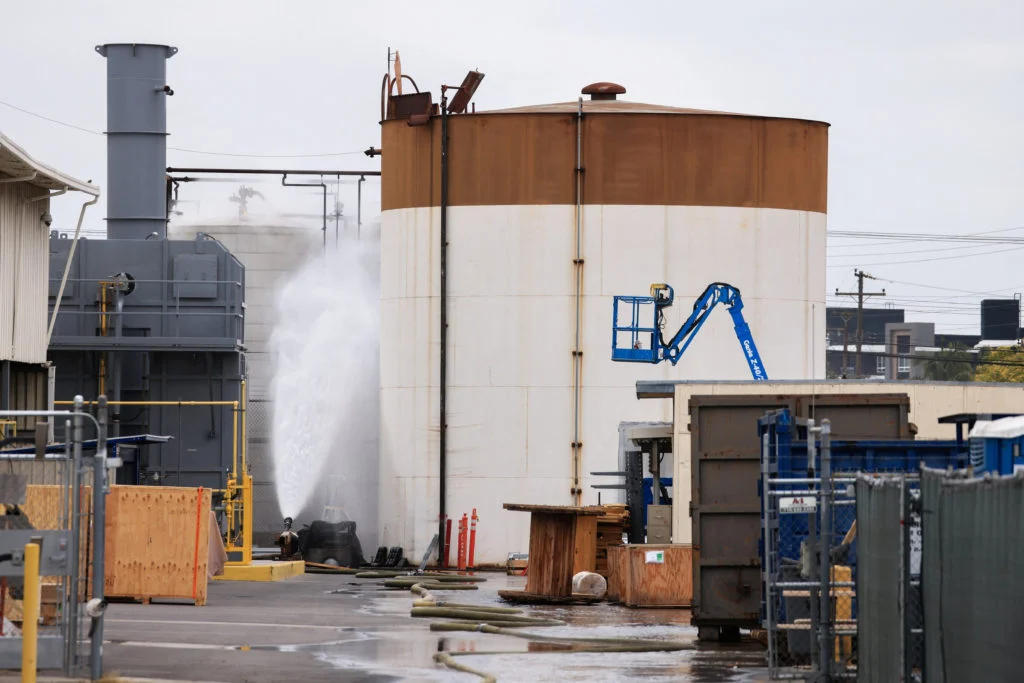
The crisis centers on a facility operated by GKN Aerospace in Garden Grove, an Orange County industrial hub. A storage tank containing thousands of gallons of methyl methacrylate—a volatile chemical essential in the production of high-performance aerospace plastics—began overheating on Thursday, initiating a hazardous vapor leak that has defied initial containment efforts.
As of Friday, the situation remained precarious. While officials managed to temporarily stabilize the temperature of the tank, the structural integrity of the vessel remains in doubt, leaving the region on a knife’s edge.
The Core Facts: A Ticking Time Bomb
The threat stems from a 6,000-to-7,000-gallon (approx. 22,700 to 26,500 liters) storage tank that has undergone a dangerous chemical reaction. Methyl methacrylate is highly flammable and, when subjected to extreme heat, can undergo "polymerization"—an exothermic process that releases significant energy and vapor.
Orange County Fire Authority (OCFA) Division Chief Craig Covey provided a sobering assessment of the danger. "This thing is going to fail, and we don’t know when," Covey stated during a press briefing. "We’re doing our best to figure out when or how we can prevent it."
The failure could manifest in one of two catastrophic ways: the tank could suffer a structural rupture, spilling the toxic chemical onto the facility grounds, or it could undergo a violent explosion, potentially scattering hazardous material over a wide residential radius.
Chronology of the Crisis
Thursday: Initial Detection
The emergency began late Thursday when the tank at the GKN Aerospace facility began venting vapors. The facility, which manufactures critical components for both commercial and military aircraft, immediately engaged emergency protocols. Despite initial attempts by on-site teams and first responders to neutralize the situation, the chemical reaction inside the tank proved too persistent to extinguish.
Friday Morning: Evacuations Expand
As night fell, it became clear that the situation would not be resolved quickly. By Friday morning, the scope of the evacuation orders had expanded significantly. Originally centered on the immediate vicinity of the Garden Grove plant, the exclusion zone grew to include residential pockets across five additional cities: Cypress, Stanton, Anaheim, Buena Park, and Westminster.
Friday Afternoon: The Battle for Stability
Throughout the day, hazardous materials (HAZMAT) teams worked to create containment barriers. Using sandbags and specialized chemical neutralizers, they sought to prevent any potential spill from entering the local storm drain system, which would risk contaminating creeks and, eventually, the Pacific Ocean. By late afternoon, OCFA confirmed that they had successfully maintained the tank’s temperature, a minor victory that provided responders with additional time to develop a long-term stabilization plan.
Human Impact: A Community Displaced
For the 40,000 residents under the evacuation order, the transition from a quiet Friday to an emergency displacement was jarring.
Danny Pham, a resident living only two blocks from the facility, was awakened at 7:00 a.m. by a frantic roommate. Working late at a local restaurant the previous evening, he had been entirely unaware of the developing disaster. "It was shocking to me," Pham recounted while seeking shelter at a friend’s business in a neighboring city. "I didn’t know how serious it would be. I never knew that a thing like this could happen."
Like many others, Pham fled with nothing but his passport and wallet, uncertain if he would be permitted to return to his home within hours or days.
The evacuation also highlighted communication challenges within Orange County’s diverse population. Kim Yen, a long-time resident of Garden Grove, expressed concern that the English-only emergency alerts might not reach all members of the local Vietnamese community. "I’m hoping they stay alert and listen to the news and the authorities," Yen said. "This is scary."
To bridge the gap, local Vietnamese-language television stations have been working around the clock to translate official bulletins and reiterate the urgency of the evacuation orders, ensuring that language barriers do not translate into a lack of safety.
Official Responses and Safety Protocols
The Role of Local Government
Garden Grove Mayor Stephanie Klopfenstein has been a consistent voice of caution, urging residents to prioritize their safety over the inconvenience of displacement. "We understand that this is frightening," Mayor Klopfenstein stated. "But the evacuation orders are in place for your safety."
Police and fire personnel have been conducting door-to-door sweeps in the evacuated zones, ensuring that the neighborhoods are effectively "ghost towns" to prevent exposure to the hazardous vapors.
Health Risks of Methyl Methacrylate
Dr. Regina Chinsio-Kwong, the Orange County health officer, provided details on the specific risks posed by the chemical. If the tank releases its contents into the atmosphere, the resulting vapor can cause severe health complications, including:
- Acute respiratory distress
- Itching and chemical burns to the eyes
- Severe nausea and debilitating headaches
The public has been advised to remain outside the exclusion zone and to seek medical attention if they exhibit symptoms after being in the vicinity of the plant.
The Stance of GKN Aerospace
GKN Aerospace issued a statement confirming that they are cooperating fully with authorities. "There are no reports of injuries at this time and our priority remains the safety of our employees, responders, and the surrounding community," a company spokesperson stated. Specialized HAZMAT consultants have been brought in to assist local crews, though the company has remained tight-lipped on the specific technical failure that caused the tank to overheat.
Implications: A Broader Concern for Industrial Safety
The event in Garden Grove has reignited debates regarding the proximity of industrial chemical storage to dense residential areas. With the facility located just 38 miles from downtown Los Angeles and adjacent to the tourist-heavy Anaheim corridor—home to Disneyland—the potential for a massive public health impact remains significant.
Environmental Safeguards
The decision to utilize sandbags to create a containment perimeter serves as a reminder of the fragility of urban infrastructure. Had the chemical reached the storm drains, the environmental remediation would have been exponentially more difficult and costly. The current effort focuses on "containment at the source," a strategy aimed at minimizing the total volume of hazardous material released into the atmosphere or the soil.
The Future of the Facility
While the immediate crisis is focused on the tank’s stability, long-term questions remain. Once the threat is neutralized, an investigation will likely follow to determine how a chemical storage vessel at an aerospace facility reached a state of "critical failure." Regulatory bodies, including the California Division of Occupational Safety and Health (Cal/OSHA), are expected to review the facility’s safety protocols and maintenance logs.
As night falls on the evacuated zones, the residents of Orange County wait. For the 40,000 displaced, the future is uncertain, but the message from authorities remains clear: the danger is real, the threat is ongoing, and the evacuation order stands until the "ticking time bomb" is safely neutralized.
Reporting by reporters from San Francisco, Portland, and Salt Lake City.