





In an era where modern medicine is increasingly looking toward integrative approaches to health, the ancient Indian system of Ayurveda offers a profound framework for healing. Central to this system is the practice of Ayurvedic massage—a sophisticated, intentional form of touch that has been utilized for millennia to restore balance to the body and mind. Far from being a simple relaxation technique, Ayurvedic massage is a highly personalized therapeutic discipline rooted in the wisdom of the Vedas.
The Foundations of Ayurvedic Healing
Ayurveda, often translated as the "science of life," posits that health is a state of equilibrium between the body, mind, and spirit. To achieve this, practitioners employ both Shamana (palliative therapies intended to pacify imbalances) and Shodhana (purificatory therapies designed to eliminate toxins).
The methodologies surrounding these practices are not modern inventions; they are meticulously documented in the brhat trayi—the "Great Three" texts of Ayurveda authored by the sages Caraka, Sushruta, and Vagbhata. Later treatises, including the Bhavaprakasha and Yogaratnakara, further codified these techniques. Historically, these modalities were used for diverse purposes: from preparing warriors and athletes for physical exertion and promoting virility to supporting postpartum recovery and providing long-term preventative healthcare.
The Science of Elements and Doshas
To understand the mechanics of Ayurvedic massage, one must first grasp the Ayurvedic understanding of matter. According to this tradition, all existence is composed of five great elements (panchamahabhutas): Space, Air, Fire, Water, and Earth.
Within the human body, these elements manifest as three fundamental energetic forces known as doshas:
- Vata: A combination of Space and Air, governing movement and communication.
- Pitta: A combination of Fire and Water, governing metabolism and transformation.
- Kapha: A combination of Water and Earth, governing structure and lubrication.
Every individual possesses a unique blueprint of these doshas known as Prakruti. Health is maintained when these doshas remain in their natural state, while illness—or Vikruti—arises when they become vitiated or imbalanced. Ayurvedic massage operates on the "like-increases-like" principle; practitioners use substances and techniques with qualities opposite to the current imbalance to restore harmony.
Individualized Care: A Tailored Approach
Unlike standardized Western massage protocols, every Ayurvedic treatment is bespoke. Before a session begins, a practitioner assesses the client’s Vikruti, their digestive fire (Agni), and the presence of accumulated metabolic waste or toxins (Ama).
The Role of Oils and Herbs
The choice of oil is a critical component of the treatment. The carrier oil serves as a vehicle for medicinal herbs, which are infused to address specific doshic needs:
- Vata Imbalance: Practitioners favor heavy, warming oils such as sesame oil to ground the erratic, light, and cold nature of Vata.
- Pitta Imbalance: Cooling, soothing oils like coconut or sunflower are selected to pacify the heat and intensity associated with Pitta.
- Kapha Imbalance: Lighter, more stimulating, and heating oils like mustard are employed to counteract the heavy, stagnant nature of Kapha.
Quantity also matters: a Vata-dominant person requires a liberal application of oil to provide insulation and stability, whereas a Kapha-dominant person requires minimal oil to avoid further congestion.
Contraindications: When Oil is Not the Answer
A hallmark of professional Ayurvedic practice is the recognition of Ama (toxins). If the body is burdened with significant levels of Ama, oil massage is often contraindicated because the heavy, sticky nature of oil can trap toxins within the tissues. In such cases, the practitioner may pivot to Udvartana—a dry, vigorous massage using herbal powders that exfoliate and stimulate the lymphatic system, effectively "scrubbing" the stagnation away.
Special Considerations: The Mind and the Vata Connection
The relationship between touch and the nervous system is a cornerstone of Ayurvedic theory. According to Samkhya philosophy, the air element is intimately linked to the Sparshendriya (the sense of touch). Because Vata is composed of air and space, the mind—which is also governed by these subtle elements—is uniquely responsive to therapeutic touch.
Consequently, Ayurvedic massage is considered a primary intervention for neurological health, anxiety, and mental fatigue. By nourishing the skin (Tvak), which is managed by bhrajaka pitta, the therapist does more than soothe the surface. They nourish the agni of the skin, allowing the medicinal properties of the oils and herbs to penetrate deep into the muscles, nerves, and organs.
Categorization of Massage Techniques
Ayurvedic massage is a broad field with specialized categories designed to address specific physiological requirements.
Abhyanga: The Art of Oleation
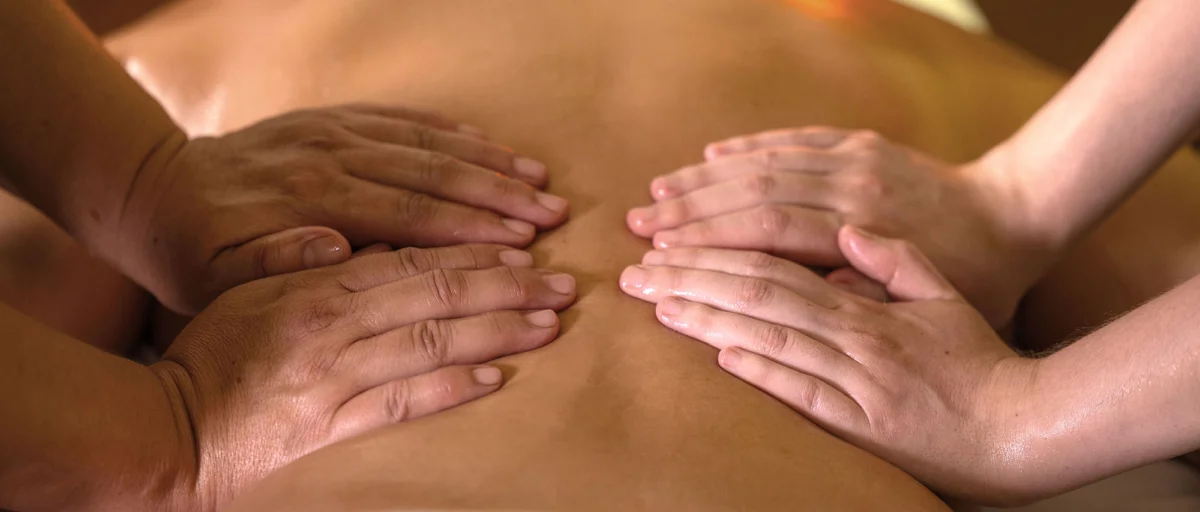
Abhyanga is perhaps the most recognized form of Ayurvedic bodywork. It involves the rhythmic application of warm, herbalized oil. Whether performed as a self-massage or by one or two practitioners in a synchronized "four-handed" session, Abhyanga is deeply medicinal. In Sanskrit, the word Snehan implies both "oil" and "love." This linguistic connection highlights the philosophy that oiling the body is a physical expression of affection, intended to harmonize the cells with a vibration of radiance.
Specialized Manual Therapies
Beyond full-body oiling, the tradition includes:
- Udvartana: Massage with hot, dry herbal powders, ideal for Kapha reduction and lymphatic drainage.
- Udsadana: Specialized dry-herb massage for cosmetic and beautification purposes.
- Udgarshana: The use of herbal pastes (herbs mixed with water or oil) to treat specific dermatological conditions.
- Deha Samvahana: Systematic massage of the entire body.
- Kesha Mardana: Targeted head massage to calm the mind and nourish the scalp.
Advanced Techniques: Strokes and Marma Therapy
The efficacy of an Ayurvedic session is dictated by the directionality of the strokes. Practitioners use Anuloma (strokes moving away from the heart) to ground and calm Vata, and Pratiloma (strokes moving toward the heart) to stimulate circulation and lymph flow.
The massage toolkit includes a variety of specialized movements:
- Garshana/Mardana: Friction-based strokes.
- Peedana: Deep kneading.
- Udvesthana: Twisting or wringing motions.
- Praharana: Percussive techniques.
- Sandhi Calana: Therapeutic joint mobilization.
Marma Therapy: The Energy Centers
Perhaps the most intriguing aspect of Ayurvedic bodywork is Marma therapy. Marma points are vital energy junctions where the physical and subtle bodies meet. Similar to, yet distinct from, Chinese acupuncture points, Marma points are often larger and correspond to specific organs, glands, and pranic (life force) channels. By applying gentle, precise pressure to these points, a practitioner can release energetic blockages and trigger the body’s "inner pharmacy" to initiate profound healing.
Implications for Modern Wellness
The resurgence of Ayurvedic massage in modern clinical settings underscores a shift toward holistic health. As we continue to face the stressors of a fast-paced, high-tech world, the ancient wisdom of "intentional touch" provides a necessary antidote to physical and mental exhaustion.
Whether used as a standalone treatment for stress management or as part of a larger Panchakarma detoxification protocol, Ayurvedic massage offers a bridge between the physical and the subtle. By treating the individual rather than the symptom, and by aligning the body with the elemental rhythms of nature, this practice remains as relevant today as it was when it was first recorded in the brhat trayi.
As the medical community continues to explore the intersections of neuroscience, psychology, and physical therapy, the ancient principles of Ayurvedic massage offer a time-tested roadmap for the maintenance of health and the restoration of human vitality. Through the consistent application of herbalized oils, targeted strokes, and the stimulation of Marma points, the practitioner does more than manipulate tissue—they facilitate a return to the natural, blissful state of health that is the birthright of every individual.