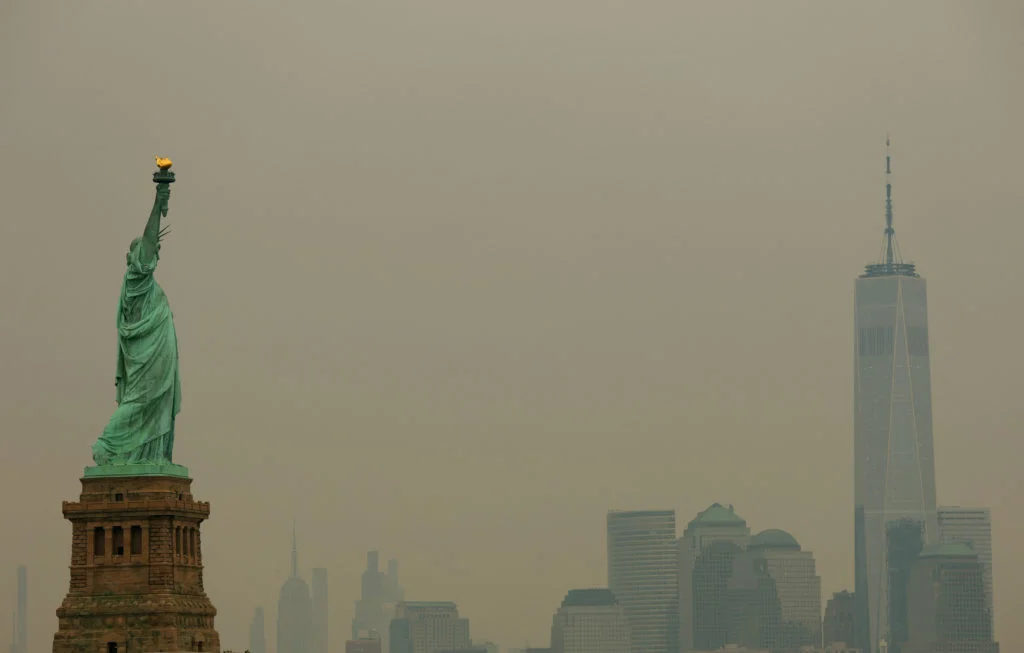
NEW YORK — A thick, acrid veil of wildfire smoke has descended across a vast swath of the United States, transforming the skies from the Great Lakes to the Atlantic Seaboard into a dystopian landscape of muted yellows and bruised oranges. The phenomenon, driven by an unyielding high-pressure system, has trapped microscopic particulate matter near the surface, forcing millions of Americans to retreat indoors and raising urgent alarms about the long-term public health consequences of a warming climate.
As of Thursday, visibility in major metropolitan hubs, including Detroit and Chicago, had plummeted to less than half a mile. In New York City, the iconic Manhattan skyline was rendered nearly invisible behind a suffocating, pungent haze. The source of the crisis—a massive cluster of wildfires burning across Canadian forests and parts of northern Minnesota—shows no sign of immediate abatement, with meteorologists and forestry officials warning that the region may face intermittent bouts of hazardous air for the remainder of the summer.
The Science of the Smog: Why the Air Is Hazardous
The air quality index (AQI) in numerous cities reached "hazardous" levels this week, a classification that indicates the air is unsafe for the entire population, regardless of baseline health status. At the heart of this crisis are PM2.5 particles—microscopic pollutants less than 2.5 micrometers in diameter. Unlike larger dust or pollen, these particles are small enough to penetrate deep into the human respiratory system, cross into the bloodstream, and circulate throughout the body.
The health risks associated with these particulates are severe. Exposure is linked to an immediate increase in respiratory distress, such as wheezing and coughing, and can trigger life-threatening cardiac events. A study published earlier this year underscored the gravity of the situation, estimating that long-term exposure to wildfire smoke contributes to approximately 24,100 premature deaths annually in the lower 48 states.
A Chronology of the Crisis
The escalation of the smoke event was swift, though the environmental conditions were set weeks in advance.
- Early Week: As wildfires intensified in the Canadian provinces and along the U.S.-Canada border, a stagnant high-pressure system settled over the Great Lakes. This atmospheric "cap" acted as a trap, preventing the smoke from dispersing into the upper atmosphere and instead forcing it to settle into the breathing zones of urban centers.
- Tuesday: Authorities moved to close the Boundary Waters Canoe Area Wilderness in Minnesota as fire risks grew. At the time of the closure, thousands of wilderness enthusiasts were in the path of the encroaching smoke and fire, prompting a massive, complex search-and-extraction operation.
- Wednesday: The crisis hit a fever pitch as the plume moved eastward. The Royal Canadian Air Force executed a successful emergency evacuation of 11 Minnesota teenagers and four staff members from an Ontario provincial park located 175 miles north of the border, highlighting the international nature of the threat.
- Thursday: The smoke reached the East Coast, prompting widespread school closures, the cancellation of outdoor athletic events, and the deployment of municipal mask-distribution programs in cities like New York and Philadelphia.
The Minnesota Wilderness: A Frontline in Flux
The situation in Minnesota remains particularly precarious. Superior National Forest staff have been engaged in a grueling effort to locate and evacuate campers in the remote Boundary Waters. While officials reported that 90% of the 6,000 to 10,000 individuals inside the area had been reached by Wednesday, the terrain and the smoke have made search-and-rescue operations incredibly difficult.
Karen Harrison, a spokesperson for the multi-agency response team, painted a grim picture of the road ahead. "There will be fire on the landscape until fall, and some fire will be burning until snow cover," she stated. The combination of dense forest, difficult topography, and persistent smoke plumes suggests that the firefighting effort will be a marathon, not a sprint.
Official Responses and Public Health Mitigation
In the absence of a quick fix, municipal governments across the Midwest and Northeast have pivoted to harm reduction. In New York City, the Department of Health and Mental Hygiene urged residents to limit strenuous activity, while the city’s education department moved all activities indoors. Tens of thousands of high-filtration masks, specifically N95 and KN95 models, were distributed at major transit hubs to shield commuters from the worst of the inhalation risk.
Philadelphia’s public health commissioner, Dr. Palak Raval-Nelson, offered a blunt assessment to the public: "Today is not the day to start your marathon training plan." Her warning reflects a broader shift in public policy, where officials are no longer simply advising caution but are actively discouraging the types of outdoor physical activities that are typically encouraged for public wellness.
In Detroit, where the air quality was recently ranked among the worst in the world for a major city, residents expressed a mixture of fear and fatigue. Omar Mitchell, 50, a local business owner, voiced the concerns of many: "You don’t know necessarily what the side effects may be. That’s days or months later."
Environmental and Long-Term Implications
The current crisis serves as a stark reminder of the "new normal" in a warming world. Experts note that while smoke events are not new, the duration and intensity of these fires are increasingly tied to climate change, which creates drier, hotter, and more volatile forest conditions.
Brent Williams, head of the Department of Soil, Water and Climate at the University of Minnesota, noted that the visual phenomena—the "glowing yellow" skies—are merely the surface-level manifestations of a deep, systemic environmental issue. "The area could be looking at weeks to months of continued smoke and flare-ups off and on as the winds blow in different directions," Williams cautioned.
Meteorologists, including Jake Petr of the National Weather Service, warn that even when winds shift and provide temporary relief, the regional atmosphere remains primed for re-contamination. As long as the wildfires continue to burn in the Canadian interior, any shift in the jet stream or local wind patterns can bring the smoke back into the U.S. interior.
Conclusion: A Fragile Future
For the residents of the Great Lakes and the East Coast, the immediate goal is survival—staying indoors, monitoring air quality reports, and protecting the most vulnerable, including children, the elderly, and those with pre-existing cardiovascular or respiratory conditions.
However, the event has triggered a wider conversation about the necessity of robust infrastructure, such as improved air filtration in public buildings, and the urgency of addressing the root causes of the increased wildfire frequency. As the smoke eventually clears, the memory of the orange skies and the stinging air will likely linger, serving as a catalyst for deeper discussions about climate resilience and the necessity of international cooperation in managing an increasingly unpredictable environment.
For now, the advice from the experts remains consistent: keep the windows closed, wear a high-quality mask if you must go outside, and prepare for a long summer of uncertainty as the fires continue to burn in the north.