










In the landscape of modern nutritional science and food policy, few voices carry as much authority—or as much capacity to incite necessary public discourse—as Marion Nestle. As a professor emerita of nutrition, food studies, and public health at New York University, Nestle has spent decades peeling back the layers of corporate influence, marketing tactics, and regulatory inertia that define the American food system. This week, the academic community and the general public received a highly anticipated update regarding her latest contribution to the field: Sugar Coated, scheduled for release on September 8, 2026.
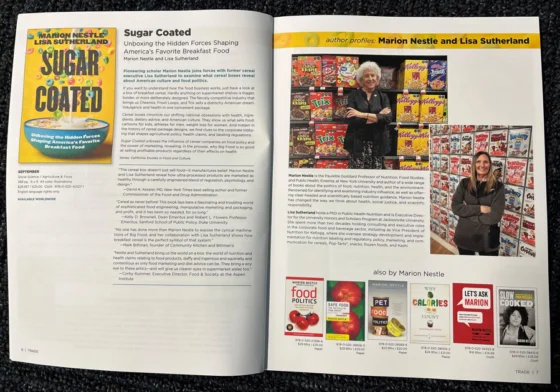
The announcement came via a preview of the University of California (UC) Press Fall 2026 catalog, marking the seventh collaboration between the renowned author and the esteemed publisher. For those who have followed Nestle’s career—from the seminal Food Politics to Soda Politics—this new volume represents a significant evolution in her work, blending rigorous research with a visual exploration of the very tools food corporations use to capture the youngest of consumers: the cereal box.
The Main Facts: An In-Depth Look at Sugar Coated
Sugar Coated is poised to be a definitive study on the intersection of public health, food marketing, and the pervasive role of sugar in the American diet. While the digital catalog is currently in limited release, the hard-copy catalog from UC Press provides a vivid window into the book’s thematic core.
The book explores how the food industry has successfully navigated changing dietary guidelines and growing public health crises by refining its messaging and aesthetic branding. Central to the book’s narrative are 44 full-color, full-page illustrations of cereal boxes. These are not merely decorative elements; they serve as primary source documents, illustrating how brands utilize bright colors, cartoon mascots, and health-related claims to manipulate consumer behavior—particularly among children—while obfuscating the high sugar content inherent in these breakfast staples.
For readers interested in securing a copy, pre-orders are currently being processed through the UC Press website. The release date of September 8, 2026, places the book at the center of the fall academic and general interest publishing season, suggesting a strategy to reach both students of public health and the general public concerned about dietary wellness.
A Chronology of Collaboration: Seven Books with UC Press
The relationship between Marion Nestle and the University of California Press is one of the most productive author-publisher partnerships in contemporary academic nonfiction. This partnership has spanned over two decades, creating a body of work that has fundamentally shifted the discourse surrounding food advocacy.
- The Foundation (2002): The publication of Food Politics established Nestle as a leading critic of the food industry’s influence on dietary advice and federal policy.
- Deepening the Analysis (2006–2015): Through subsequent works, including Safe Food, What to Eat, and the exhaustive Soda Politics, Nestle systematically dismantled the "Big Food" narrative, focusing on the lobbying efforts of soft drink giants and the lack of transparency in food safety regulations.
- Broadening the Scope: With books like Unsavory Truth, Nestle turned her attention to the corruption of nutritional science by industry-funded studies.
- The Current Milestone (2026): Sugar Coated marks the seventh installment in this series. This long-standing collaboration underscores a commitment to accessible, evidence-based research that bridges the gap between the ivory tower and the kitchen table.
Supporting Data: The Anatomy of Sugar Consumption
While Sugar Coated will provide the qualitative narrative, the context for this book is supported by decades of quantitative data regarding the health outcomes of excessive sugar consumption. According to the Centers for Disease Control and Prevention (CDC), the average American adult consumes approximately 17 teaspoons of added sugar per day, far exceeding the American Heart Association’s recommended limits of 6 teaspoons for women and 9 for men.
The cereal aisle has long been a battleground for these statistics. Research highlighted in previous works by Nestle, as well as by independent public health organizations, indicates that many popular breakfast cereals marketed to children contain sugar levels that mirror those found in desserts.
The decision to feature 44 full-page cereal box illustrations in Sugar Coated is a strategic methodological choice. By focusing on the visual rhetoric of packaging, Nestle aims to show how "health halos"—such as claims of "whole grains" or "added vitamins"—are used to mask the presence of high-fructose corn syrup and refined sugars. This serves as a reminder that in the supermarket, the most important information is often hidden in plain sight, obscured by the very branding designed to attract the consumer’s eye.
Official Responses and Academic Reception
The announcement of Sugar Coated has been met with enthusiasm within the academic community, which views Nestle as a rare scholar who can translate dense public health data into actionable public knowledge.
"Marion Nestle’s work is indispensable because she makes the invisible visible," says Dr. Elena Rodriguez, a professor of public health at a major research university. "By focusing on the cereal box as a site of corporate messaging, she is tackling the psychological and cultural underpinnings of the obesity epidemic. It’s not just about the sugar; it’s about how we are taught to crave it from the time we can read."
UC Press, in its catalog materials, has highlighted the aesthetic quality of the book, noting that the inclusion of high-resolution, full-color imagery is a departure from traditional, text-heavy academic texts. This indicates a shift in the press’s strategy to make the book more marketable to a broader, trade-focused audience while maintaining the scholarly rigor expected of a University Press.
Implications: Changing the Food System
The implications of Sugar Coated are broad. If the history of Nestle’s past work is any indicator, this book will likely influence the discourse around:
- Regulatory Reform: By documenting the deceptive marketing practices of cereal manufacturers, the book provides fuel for advocacy groups calling for stricter labeling laws and restrictions on marketing high-sugar products to minors.
- Nutritional Literacy: The book aims to arm parents and consumers with the critical tools needed to look past the branding and evaluate the nutritional density of the products they purchase.
- Industry Accountability: By documenting the evolution of packaging, the book serves as a historical record of how the food industry has adapted to public pressure, potentially forcing a defensive response from corporate entities.
As we look toward September 2026, the arrival of Sugar Coated will undoubtedly serve as a catalyst for renewed debate. In an era where "ultra-processed" has become a household term, Nestle’s latest work offers a timely intervention, suggesting that the path to a healthier society requires not just better food policy, but a more discerning and critical eye for the narratives—and the boxes—that land in our grocery carts.
For those waiting for the release, the message from the author is clear: the history of how we eat is written on the packaging we encounter every day. To understand the future of American health, one must first understand the sugar-coated messages that have defined our past.
For more information on the publication or to view the catalog entry, readers can visit the University of California Press website.