










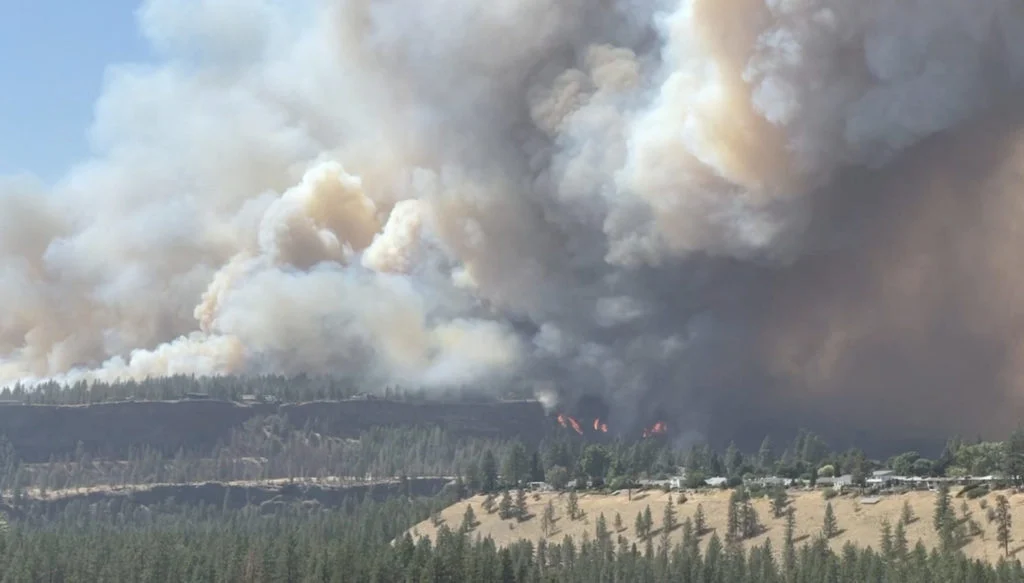
The Pacific Northwest is currently facing one of its most perilous environmental crises in recent memory. Across Washington State, a volatile combination of historic drought, extreme weather patterns, and widespread ignition points has transformed the landscape into a tinderbox. As of this week, 16 major wildfires are raging across the region, consuming over 250,000 acres and threatening the structural integrity of entire communities. Nowhere is this devastation more acute than in the area surrounding Spokane, Washington’s second-largest city, where the "Old Trails" fire—now the subject of a criminal arson investigation—has obliterated hundreds of homes and forced tens of thousands of residents into a desperate flight for safety.
The Human Toll and the Scope of Destruction
The scale of the destruction in Spokane County is staggering. Authorities report that at least 700 structures have been leveled, with officials warning that the final count of destroyed homes will likely climb as teams gain access to restricted areas.
For the roughly 67,000 residents who were ordered to evacuate, the experience was one of rapid, life-altering terror. Kami Fehlig, a resident displaced by the inferno, described the frantic final moments before her family fled. "About 30 minutes before it jumped the river, my husband and I were seeing how bad it was," Fehlig recounted. "We told the kids, ‘We don’t want to scare you, but we think you should start preparing.’ I grabbed my wedding album, I grabbed the kids’ baby books, and within a few minutes, the power went out. It was: ‘Go now. Go now.’"
Despite the sheer volume of destruction, there have been no reports of fatalities or serious injuries—a statistical anomaly that Commissioner of Public Lands Dave Upthegrove attributes to the near-miraculous performance of local emergency responders. The efficiency of the evacuation orders, coordinated by local sheriff’s offices and fire departments, allowed for the orderly relocation of tens of thousands of people under extreme duress. However, Commissioner Upthegrove cautioned that the danger is not yet in the rearview mirror. "This event is not over," he noted. "As these fires are brought under control and residents return to survey the wreckage, there is still a risk of hidden hazards."
The Old Trails Fire: Arson Allegations and Criminal Justice
The most destructive of the Spokane blazes, the Old Trails fire, has brought a secondary layer of tragedy to the disaster: the suspicion of human culpability. Last night, authorities arrested a 37-year-old suspect, Aaron Farinacci, following a tip from a member of the public.
The investigation into the fire’s origins is ongoing, led by the Spokane County Sheriff’s Office. The suspect, who has a prior criminal record including a 2010 conviction for the killing of his father, has vehemently denied setting the fire. Reports have surfaced suggesting that Farinacci had been contacted by law enforcement regarding two other fire incidents last year, though he was never charged in those cases.
While the legal process moves forward, the emotional impact on the community is profound. "If someone intentionally started a fire that endangers homes, lives, and firefighters, that is an incredible betrayal of this community," Commissioner Upthegrove said. "They absolutely need to be held accountable under the law. But whether this fire proves to have been started intentionally or not, the story I hope people remember are the thousands of community members who have responded with compassion and courage."
A Chronology of Crisis
The current fire season in Washington is being described as one of the most severe in decades. The chronology of this disaster began with the convergence of an multi-year emergency drought and the onset of El Niño weather patterns, which primed the state’s forests and grasslands for rapid ignition.
- The Pre-Season Drought: Washington entered this summer in its fourth consecutive year of emergency drought, leaving vegetation critically dry.
- The Outbreak: As temperatures spiked, multiple ignition points emerged across the eastern part of the state. Within days, 16 major fires were burning simultaneously, stretching state resources to the breaking point.
- The Spokane Crisis: The Old Trails fire breached the outskirts of Spokane, forcing the evacuation of tens of thousands and overwhelming local infrastructure.
- Federal Intervention: President Biden authorized federal disaster relief, unlocking essential resources for the state, including search-and-rescue support and emergency infrastructure like power generators for water systems.
- The Current State: As of mid-week, the state is engaged in a massive multi-state and international containment effort, with 5,000 personnel deployed from across the U.S. and as far away as Australia.
Supporting Data: By the Numbers
The metrics of this fire season paint a grim picture of the challenges facing the Pacific Northwest:
- Total Acreage Burned: Over 500,000 acres statewide so far this year.
- Active Major Fires: 16 large-scale blazes.
- Personnel Deployed: 5,000 firefighters and support staff from over a dozen states and Australia.
- Structures Lost: At least 700 confirmed, with an expectation that the number will rise.
- Evacuations: Approximately 67,000 individuals forced from their homes.
- Shelter Occupancy: 500+ residents currently housed at the Spokane Convention Center.
Official Responses and Strategic Challenges
The response to the wildfires has been a collaborative effort between local, state, and federal agencies. Commissioner Upthegrove emphasized that the state’s primary focus remains on fire suppression and life safety. "We have an incident command team making meaningful progress, but there is a lot of work to do," he explained.
The federal authorization of disaster relief is a critical lifeline, providing the immediate short-term assistance necessary to maintain public utility stability. However, the Commissioner noted that the long-term recovery will be an arduous, multi-year process. The state’s ability to combat these fires is hampered by the fact that multiple regions across the country are facing similar climate-driven crises, creating a global shortage of available firefighting resources and equipment.
Implications: The "New Normal" in the Pacific Northwest
The implications of this disaster extend far beyond the immediate damage to homes and property. The fact that a wildfire of this magnitude could penetrate the suburban periphery of Spokane—the state’s second-largest city—is viewed by officials as a harbinger of a new, more dangerous climate reality.
The Weather Factor
Meteorologists and fire officials are keeping a close eye on wind speeds and humidity levels. While winds have recently subsided, the long-term outlook remains volatile. High temperatures are predicted for the coming days, and the underlying moisture deficit remains unaddressed. The confluence of El Niño-driven weather patterns and persistent drought suggests that the "fire season" is no longer a seasonal event, but an ongoing risk that could persist well into the autumn.
Infrastructure and Policy
The destruction in Spokane will likely trigger a massive policy shift regarding urban-wildland interface management. As residential developments continue to expand into historically fire-prone landscapes, the cost of protection and the risk of catastrophic loss continue to rise. State leaders are now facing the difficult task of balancing the need for housing with the requirement for rigorous fire-resilient zoning.
A Community United
Despite the bleak statistics and the shadow of arson, Commissioner Upthegrove remains resolute. "One individual doesn’t define this community," he said. "The way the community responded has."
The resilience of the Spokane population—as evidenced by the rapid mobilization of shelters and the outpouring of community support—serves as the primary source of hope for the region. As the fires continue to burn, the state of Washington remains in a state of high alert, awaiting the shift in weather that will finally allow exhausted crews to gain the upper hand. For now, the focus is singular: protect the people, hold the line, and prepare for the long, difficult road to rebuilding what has been lost.