








By Editorial Staff
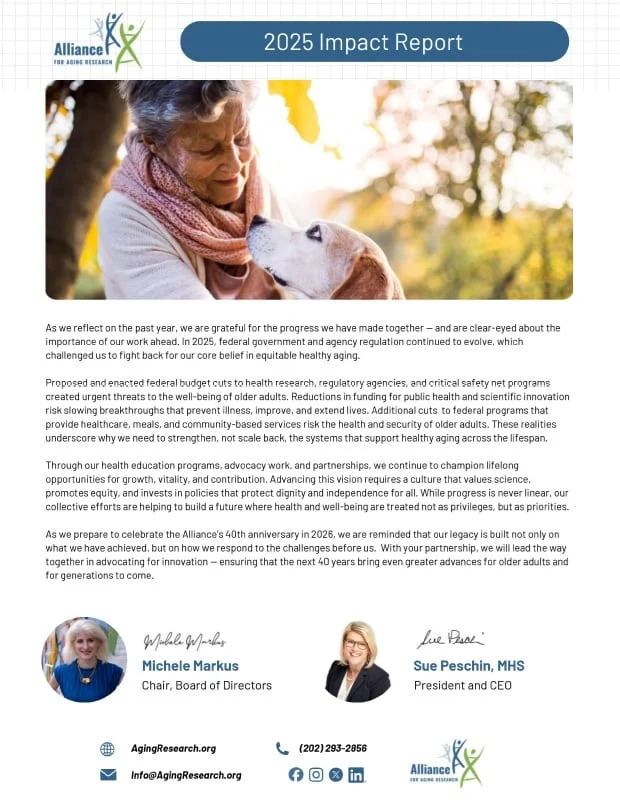
As the global population undergoes a demographic shift of unprecedented proportions, the role of advocacy, health education, and policy-driven research has never been more critical. This month, the Alliance for Aging Research—the nation’s leading nonprofit organization dedicated to accelerating the pace of scientific discovery and improving the lives of older adults—officially released its 2025 Impact Report.
The document serves as more than just an annual summary; it acts as a comprehensive blueprint for the future of healthy aging. Packed with insights into the organization’s governance, award-winning advocacy campaigns, and strategic initiatives, the interactive report illuminates how the Alliance has navigated a complex, evolving landscape of federal regulations and public health challenges over the past year.
Main Facts: A Year of Advocacy and Transformation
The 2025 Impact Report details a year defined by resilience and strategic expansion. For the Alliance, 2025 was a period marked by significant shifts in how the federal government interacts with geriatric health policy. As regulatory frameworks evolved, the Alliance positioned itself as a bulwark for patient-centered care.
Key takeaways from the report include:
- Expansion of Health Education: The Alliance successfully scaled its digital and community-based health education initiatives, reaching record numbers of older adults with evidence-based resources.
- Policy Advocacy: The organization remained at the forefront of legislative debates, advocating for equitable access to medical innovation and the protection of patient rights within the Medicare and Medicaid systems.
- Organizational Milestones: The report highlights the internal strengthening of the Alliance’s Board and staff, ensuring that the organization is equipped with the subject-matter expertise necessary to tackle the complexities of chronic disease management and longevity science.
The report is now available to the public via the Alliance’s Financial Reports & Funding page, offering both a dynamic, interactive web experience and a comprehensive PDF download for stakeholders and researchers.
Chronology: Navigating the 2025 Regulatory Landscape
To understand the weight of the 2025 Impact Report, one must look at the timeline of the year. Throughout the first and second quarters, the Alliance focused heavily on responding to proposed federal regulations that threatened to stifle innovation in drug development.
- Q1 2025: The Alliance launched a series of "State of Aging" briefings, identifying critical gaps in chronic disease care that would define the advocacy agenda for the remainder of the year.
- Q2 2025: As new agency regulations emerged from Washington, the Alliance mobilized its coalition of partners. This period was marked by an intensive effort to ensure that the voice of the older patient was not sidelined in favor of fiscal austerity measures.
- Q3 2025: The Alliance shifted its focus toward the promotion of healthy aging literacy, hosting virtual symposiums that addressed the intersection of technology and geriatric health.
- Q4 2025: The year culminated in the finalization of the Impact Report, synthesizing data from the previous twelve months and preparing the organization for its milestone 40th anniversary celebrations.
Supporting Data: Why Evidence-Based Advocacy Matters
The effectiveness of the Alliance’s work is predicated on its reliance on rigorous data. In an era where health misinformation is prevalent, the Alliance serves as a verified source for older adults, caregivers, and medical professionals.
The 2025 report underscores several data-driven achievements:
- Engagement Metrics: Through its multi-channel approach, the Alliance saw a significant increase in engagement across its digital platforms, suggesting that the demand for accessible information regarding age-related conditions—such as Alzheimer’s disease, heart failure, and sensory loss—is at an all-time high.
- Regulatory Impact: By tracking the outcomes of its advocacy efforts, the Alliance demonstrated a tangible influence on policy decisions, effectively pushing back against proposed cuts that would have limited access to life-saving therapies for seniors.
- Collaborative Funding: The document details the financial stewardship of the organization. With support from a diverse coalition of philanthropic partners and individual donors, the Alliance maintained its fiscal health, allowing for the launch of new, high-impact programs that would otherwise be impossible to sustain.
Official Responses: Reflections from Leadership
The release of the report is accompanied by a joint statement from the Alliance’s leadership, which underscores the gravity of the current moment in the aging advocacy movement.
"As we reflect on the past year, we are grateful for the progress we have made together—and are clear-eyed about the importance of our work ahead," stated Alliance Board Chair Michele Markus and Alliance President & CEO Sue Peschin.
The leadership team emphasized that 2025 was not a year of passive observation but one of active resistance against policies that undermined the equity of healthcare. "In 2025, federal government and agency regulation continued to evolve, which challenged us to fight back for our core belief in equitable healthy aging," they added.
This sentiment serves as the heartbeat of the report. It is a recognition that while progress has been made, the fight for equitable access to care, the reduction of ageism in medicine, and the acceleration of research into the biology of aging remains an urgent, ongoing mission.
Implications: The Road Ahead and the 40th Anniversary
The 2025 Impact Report arrives at a symbolic juncture. As the Alliance enters its 40th year, the implications of its work extend far beyond the immediate gains of the last twelve months.
The 40-Year Legacy
Founded on the principle that the scientific community must prioritize the unique needs of an aging population, the Alliance has spent four decades changing the national conversation. From its early days of highlighting the importance of basic research to its current role as a sophisticated policy engine, the Alliance has become a cornerstone of the American health infrastructure.
Building for the Future
The implications of the 2025 report suggest a clear strategy for the next decade:
- Technological Integration: The Alliance is increasingly looking at how artificial intelligence and remote monitoring can improve outcomes for older adults living independently.
- Policy Resilience: With a new legislative session looming, the Alliance is preparing to defend the progress made in Medicare and other social safety nets.
- Public Awareness: A key takeaway from the report is the need to dismantle the systemic ageism that persists in healthcare. The Alliance plans to continue its award-winning media campaigns to change the narrative around what it means to age in the 21st century.
A Call to Action
The report concludes with a message of profound gratitude. The work of the Alliance is only possible because of its community. "We are grateful to you and our entire community of partners, whose generous support allows us to do meaningful work for older adults and their loved ones," the organization notes.
As Katie Riley, Vice President of Communications, notes in the closing of the report’s introduction, the mission is far from complete. The organization encourages all stakeholders, from medical researchers to the everyday reader, to visit www.AgingResearch.org to stay connected.
Whether it is through volunteering, supporting the Alliance’s advocacy campaigns, or simply engaging with the wealth of educational content provided in the report, the path forward is a collective one. By bridging the gap between scientific discovery and public policy, the Alliance for Aging Research is ensuring that the "silver tsunami" is not a crisis, but a new era of opportunity for human longevity.
As the organization marks its 40th anniversary, the 2025 Impact Report stands as a testament to the fact that while aging is inevitable, the quality of that experience is something that can—and must—be improved through dedicated, tireless advocacy.