









For decades, the fitness and nutrition industries have been tethered to a culture of meticulous quantification. From the rise of smartphone calorie-counting apps to the ubiquitous nature of wearable tech, the modern eater is constantly bombarded with external metrics. Yet, for many—including those with professional expertise—this reliance on data has begun to produce diminishing returns.
Dr. Gabrielle Fundaro, a PhD in Human Nutrition, a seasoned nutrition coach, and a competitive powerlifter, found herself at a breaking point. Despite having the academic credentials and the practical experience to navigate the world of macronutrient tracking, she realized that the method she preached was becoming a source of anxiety rather than liberation. Her story marks a shifting tide in the nutritional landscape: the emergence of "RPE-Eating," a framework that trades digital spreadsheets for internal biological awareness.
The Chronology of a Shift: From Macro-Counting to Autoregulation
The evolution of Dr. Fundaro’s approach did not happen overnight; it was a slow realization born of exhaustion. For years, she utilized macro-tracking to maintain her physique for powerlifting competitions. It was, by all conventional accounts, a "success." She hit her targets, managed her weight, and performed at a high level.
However, the psychological cost began to accrue. The precision required to hit exact protein, fat, and carbohydrate ratios meant that spontaneous social interactions—like dinner with friends or enjoying a meal at a restaurant—became logistical hurdles rather than sources of pleasure.
"I worried that if I stopped tracking macros, I would lose my physique," Dr. Fundaro admits. This fear is common among athletes and fitness enthusiasts, creating a cycle of dependency. The tipping point arrived when the mental fatigue of balancing numbers began to overshadow the physical benefits of the diet.
The turning point occurred at the gym. Dr. Fundaro, like many strength athletes, began incorporating the Rate of Perceived Exertion (RPE) scale into her training. Instead of obsessively hitting specific percentages of her one-rep max, she listened to her body’s daily capacity. She found that her recovery improved, her strength gains were consistent, and most importantly, she felt more in tune with her physical state. The analogy was striking: if RPE could optimize physical output, could it also optimize caloric intake?
Supporting Data: The Science of Interoception
At the heart of the RPE-Eating method is the concept of interoceptive awareness. This is the ability to perceive and interpret signals from within the body—hunger, fullness, fatigue, and satisfaction.
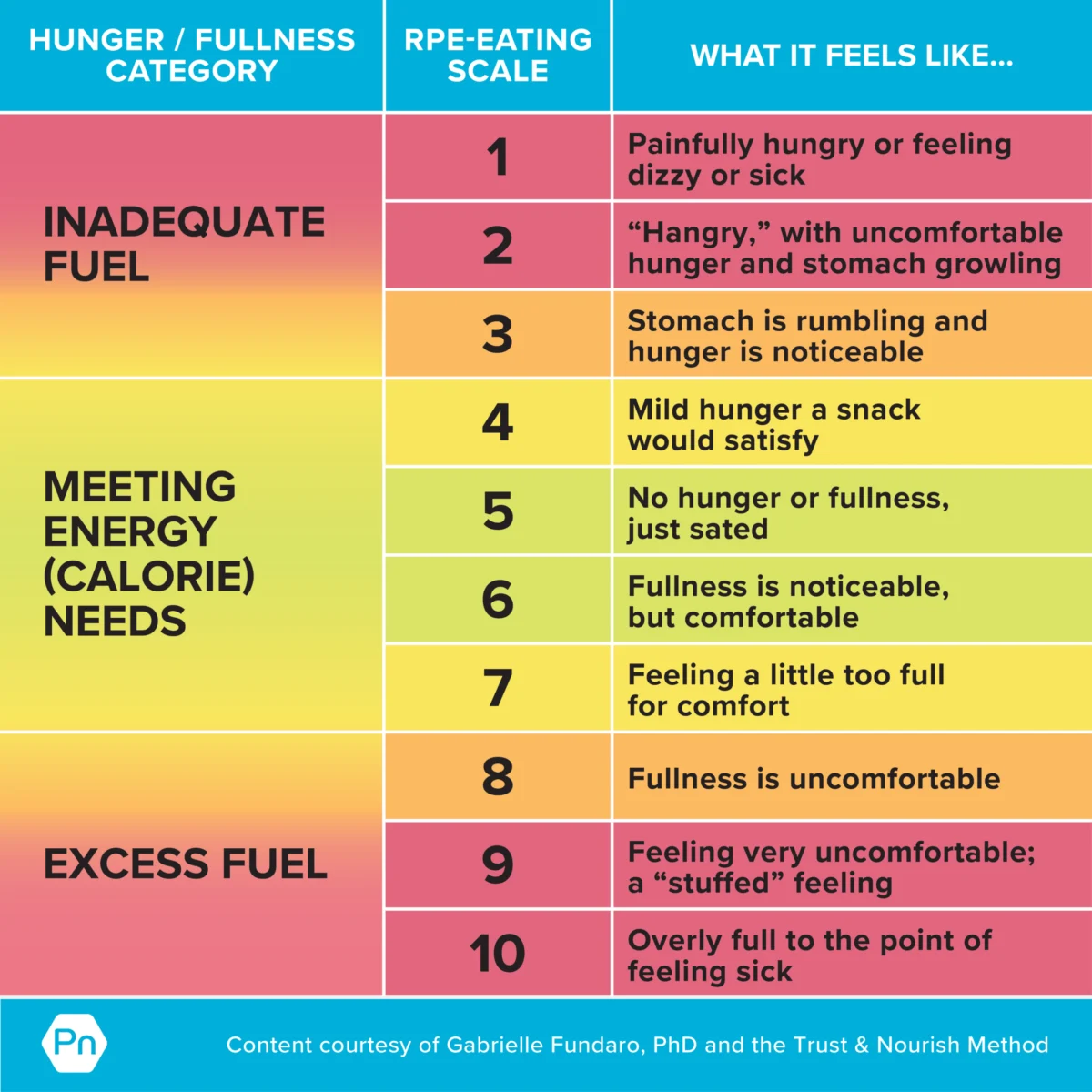
The RPE scale, originally invented by Gunnar Borg in the 1960s, was designed to measure physical exertion during exercise. While traditional scales ranged from 6 to 20, modern adaptations often use a 0–10 scale. Dr. Fundaro adapted this framework for nutrition, mapping it against hunger and fullness.
The RPE-Eating Scale Breakdown:
- 1–3 (Inadequate Fuel): Characterized by physical emptiness, stomach growling, or lightheadedness.
- 4–7 (Adequate Fuel): The "Goldilocks" zone. Mild hunger satisfied by a meal, leading to a state of comfortable satiety.
- 8–10 (Excess Fuel): Ranging from "a little too full" to physical discomfort or sickness.
By shifting the focus from external data (the app) to internal data (the body), individuals can cultivate a more intuitive relationship with food. This isn’t merely "eating by feelings"; it is the practice of training the brain to recognize the physiological markers that correspond to the body’s actual energetic needs.

Official Perspective: The Role of Structure vs. Freedom
The transition away from macro-tracking often triggers a fear of "losing control." Dr. Fundaro argues that RPE-Eating is not the absence of structure, but rather the implementation of a more sophisticated structure.
"RPE-Eating is about sensing into what your body needs and giving yourself appropriate nourishment—while building inner trust and confidence," she explains. She distinguishes this clearly from intuitive eating, which can feel overwhelming for those who have spent years ignoring their body’s signals. RPE-Eating provides the "guardrails" that many former dieters need to feel secure.
The Four Pillars of Practice:
- Define Your Goal: Acknowledge that the goal is not "optimal perfection," but rather "sustainable self-trust."
- Identify Hunger vs. Appetite: Distinguish between physical hunger (the need for energy) and appetite (the psychological desire for pleasure).
- Notice and Name: Use this technique to identify emotional triggers for eating. If you find yourself eating compulsively, ask: "What feeling am I experiencing right now?"
- Balance Satiety and Satisfaction: Recognizing that a meal must satisfy both the body (fuel) and the mind (pleasure) to be truly nourishing.
Implications for the Future of Nutrition Coaching
The rise of RPE-Eating has profound implications for the fitness industry. For years, the industry has relied on "one-size-fits-all" calculations. While these are useful for novices, they often fail to account for the dynamic, fluctuating needs of the human body over months and years of training.
Is RPE-Eating for Everyone?
Dr. Fundaro is careful to note that this method is not a panacea. It requires a level of mindfulness that can be challenging for those with chaotic schedules, such as parents or shift workers. However, for those who feel trapped by the "tracking-binge" cycle, it offers a vital exit ramp.
- For the Coach: It allows for a more personalized approach to client care. Instead of dictating a spreadsheet, the coach teaches the client how to read their own biological feedback.
- For the Athlete: It removes the stigma of "not tracking" and provides a framework to maintain a physique without the psychological burden of digital counting.
- For the General Population: It provides a pathway to mend a fractured relationship with food, moving away from the binary "good/bad" food mentality and toward a more flexible, sustainable lifestyle.
Addressing the Skeptics: "Feelings Over Facts?"
Critics of RPE-Eating often argue that it lacks the precision of traditional tracking. To this, Dr. Fundaro points to the evolution of sports science. "RPE was once laughed at by lifters, too," she notes. Today, it is a gold standard in training because it respects the reality that an athlete is not a machine. If an athlete is stressed, sleep-deprived, or overtrained, their ability to perform changes; the RPE scale adjusts to that reality in real-time.
By applying this logic to nutrition, we acknowledge that human metabolism and appetite are similarly dynamic. A fixed calorie count cannot account for a stressful day at work, a hard workout, or a change in hormonal cycles.
Conclusion: Reclaiming the Dinner Table
The ultimate goal of Dr. Fundaro’s work is not to eliminate nutrition science, but to integrate it into the human experience. By treating our internal cues with the same respect we afford a GPS or a heart-rate monitor, we reclaim a sense of autonomy that has been lost in the age of algorithmic diet culture.
For those who have spent years staring at a phone screen before every bite, the shift to RPE-Eating represents a radical act of self-trust. It is the realization that while data can be a useful servant, it makes for a poor master. As Dr. Fundaro concludes, "The goal is to know that you are nourishing yourself—and you don’t need a food tracker to do that."
Disclaimer: RPE-Eating is a tool for developing awareness and is not a substitute for professional medical or psychological treatment. Individuals with a history of disordered eating should consult with a qualified health professional before altering their nutritional approach.