For years, Dr. Gabrielle Fundaro was the gold standard of nutritional discipline. With a PhD in Human Nutrition, over a decade of experience as a high-level coach, and a competitive history as a powerlifter, she lived by the data. Every meal was meticulously tracked, every macronutrient accounted for, and every calorie logged. It was the "optimal" way to live—until, quite suddenly, it wasn’t.
Despite her professional expertise, Dr. Fundaro found herself trapped in a cycle of dependency. The very tools meant to empower her—macro-tracking apps and digital logs—had become a psychological shackle. She realized that while she knew how to fuel a body, she had lost the ability to listen to one.
"I worried that if I stopped tracking macros, I would lose my physique," she admits. It was a fear shared by many, but for an expert in the field, the admission felt like a professional vulnerability. This realization served as the catalyst for a new, revolutionary approach: RPE-Eating.
The Chronology of a Paradigm Shift
The journey toward RPE-Eating began in the weight room. As a powerlifter, Dr. Fundaro had transitioned her training from rigid percentage-based programming to the Rate of Perceived Exertion (RPE) scale. By gauging her effort based on how the weight felt on any given day—rather than a pre-determined spreadsheet—she found she was not only hitting new personal bests but also recovering with greater efficiency.
The lightbulb moment was stark: If athletes could effectively manage intense physical output through subjective internal feedback, why were they treating nutritional intake as a math problem to be solved rather than a biological process to be experienced?
Dr. Fundaro began experimenting with the RPE scale—a 1–10 metric originally popularized by Gunnar Borg in the 1960s—and adapted it for the dinner table. She moved away from external trackers, opting instead for a system that prioritized hunger cues, satiety, and emotional awareness. The result was not just a change in diet, but a total restoration of her relationship with food.
The Mechanics of RPE-Eating: Supporting Data and Methodology
At its core, RPE-Eating is an exercise in interoceptive awareness—the body’s ability to sense its own internal state. While traditional dieting relies on external data (calories, grams of protein, percentages), RPE-Eating relies on biological feedback.
The Scale Defined
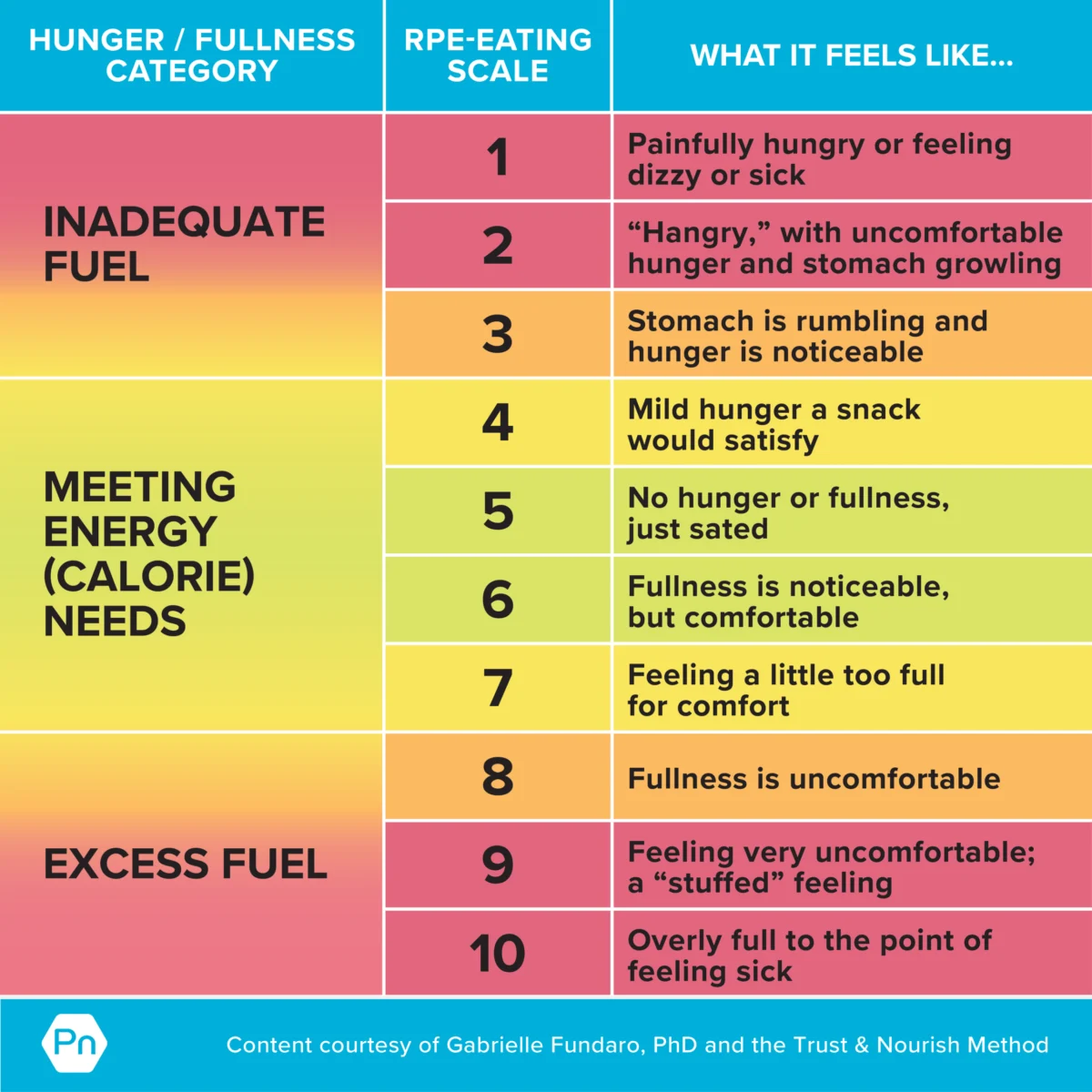
The RPE-Eating scale functions as a navigational tool for the stomach:
- Levels 1–3: Inadequate fuel (Feeling dizzy, "hangry," or physically empty).
- Levels 4–7: Adequate fuel (Comfortably full, satisfied, and energized).
- Levels 8–10: Excess fuel (Uncomfortably full, sluggish, or bloated).
The methodology requires a four-step process that shifts the focus from "what" to eat to "how" the body responds to nourishment.
- Goal Alignment: RPE-Eating is primarily a tool for self-trust. While it can be adapted for weight management, its primary function is to remove the "all-or-nothing" mentality that plagues most dieters.
- Hunger vs. Appetite: The system forces users to distinguish between genuine physiological hunger (the body needing energy) and appetite (the psychological desire to eat for pleasure or comfort).
- Trigger Mapping: By employing a "Notice and Name" strategy, practitioners learn to identify why they eat when they aren’t hungry, replacing mindless snacking with intentional pauses.
- Satiety and Satisfaction: Dr. Fundaro emphasizes that physical fullness (satiety) is only half the battle. True dietary peace comes from satisfaction—the emotional fulfillment that comes from enjoying food without guilt.
Implications for Modern Nutrition
The implications of this shift are profound, particularly for the fitness industry. For decades, the "If It Fits Your Macros" (IIFYM) movement has dominated, teaching individuals that as long as the numbers align, the source of the calories is secondary. While mathematically sound, this approach often ignores the psychological burden of constant data entry.
A Safety Net for Weight Management
For those concerned about weight loss or gain, Dr. Fundaro advocates for a "weight-neutral" starting point. By learning to eat within the 4–7 range consistently, individuals often find that their weight stabilizes naturally. If a specific goal is required, the scale can be tilted:

- For weight gain: Aiming for the higher end of the "adequate" spectrum (7–8).
- For weight loss: Focusing on the lower end (4–5).
However, she warns against using this method for extreme scenarios, such as professional bodybuilding preparation. "That would be like using physical therapy exercises to prepare for a powerlifting competition," she notes. It is a tool for life, not necessarily for the extreme fringes of performance sports.
Addressing the Skeptics: Feelings Over Facts?
Critics often argue that RPE-Eating is merely "eating by feelings," dismissing it as unscientific or overly subjective. Dr. Fundaro counters this by pointing to the evolution of strength training.
"RPE was once laughed at by lifters, too," she says. "They thought if you weren’t hitting a specific percentage of your one-rep max, you were wasting time." Today, RPE is a cornerstone of autoregulation in elite sports science. The science, she argues, lies in the body’s consistent ability to signal its needs when the noise of external tracking is removed.
By tracking internal sensations, practitioners are essentially performing a more complex, biological version of data logging. Instead of checking a blood glucose monitor, they are learning the subtle signs of blood sugar stabilization. It is, in many ways, a more sophisticated form of data collection than a generic app can provide.
Challenges and Considerations
While RPE-Eating offers a path to freedom, it is not a "magic bullet." It is, by definition, more laborious than mindlessly scanning barcodes into an app. It requires the practitioner to sit, be present, and reflect—a luxury that is not always possible for busy professionals, parents, or those working high-stress shifts.
Furthermore, Dr. Fundaro is quick to note that this is not a clinical intervention for those with active eating disorders. "If you or your client struggles with disordered eating, this tool does not replace working with a health professional," she emphasizes. It is a tool for autonomy, designed to help those who have already established a baseline of health but have lost their internal compass due to years of restrictive dieting.
Conclusion: The Ultimate Goal
The ultimate goal of RPE-Eating is not to create a new, stricter set of rules, but to eventually move beyond the need for any "system" at all. It is an off-ramp for the chronic dieter.
For many, the transition away from macro-tracking is terrifying. The fear of "losing control" is the primary barrier to sustainable health. By providing a structured way to practice intuition, Dr. Fundaro’s method bridges the gap between the rigid, numbers-driven world of modern nutrition and the intuitive, human-centered approach that has been lost to technology.
As Dr. Fundaro demonstrates, you don’t need a tracker to be a healthy, high-performing individual. You simply need to learn how to speak the language of your own body. By trading the digital spreadsheet for the biological scale, she has helped herself—and countless others—find a sense of peace that no app could ever provide.
"The goal," she concludes, "is to know that you are nourishing yourself, and that you don’t need a food tracker to do that." In a world obsessed with data, that kind of self-trust is perhaps the most valuable metric of all.