









For years, the gold standard for fitness enthusiasts and athletes has been clear: track your macros. Whether through MyFitnessPal, a spreadsheet, or a notebook, the practice of quantifying every gram of protein, carbohydrate, and fat has become synonymous with achieving a “perfect” physique. But what happens when the very tool designed to provide control becomes a source of anxiety, restriction, and disconnection?
Dr. Gabrielle Fundaro, a PhD in Human Nutrition, an experienced coach, and a decorated powerlifter, found herself at this exact crossroads. Despite her extensive credentials and years of professional success in the nutrition space, she realized that the rigid structure of macro tracking had eroded her ability to simply exist in a healthy relationship with food.
Today, Dr. Fundaro is championing a paradigm shift in how we approach nutrition: the RPE-Eating scale. By borrowing the principles of "Rate of Perceived Exertion" (RPE) from the strength training world, she is helping people move away from external data and toward a more intuitive, sustainable, and psychologically sound way of nourishing the body.
The Chronology of a Shift: From Tracking to Trust
Dr. Fundaro’s journey began with the same motivations as many others: performance and physique. As an athlete, tracking macros offered a precise, quantifiable way to ensure she was fueling her powerlifting training and maintaining a specific body composition. For over a decade, it worked.
However, the psychological toll began to accumulate. The perfectionism required to balance macros became an exhausting mental load. The inability to enjoy a social meal or trust her own body’s signals without checking an app created a sense of dependency. The breaking point arrived when she realized that she was no longer eating to live or even eating to perform—she was eating to satisfy an algorithm.
The fear of stopping, however, was profound. Like many who have spent years in the “tracking trap,” Dr. Fundaro feared the worst: muscle loss, fat gain, and the loss of her professional identity as a nutrition expert. If she couldn’t track, who was she? Through trial and error, she rejected both the total abandonment of structure—which felt too chaotic—and the rigidity of standard calorie counting. Drawing inspiration from her training in the gym, where she had successfully transitioned to RPE-based training, she realized the solution was hiding in plain sight.
The Science of Subjectivity: Understanding RPE
The Rate of Perceived Exertion (RPE) was pioneered by Gunnar Borg in the 1960s. Originally used in clinical settings to measure exertion during exercise, the scale is now a staple of modern athletics. It allows an athlete to gauge the intensity of a workout based on how it feels in real-time, rather than relying solely on heart rate monitors or fixed weights.
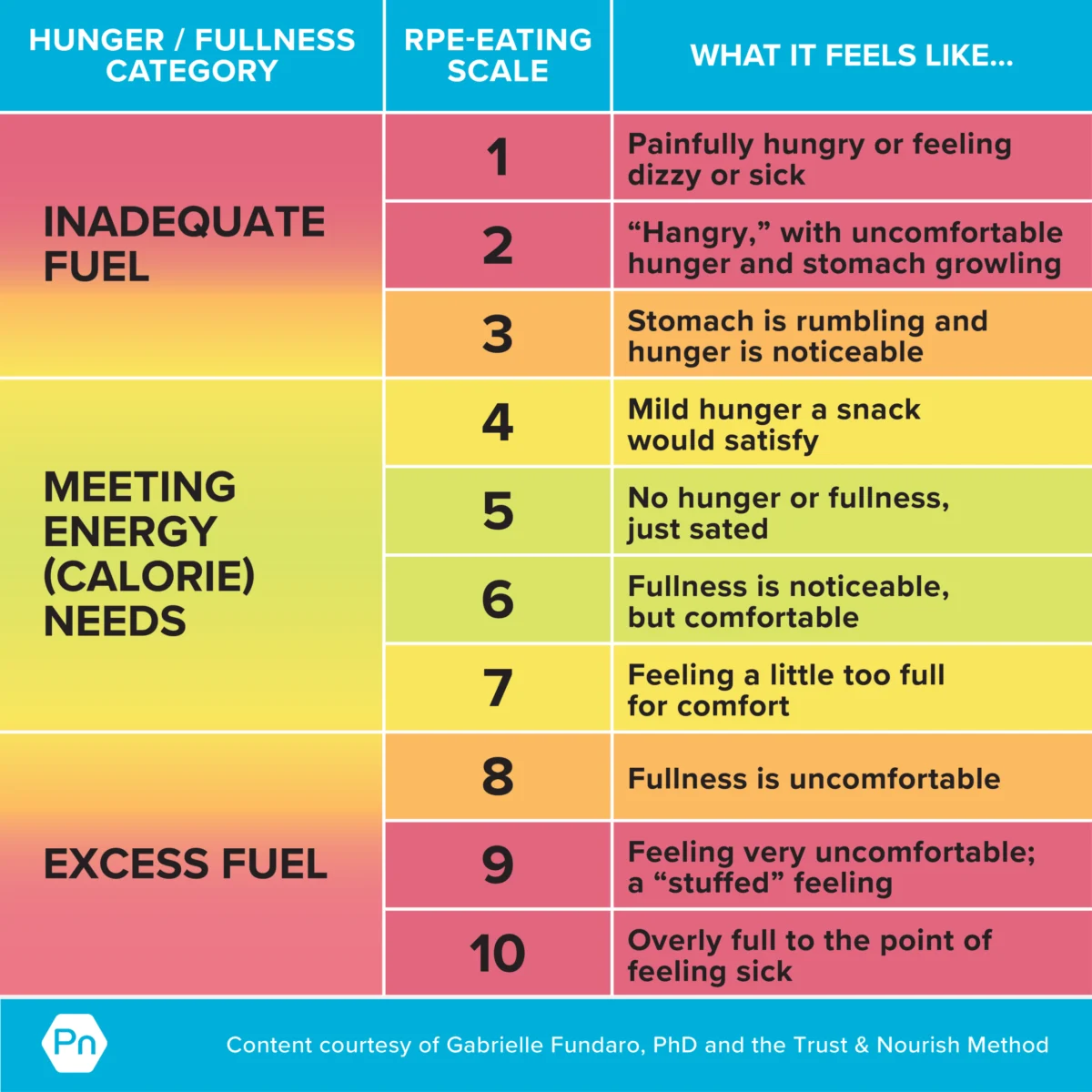
Dr. Fundaro’s adaptation, the RPE-Eating Scale, utilizes a 1–10 system that shifts the focus from calories to internal sensations. It is not an invitation to "eat whatever you want whenever you want," but rather a tool to cultivate interoceptive awareness—the ability to identify and respond to the body’s internal cues.
The Scale Breakdown:
- 1–3 (Inadequate Fuel): Ranging from painful hunger to lightheadedness.
- 4–7 (Adequate Fuel): The “Goldilocks” zone of comfortable, satisfied, and energized.
- 8–10 (Excess Fuel): Moving from comfortably full to the point of physical discomfort or sickness.
Supporting Data: Why "Feelings" Aren’t Just "Feelings"
Critics often dismiss intuitive or RPE-based eating as being too subjective, labeling it "feelings over facts." However, proponents argue that this mindset ignores the physiological reality of the human body. Interoceptive awareness is a skill, and like any other skill, it can be developed.

In strength training, the efficacy of RPE is well-documented. When an athlete learns to feel when a bar is moving slower (indicating fatigue) or when they have "reps in reserve," they train more safely and effectively. RPE-Eating functions similarly. When a person tunes into their body, they are monitoring internal biological feedback—blood sugar fluctuations, gastric distension, and metabolic signaling—that are more immediate and biologically relevant than a food app’s estimation of calories.
Furthermore, research into "mindful eating" consistently shows that individuals who are more attuned to hunger and fullness cues are less likely to experience binge eating episodes or the "yo-yo" dieting cycle common among chronic trackers. By moving from external metrics to internal awareness, individuals build a sustainable framework that doesn’t "break" when they go out to dinner or encounter a stressful day.
Official Stance: A Tool, Not a Religion
Dr. Fundaro is careful to emphasize that RPE-Eating is not a "cure-all." It is a tool, and like any tool, it has a specific utility. It is particularly effective for those who feel trapped by the compulsive nature of tracking or who have a history of disordered eating and body dissatisfaction.
For those who view macro tracking as a "security blanket," RPE-Eating acts as an off-ramp. It provides enough structure to feel safe while systematically dismantling the need for external validation.
When to Use It:
- For the "Recovering Tracker": Someone who wants to stop tracking but is afraid of losing control.
- For the Professional Athlete: To supplement training during off-seasons or to maintain a healthy relationship with food.
- For the Disordered Eater: As part of a broader therapeutic approach to regain trust in one’s own body.
When It May Not Be Appropriate:
- For Extreme Performance Goals: Dr. Fundaro notes that for professional bodybuilders or those needing extreme weight cuts for specific competitions, RPE-Eating is not the appropriate tool, just as physical therapy exercises are not meant to replace heavy barbell training during a meet.
- For Those with Clinical Eating Disorders: RPE-Eating is not a replacement for professional clinical intervention. Anyone struggling with severe disordered eating patterns should always seek the guidance of a registered dietitian, therapist, or specialized physician.
Implications: The Future of Nutrition Coaching
The shift toward RPE-Eating has significant implications for the coaching industry. For decades, the industry has sold "precision" through tracking. The future, however, may lie in "competence" through awareness.
By teaching clients how to identify their own hunger, recognize non-hunger triggers (such as emotional eating or stress), and distinguish between satiety (physical fullness) and satisfaction (emotional fulfillment), coaches can empower their clients to move beyond the app. This creates a client who is not dependent on their coach’s macro math, but one who possesses the lifelong skill of self-regulation.
The implications for long-term health are profound. When an individual stops fighting their body’s signals and starts working with them, they tend to adopt more consistent, moderate eating habits. They learn that they can enjoy a "fun" food—like a slice of pizza—without triggering a binge-restrict cycle, simply by checking in with where they fall on the RPE scale.
Closing the Gap: How to Start
For those interested in exploring this method, Dr. Fundaro suggests a simple, step-by-step integration:
- Define Your Goal: Are you looking to build self-trust or change your physique? If it’s the former, prioritize the process over the outcome.
- Practice Identification: Before every meal, record your hunger level on the 1–10 scale. Check in halfway through, and again at the end.
- Identify Triggers: When you find yourself eating compulsively, "notice and name" the emotion. Are you hungry, or are you stressed?
- Prioritize Satisfaction: Don’t just eat for fuel. Eat for enjoyment as well, but do so mindfully.
As Dr. Fundaro’s own experience proves, the goal of nutrition shouldn’t be to see how well you can manipulate a spreadsheet; it should be to cultivate a body that is fueled, satisfied, and capable of trusting its own needs. In a world obsessed with data, perhaps the most radical act of health is to stop tracking and start listening.