For years, the gold standard of physique management has been the digital logbook. Whether it is a dedicated app or a color-coded spreadsheet, the practice of "tracking macros"—counting grams of protein, fats, and carbohydrates—has dominated the fitness landscape. For Dr. Gabrielle Fundaro, a PhD in Human Nutrition and a seasoned powerlifting competitor, this method was not just a tool; it was a security blanket.
Yet, despite her academic pedigree and over a decade of coaching experience, Dr. Fundaro reached a breaking point. The very system she used to master her health had become a source of anxiety. She realized that she was no longer eating to fuel her life; she was eating to satisfy a mathematical equation.
This is the story of how a nutrition expert moved from the rigidity of external tracking to a new, internal-based framework: RPE-Eating.
The Crisis of Confidence: When Tracking Fails
For many, macro tracking serves as a vital learning phase. It provides a crash course in portion sizes and macronutrient density. However, for Dr. Fundaro, the practice eventually evolved into a psychological burden. The desire for "perfect" balance made dining out a chore and spontaneous eating a source of guilt.
The core of her struggle wasn’t a lack of knowledge; it was a lack of autonomy. Every time she attempted to stop tracking, a wave of "what-ifs" crashed over her: What if I lose my muscle mass? What if I inadvertently overeat and gain fat? If I can’t hit my numbers, am I even an expert?
She discovered that she was not alone. Many individuals find themselves caught in a cycle of "all-or-nothing" thinking, where the absence of a tracker triggers a fear of total loss of control. Traditional intuitive eating, while popular, often felt too nebulous for those who thrived on the structure of data. Dr. Fundaro needed a "middle way"—a framework that provided structure without the digital leash.
Chronology of a Shift: From the Gym to the Kitchen
The breakthrough arrived in an unexpected place: the weight room.
In her training, Dr. Fundaro had transitioned to the Rate of Perceived Exertion (RPE) scale. RPE is a well-established tool in strength sports, used to quantify the intensity of an effort based on how the lifter feels on a given day, rather than an arbitrary percentage of a "one-rep max."
She noticed that when she used RPE to guide her training, she didn’t just train safer; she performed better. She was able to adjust her intensity based on her recovery, stress levels, and sleep. It was a perfect marriage of structure and biological reality.
The realization was sudden: If RPE could optimize the stress placed on muscles, why couldn’t a similar scale optimize the fuel provided to the body? By adapting the 1–10 intensity scale used in physiology, Dr. Fundaro began developing "RPE-Eating"—a method designed to help individuals regain trust in their own hunger signals.
Understanding the RPE-Eating Framework
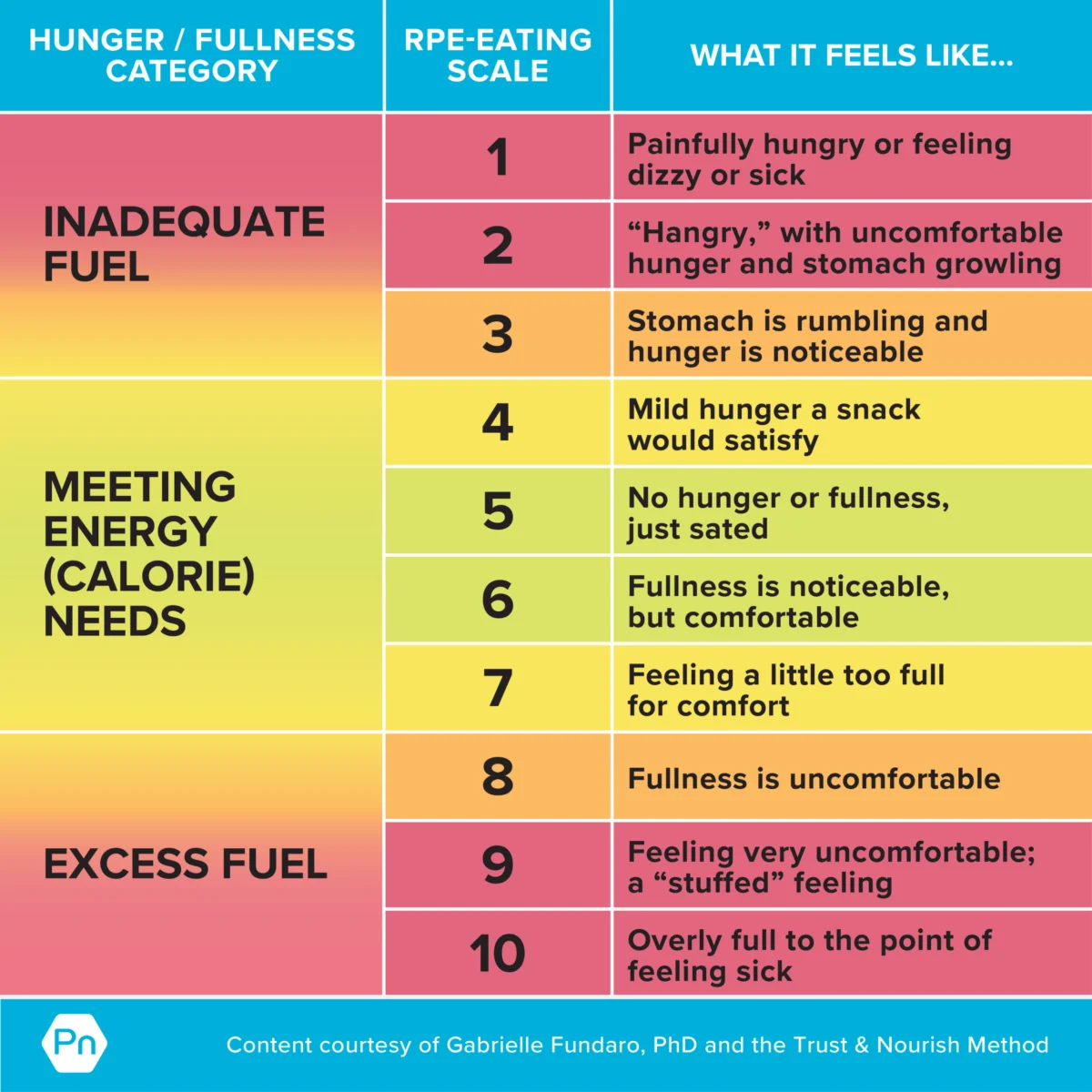
Invented in the 1960s by Gunnar Borg for use in clinical settings, the original RPE scale measured physiological strain. Dr. Fundaro adapted this into a 1–10 hunger and fullness scale.
The RPE-Eating Scale Breakdown
- 1–3 (Inadequate Fuel): Characterized by physical symptoms like dizziness, lightheadedness, or intense "hangry" irritability.
- 4–7 (Adequate Fuel): The "sweet spot." Here, the body feels satisfied, energized, and nourished without being weighed down.
- 8–10 (Excess Fuel): Ranges from feeling "too full" to the point of physical discomfort or sickness.
The objective of this framework is not to reach a specific number, but to move through the day with an awareness of where one sits on the scale. By checking in before, during, and after a meal, the practitioner learns to identify the difference between hunger (a physical requirement for energy) and appetite (the desire to eat for pleasure or emotional comfort).

Supporting Data: Why "Feelings" Are Actually "Facts"
Critics often dismiss RPE-based methods as "eating by feelings." However, experts argue that this is a misunderstanding of interoceptive awareness—the body’s ability to sense its internal state.
Research into autoregulation in athletics has shown that athletes who rely on perceived effort are often more consistent and less prone to burnout than those who follow rigid, inflexible protocols. When applied to nutrition, this isn’t about ignoring logic; it’s about substituting external software with internal hardware.
By practicing "Notice and Name"—a technique used to identify emotional triggers for eating—individuals can distinguish between a genuine physiological need for fuel and a reaction to a stressful event. This builds a psychological "muscle" that is far more resilient than a mobile app that deletes all your progress if you forget to log a snack.
Implications for Nutrition and Weight Management
The implications of this shift are profound for both the general public and those working toward specific body composition goals.
The Role of Satisfaction
Dr. Fundaro emphasizes that physical satiety is not the same as satisfaction. One can eat a bowl of steamed broccoli and chicken to the point of physical fullness (satiety) and yet still feel a nagging desire for something else (satisfaction). RPE-Eating advocates for incorporating foods that provide both. By removing the "forbidden" label from specific foods, the pendulum-swing of restriction and bingeing is significantly dampened.
Weight Modification
Can this method work for weight loss or muscle gain? Yes, but with caveats. Dr. Fundaro treats intentional weight modification like a contact sport: it carries inherent risks that must be managed.
- For weight gain: One might aim to hover in the 7–8 range to ensure caloric surplus.
- For weight loss: One might aim to consistently hit the 4–5 range.
However, she stresses that this is not a method for extreme bodybuilding prep. Just as you wouldn’t use light physiotherapy to train for an Olympic weightlifting meet, RPE-Eating is not the tool for extreme, short-term physique transformation. It is a tool for long-term, sustainable health.
Who is RPE-Eating For?
This framework is particularly valuable for:
- The Recovering Tracker: Those who feel trapped by the constant need to input data into a phone but fear they will lose their physique if they stop.
- The Burned-Out Athlete: Individuals who find that the stress of tracking is negatively impacting their mental health or recovery.
- The "Yo-Yo" Dieter: Those with a history of restrictive dieting who need a structured way to reconnect with their body’s natural signals.
It is important to note that RPE-Eating is not a replacement for clinical treatment. For individuals struggling with severe disordered eating, this tool should be used only under the guidance of a therapist or a registered dietitian.
Conclusion: The Ultimate Goal
The transition from tracking macros to practicing RPE-Eating is essentially a shift in philosophy. It is the move from viewing the human body as a machine that needs to be "calibrated" to viewing it as a partner that needs to be "heard."
As Dr. Fundaro concludes, the goal is not to reach a state of nutritional perfection, but to reach a state of nutritional competence. When you no longer need an app to tell you if you are hungry or full, you have achieved a level of freedom that no spreadsheet can provide. You are, for the first time, truly in the driver’s seat.