









In the high-stakes environment of an out-of-hospital cardiac arrest (OHCA), the focus has historically been laser-focused on the patient. While the "Chain of Survival"—early recognition, CPR, and defibrillation—is well-documented, a vital link has long been missing: the psychological welfare of the bystanders who perform these life-saving interventions.
A pioneering support service developed at Basildon Hospital’s Essex Cardiothoracic Centre is changing this narrative. Known as RescQ, this initiative has provided critical psychological and practical support to more than 260 bystanders in its inaugural year, filling a significant void in emergency medical care. By integrating digital innovation with compassionate clinical follow-up, RescQ is setting a new standard for how healthcare systems treat the "everyday heroes" of cardiac emergencies.
The Genesis of RescQ: Recognizing the Invisible Victim
The Clinical Impetus
Professor Thomas Keeble, the founder of RescQ and the clinical lead for cardiac arrest services in Essex, identified a glaring gap in the emergency response pathway. For years, ambulance crews and hospital staff have been trained to manage the patient’s cardiac physiology, yet the emotional fallout for the civilian witness—the person performing chest compressions or witnessing a resuscitation—was largely unaddressed.
“People who witness, or take action, when they see someone in distress, play a critical role in the chain of survival when it comes to OHCA, but their needs have often been overlooked,” Professor Keeble explains. “Clinical care has traditionally focused on the patient, but growing evidence highlights the psychological impact these events can have on bystanders and everyday heroes, including anxiety, flashbacks, and ongoing distress.”
Development and Collaboration
The development of RescQ was not an isolated academic exercise; it was a multi-agency effort. The platform was crafted in collaboration with the East of England Ambulance Service, the Essex & Herts Air Ambulance, and the East Anglian Air Ambulance. Crucially, the design process included input from psychologists, cardiac survivors, and those who have performed CPR or used a defibrillator. This diverse coalition ensured that the service was grounded in real-world experiences rather than purely theoretical models.
How It Works: The Digital Emergency Pathway
Integrated Response
RescQ is uniquely integrated into the emergency response workflow. When ambulance clinicians arrive at the scene of a cardiac arrest, they utilize a dedicated app to register the bystanders involved. This immediate identification allows for a "warm handover" of support.
Bystanders are offered an on-scene debriefing, a critical step in normalizing the trauma of the event. They are then provided with a secure digital link to the RescQ platform, ensuring that support is accessible the moment the ambulance leaves.
The Digital Portal
The RescQ website serves as a central repository for emotional and practical resources. Since its launch, the site has recorded over 6,000 views. The platform offers:
- Practical Guidance: Step-by-step information on what to expect following an incident.
- Peer Narratives: Real-life testimonials from others who have navigated similar crises, helping to mitigate the feelings of isolation.
- Multimedia Content: High-quality video resources that explain the physiological response to trauma and provide coping mechanisms.
For those requiring more intensive support, the service provides personalized follow-up through a dedicated liaison officer, bridging the gap between the chaotic scene of an arrest and formal mental health services.
Supporting Data: Measuring the Human Impact
In its first year of operation, the data underscores the necessity of the service. With over 260 individuals formally supported and 6,000 digital engagements, the reach of RescQ suggests that the need for such intervention is vast and previously unmet.
Qualitative Success
The success of the platform is best illustrated through the experiences of those it serves. One user, reflecting on their experience, noted: “I kept replaying the scene over and over. I didn’t realise how much it had affected me until I spoke to someone. Having that support made a real difference.”
This testimony highlights a common phenomenon: the "delayed reaction." Bystanders often remain in a state of high-functioning adrenaline during the event, only to experience the onset of anxiety, intrusive memories, or PTSD-like symptoms weeks later. By providing an established pathway for support, RescQ ensures that these individuals do not have to navigate their trauma alone.
Official Perspectives: The Vision for the Future
Dr. Uzma Sajjad: Expanding the Horizon
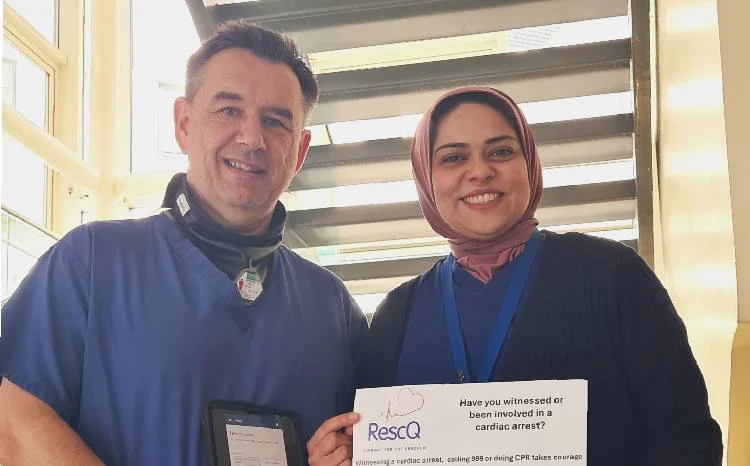
Dr. Uzma Sajjad, the developmental lead and liaison officer for bystander support at RescQ, views the first year as merely the beginning. As the program enters its second year, the focus is shifting toward scalability and inclusivity.
“Supporting those who step forward to help is an essential part of saving lives,” says Dr. Sajjad. “As RescQ enters its second year, we aim to expand the service across the wider East of England, making support available to more communities.”
Accessibility and Diversity
A primary goal for the next phase of development is to break down language and cultural barriers. Recognizing that cardiac arrest does not discriminate, the team is working to increase the accessibility of their educational content. This includes:
- Multi-language Captions: Translating video resources into several languages to ensure that support reaches diverse populations across the UK.
- Broadened Digital Reach: Utilizing platforms like YouTube to ensure that RescQ’s guidance is not just a clinical tool, but a public health resource available to anyone with internet access.
The Broader Implications: A Paradigm Shift in Cardiac Care
The success of RescQ has significant implications for how emergency medical services (EMS) are structured globally.
1. Reconceptualizing the ‘Chain of Survival’
For decades, the "Chain of Survival" has been taught as a four or five-link process (Early Access, Early CPR, Early Defibrillation, Advanced Care, Post-Arrest Care). RescQ makes a compelling case for a new, mandatory sixth link: Bystander Aftercare. By acknowledging the trauma of the rescuer, the medical community protects the very people it relies on to sustain the chain in the first place.
2. The Role of Digital Health
RescQ is a prime example of "Digital Health" done correctly. Rather than using technology to distance the patient or provider from the care process, the app serves as a bridge. It facilitates human interaction, enables immediate follow-up, and provides a secure, private space for vulnerable individuals to seek help.
3. Reducing the Burden on Mental Health Services
By providing early, proactive support to bystanders, RescQ may effectively reduce the long-term burden on National Health Service (NHS) mental health services. Addressing acute stress immediately can prevent the development of chronic conditions such as PTSD, which are costly to treat and debilitating for the individual.
Conclusion: A Model for National Adoption
The RescQ initiative, born in the heart of the Essex Cardiothoracic Centre, stands as a testament to the power of human-centered design. By acknowledging that a cardiac arrest is a traumatic event not only for the patient but for every person present, Professor Keeble, Dr. Sajjad, and their team have pioneered a service that is as empathetic as it is efficient.
As the program looks toward expanding across the East of England, it offers a replicable model for other regions and countries. The "everyday hero" who performs CPR is the backbone of emergency response. With RescQ, they are finally receiving the care, recognition, and support they have long deserved.
The first year of RescQ has proven that while the medical team fights to restart the heart, the RescQ team is fighting to heal the mind—ensuring that the act of saving a life does not come at the cost of the bystander’s own mental wellbeing. As the service continues to grow, it promises to reshape the landscape of emergency response, proving that in the face of cardiac catastrophe, nobody—not even the rescuer—should have to walk the road to recovery alone.