The sleep tracking industry is undergoing a tectonic shift. For over a decade, organizations ranging from corporate wellness programs to clinical research facilities have relied on wearable technology to quantify recovery, productivity, and health risk. While these devices have provided unprecedented insights into human physiology, the industry has hit a persistent ceiling: user compliance. As the focus shifts from voluntary wellness tracking to rigorous, data-driven health management, the industry is moving away from the wrist and toward the environment, signaling the end of the "wearable-first" era and the dawn of passive, ambient sensing.
The Compliance Crisis: Why Wearables Fail
For years, organizations have invested heavily in programs expecting deep insights into workforce recovery. However, the hardware—sophisticated as it may be—is only as effective as the human willing to wear it. A landmark 2016 Gartner survey of 9,592 consumers revealed a sobering reality: 29% of smartwatch owners and 30% of fitness tracker owners abandon their devices within the first six months. Most of this attrition occurs in the first several weeks.
The implications for data integrity are profound. When nearly a third of a cohort stops using a device, the resulting data is not a representative sample of a population; it is a "survivorship bias" dataset, reflecting only the habits of the most engaged, tech-savvy users.
This attrition is rarely a result of laziness. Users often abandon devices when life gets in the way: schedules compress, travel intensifies, or physical discomfort—such as skin irritation from silicone bands or the tactile intrusion of a ring—becomes too much to bear. Paradoxically, the sleepers who would benefit most from consistent tracking—those with chronic stress, demanding schedules, or health complications—are often the least likely to tolerate the daily ritual of charging, syncing, and wearing a device.
The Ambient Solution: Passive Data Collection
The market is currently pivoting toward "ambient sensing"—technology that moves the sensor out of the personal space and into the environment. By eliminating the need for a user to remember, charge, or tolerate a physical form factor, ambient sensing removes the friction that has historically plagued the industry.
This shift is currently manifesting through several distinct technical paths:
- Under-Mattress Radar: Norwegian startup Somnofy has pioneered the use of radar technology to detect movement and sleep staging without direct contact.
- Piezoelectric Strips: Withings has successfully integrated sensors into the mattress itself, using pressure-sensitive strips to measure heart rate and respiratory patterns.
- Multi-Sensor Fusion: Emerging players like Sleepal are adopting a holistic approach, combining radar, thermal, and environmental sensing into a single bedside unit to create a comprehensive model of the sleep environment rather than relying on a single, potentially noisy signal source.
Data Sovereignty and the New Procurement Checklist
As sleep data transitions from personal wellness apps to employer-managed dashboards and high-stakes risk models, the "compliance" problem is being replaced by a "privacy" problem.
Raw respiration and motion signals are among the most intimate biometric data an individual can generate. When wrist-worn devices transmit this raw data to cloud servers under opaque, vendor-controlled terms, organizations are increasingly vulnerable to questions regarding data sovereignty, employee consent, and the downstream use of sensitive health information.
Consequently, privacy architecture is becoming a primary procurement issue. Modern enterprise checklists are no longer concerned solely with accuracy metrics; they now demand hardware-level controls, including:
- Local Processing: Ensuring that raw data never leaves the device, with only encrypted summaries transmitted to the cloud.
- Circuit-Level Disconnections: The ability to physically disable sensors when tracking is not desired.
- Data Minimization: Ensuring that only necessary metrics are stored, reducing the footprint of sensitive biometric information.
Biological Barriers and Inclusive Design
Beyond privacy and compliance lies the issue of physical tolerance. Wearables that rely on continuous skin contact are inherently exclusionary. They create significant barriers for specific populations, including:
- Medical Sensitivities: Individuals with silicone allergies, metal sensitivities, or fragile skin (common in the elderly) cannot consistently wear current devices.
- Physical Limitations: Those suffering from joint swelling or conditions affecting the hands and wrists often find rings and watches physically painful or impossible to fit.
- Hygiene-Critical Roles: In healthcare support roles where hand hygiene protocols are strict, wrist-worn devices are often prohibited or impractical.
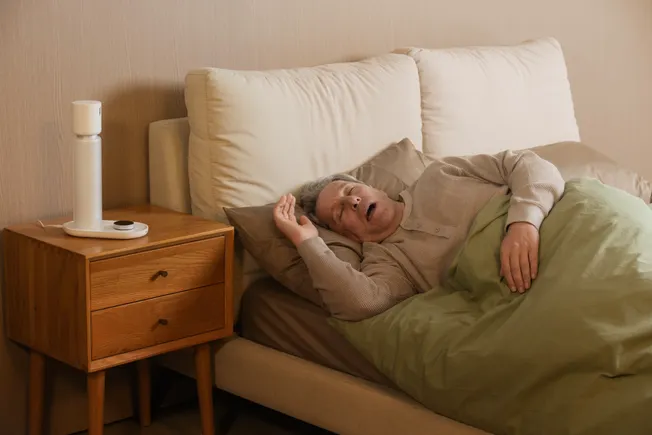
Ambient sensing effectively democratizes health tracking by removing these biological and environmental barriers. By moving the sensors to a bedside lamp or a discreet wall unit, the "form factor" ceases to be a limitation.
Validation: The New Price of Entry
The most significant change in the industry is the professionalization of validation standards. In the past, the wellness sector relied on marketing collateral and proprietary "black box" algorithms. Today, leaders in the field are treating pre-launch validation as essential infrastructure.
A compelling case study is the recent validation of the Sleepal AI Lamp. In a study spanning 1,022 nights across multiple independent facilities, the radar-based device demonstrated remarkable accuracy. The system achieved a 92.77% sleep-wake accuracy rate and a 77.2% four-stage sleep classification accuracy. Notably, the study cohort was not curated for "perfect" sleepers; it deliberately included nearly 30% of participants with moderate-to-severe breathing disruptions, proving that the technology works in real-world conditions.
This study, co-authored by Thomas Penzel, President of the World Sleep Society, and published as arXiv preprint 2604.16442, sets a new benchmark for transparency. It marks a departure from the "move fast and break things" approach, signaling that for contactless sensing to earn sustained trust, rigorous, peer-reviewed evidence is no longer optional—it is the price of entry.
Implications for the Future
The transition from laboratory validation to real-world deployment remains the industry’s next frontier. Bedroom environments are chaotic—they feature ambient noise, shifting furniture layouts, and multiple occupants. Sleepal’s dataset, which now exceeds 2,000 nights collected over 2.5 years, serves as a testament to the effort required to master these variables.
For program managers and organizational leaders, the implication is clear: the era of asking employees to remember to charge their rings is ending. The focus is shifting toward "passive, ambient insight."
As we move forward, the question for those investing in digital health is no longer "How can we get our employees to use this device?" but rather "What can we learn when we stop asking the employee to do the work?" By moving data collection from the wrist to the environment, the industry is finally poised to deliver the recovery insights that programs have sought for years, without the constant, friction-filled battle for user compliance.
The future of health monitoring is invisible, ambient, and—most importantly—unobtrusive. Those who prioritize this shift toward passive, validated, and privacy-first sensing will likely set the standard for the next decade of digital health, while those tethered to the wrist may find themselves left behind in the data-deficient past.