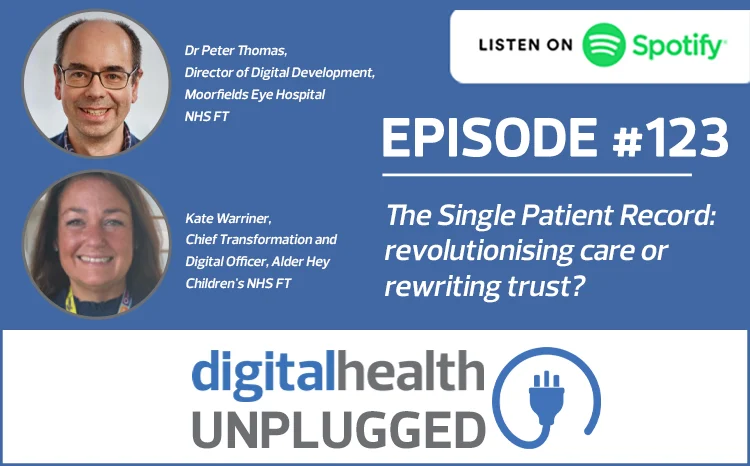
The digital transformation of the National Health Service (NHS) has long been the "holy grail" of UK healthcare policy, a pursuit marked by ambitious promises and complex technical hurdles. In the latest episode of Digital Health Unplugged, host Jordan Sollof sat down with two of the sector’s most prominent voices—Dr. Peter Thomas of Moorfields Eye Hospital and Kate Warriner of Alder Hey Children’s Hospital—to dissect the government’s most recent and significant legislative push: the mandate for a Single Patient Record (SPR).
Recorded live at NHS ConfedExpo 2026, the discussion comes at a pivotal moment. With the NHS Modernisation Bill currently winding its way through the legislative process, the requirement for all NHS providers to share patient data to populate a unified record is no longer a distant aspiration—it is becoming a statutory obligation.
Main Facts: The Mandate for a Unified Record
The core objective of the NHS Modernisation Bill is the creation of a Single Patient Record. For decades, the NHS has grappled with the challenge of "data siloing," where information remains trapped within individual trusts, GP practices, or regional care settings. A patient visiting a hospital in one region often finds that their medical history, allergy list, and previous diagnostics are inaccessible to the attending physician, leading to redundant testing, diagnostic delays, and—in critical scenarios—heightened clinical risk.
The SPR aims to dissolve these barriers. Under the proposed legislation, providers will be legally compelled to participate in a data-sharing ecosystem. This is not merely an interoperability project; it is a structural overhaul of how healthcare data is governed, stored, and retrieved. By centralizing the patient’s longitudinal record, the government aims to provide clinicians with a "single version of the truth," theoretically allowing for safer, faster, and more informed decision-making.
Chronology: The Road to the SPR
The path to the SPR is the culmination of years of iterative digital strategy within the NHS.
- The Early 2020s: Following the accelerated digital adoption necessitated by the COVID-19 pandemic, the NHS began focusing on "Integrated Care Systems" (ICSs). These systems laid the groundwork for regional data sharing, yet gaps remained between trust-level systems.
- 2024–2025: Government policy shifted from encouraging voluntary data sharing to emphasizing the necessity of a national standard. Discussions regarding the "NHS Modernisation Bill" gained momentum as it became clear that disparate IT architectures were preventing the health service from realizing its full digital potential.
- May 2026 (NHS ConfedExpo): The debate reached a crescendo as officials and clinicians gathered to discuss the reality of the mandate. The announcement that GPs and hospitals would be legally required to integrate their data streams marked a point of no return for the program.
- The Future Horizon: The government has set a five-year window for the realization of the SPR’s primary objectives, aiming for a fully functional, national record that is accessible across all care settings by 2031.
Supporting Data: The Clinical and Operational Case
The impetus for the SPR is rooted in clear clinical data. Research cited during the discussion points to significant efficiency gains when data is readily available.
Clinical Outcomes
Dr. Peter Thomas, speaking from his experience at Moorfields Eye Hospital, noted that the current fragmentation forces clinicians into "detective work." When a patient’s historical records are missing, the clinician must either rely on the patient’s memory—which can be unreliable under stress—or repeat diagnostic tests. Reducing this duplication not only saves money but also significantly improves patient safety by ensuring that clinicians are aware of contraindications and past reactions to treatments.
Operational Efficiency
Kate Warriner, representing the digital transformation efforts at Alder Hey, emphasized the administrative burden currently placed on staff. "The time spent chasing records is time not spent with the patient," Warriner stated. By automating the flow of data, the NHS expects to reduce the administrative overhead of medical record requests, which currently consume thousands of hours of clerical time across the service annually.
Official Responses and Stakeholder Perspectives
The reception to the mandate has been nuanced, characterized by a mix of optimism for the clinical potential and caution regarding the implementation.
The Clinician’s View
Dr. Peter Thomas highlighted that while the clinical benefit is obvious, the "human factor" of data entry remains a challenge. For an SPR to be effective, the data being shared must be of high quality. "Garbage in, garbage out," is the adage often cited in digital health, and Thomas emphasized that the burden of documentation must not distract from the primary goal of patient care.
The Transformation Strategy
Kate Warriner focused on the governance of this transition. She noted that the move toward a national standard requires more than just technical solutions; it requires a cultural shift within Trusts. Leadership must ensure that staff are trained to navigate these new systems and that the transition does not overwhelm frontline workers.
Public Expectations
A recurring theme in the discussion was the tension between "easier access" and "patient consent." The public is increasingly aware of data privacy. While patients want their care to be joined up, they also want assurances that their sensitive health data is not being exploited or mishandled. The panel stressed that transparency is the only way to maintain the "social contract" between the NHS and the public.
Implications: The Hurdles Ahead
Transitioning the NHS to a single record model is an endeavor of unprecedented scale. The implications are far-reaching, spanning technology, ethics, and long-term sustainability.
Technical Barriers: The Legacy Debt
The NHS is built on a patchwork of legacy systems. Some trusts utilize cutting-edge electronic patient record (EPR) systems, while others rely on systems that are decades old. Harmonizing these disparate architectures is the primary technical barrier. The SPR program must account for varying data formats, coding standards (such as SNOMED CT and FHIR), and varying levels of digital maturity across the country.
Governance and Trust
Who owns the data? Who governs the access? These questions remain at the heart of the debate. The legislation must provide a robust framework that defines the roles of Integrated Care Boards (ICBs) and individual Trusts. Without clear governance, the system risks becoming a bureaucratic nightmare, with clinicians unsure of who has authorized access to specific records.
The "Five-Year Test"
When asked what would constitute success in five years, the guests were clear: success will be defined by the absence of data friction. In 2031, a clinician should not have to ask a patient for their medical history. The record should be available, legible, and actionable the moment the patient enters the room, regardless of whether they are in London, Liverpool, or a rural community clinic.
Conclusion: A New Era of Digital Health
The NHS Modernisation Bill and the subsequent move toward a Single Patient Record represent a bold gamble. It is a move away from the "federated" approach of the past toward a centralized, digitized future. However, as Dr. Thomas and Kate Warriner underscored during their Digital Health Unplugged appearance, technology is merely the facilitator.
The real challenge lies in leadership. The success of the SPR will not be measured by the software purchased or the databases built, but by the ability of the NHS to integrate these tools into the daily rhythm of clinical practice. It requires a sustained commitment to patient privacy, rigorous standards for data quality, and a culture that prioritizes the patient’s journey above the institutional borders of the past.
As the legislation proceeds, the eyes of the healthcare world will be on the UK. If successful, the NHS SPR could serve as a global blueprint for how large, complex, and public health systems can modernize in the digital age. If it falters, it will serve as a stark reminder of the limitations of top-down digital reform. For now, the mandate is set, the path is clear, and the work—the difficult, meticulous work of transformation—has only just begun.
To hear the full discussion between Jordan Sollof, Dr. Peter Thomas, and Kate Warriner, listeners can tune into the latest episode of Digital Health Unplugged, available now on Spotify, Apple Podcasts, and the Digital Health YouTube channel.