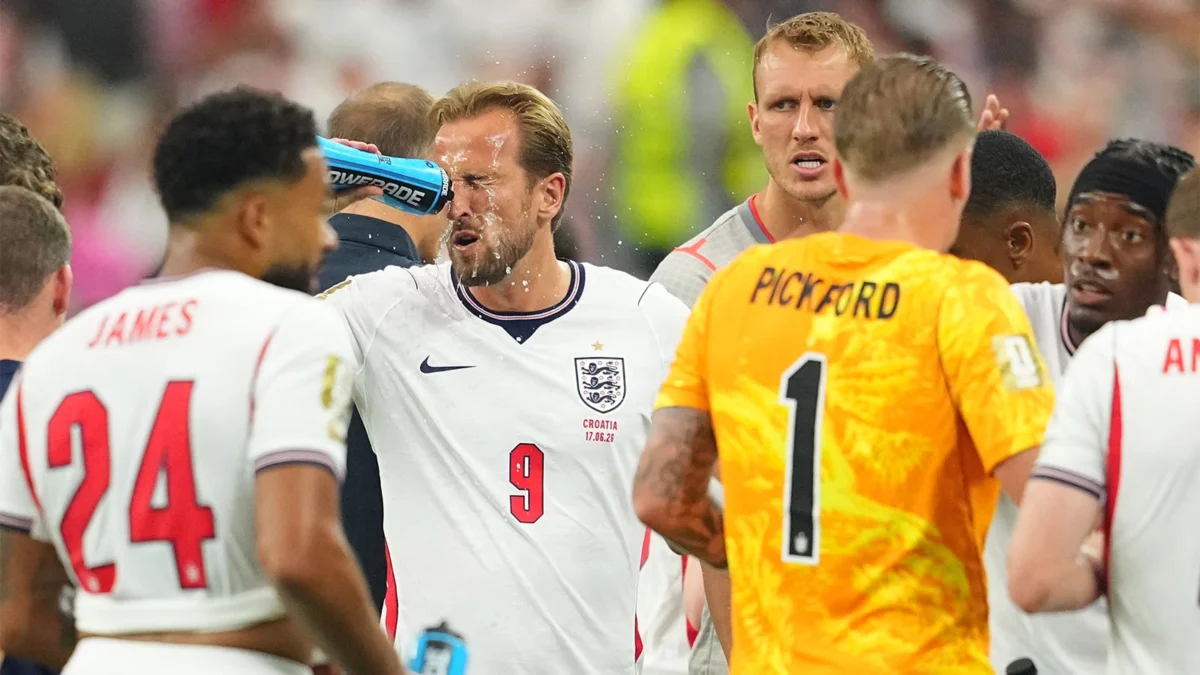
LOS ANGELES — As the world prepares for the upcoming World Cup, co-hosted by the United States, Mexico, and Canada, the global football community finds itself navigating a precarious intersection of athletic performance and a rapidly warming planet. For the first time in the history of the tournament, FIFA has instituted a universal mandate: every match will include mandatory three-minute hydration breaks midway through each half, regardless of the ambient temperature or the climate-controlled status of the stadium.
While FIFA frames this as a necessary evolution to ensure parity and protect player welfare, the policy has triggered a firestorm of debate. Critics argue that the breaks disrupt the tactical fluidity of the game, while leading sports scientists contend that the three-minute duration is biologically insufficient to combat the physiological toll of extreme heat.
The Main Facts: A Universal Protocol
The decision to implement mandatory breaks represents a significant shift in FIFA’s approach to environmental regulation. Historically, hydration breaks were "ad-hoc" decisions made by referees based on specific heat-index readings during a match. This year, the governing body has removed that discretion, opting for a blanket policy.
FIFA maintains that this uniformity is essential to "ensure equal conditions for all teams, in all matches." By applying the rule universally, FIFA aims to prevent situations where one team might be penalized by a lack of breaks in a match played in moderate conditions, while another benefits from them in sweltering heat. The policy draws heavily from lessons learned during the FIFA Club World Cup in the U.S. last summer, where temperatures in several host cities routinely soared into the 90s Fahrenheit (mid-30s Celsius).
Chronology of Climate Concerns in Sports
The path to this mandate has been marked by a decade of increasing concern regarding climate change and professional athletics:
- 2014 Brazil World Cup: The first time FIFA formally introduced cooling breaks during matches, though they were strictly conditional based on "wet bulb globe temperature" (WBGT) thresholds.
- 2022 Qatar World Cup: Despite fears of extreme heat, the tournament was moved to the winter months, avoiding the worst of the Middle Eastern summer. This underscored the growing necessity of adjusting global schedules to accommodate weather extremes.
- 2023 Club World Cup (USA): The "testing ground" for the current policy. The extreme heat encountered by players across North American venues served as a wake-up call for FIFA officials, highlighting that modern stadiums—even those with advanced HVAC systems—cannot always mitigate the humidity and heat stress experienced on the pitch.
- May 2024: A coalition of international sports scientists and medical experts signed an open letter to FIFA, formally requesting that cooling breaks be extended to a minimum of six minutes to provide genuine physiological recovery.
- The Present: The mandate is officially written into the tournament regulations, setting a precedent that will likely govern all future FIFA-sanctioned events.
Supporting Data: The Physiology of Heat Stress
To understand why the debate is so heated, one must look at the physiological strain placed on an elite athlete. When a player engages in high-intensity exercise—running up to 10 kilometers per match—in high humidity, their core temperature rises rapidly.
The Threshold of Failure
According to Dr. Ryan Calsbeek, a professor of biological sciences at Dartmouth College, there is a "critical threshold" for human performance. "Your body starts to really fall apart, you lose the ability to cool off fast enough," Calsbeek explains. "The physiological mechanisms just break down."
When the WBGT—a measure that accounts for temperature, humidity, wind speed, and solar radiation—exceeds 95°F (35°C), the human body struggles to dissipate heat through sweat. At this point, even the most elite athletes face:
- Exertional Heat Illness (EHI): A spectrum of conditions ranging from muscle cramps and fatigue to life-threatening heat stroke.
- Cognitive Decline: As core temperatures exceed 105°F (40.5°C), athletes may experience confusion, aggression, and lapses in judgment. Dr. Yuri Hosokawa of Waseda University notes that these are "characteristic signs of exertional heat stroke and require immediate medical attention."
- Dehydration Deficits: Players can lose between 1 and 2 liters of fluid per hour. A loss of just 2% of total body weight through sweat is enough to cause a measurable, significant decline in speed, precision, and endurance.
The Case for Longer Breaks
The current three-minute break is intended to allow for hydration and the application of cooling agents. Dr. Douglas Casa, CEO of the Korey Stringer Institute, emphasizes that the efficacy of these breaks depends on the intensity of the cooling. "Putting wet, cold towels on the head, neck, and arms can reduce core temperature by approximately 0.22°F per minute," Casa notes.
However, experts argue that three minutes is simply not enough time to reach the "thermal equilibrium" necessary to reset the body’s cooling systems. A six-minute break, as requested by the coalition of scientists, would allow for more substantial cooling of the skin surface and safer consumption of fluids, preventing the "sloshing" sensation in the stomach that occurs when athletes are forced to drink large volumes too quickly.
Official Responses and Tactical Implications
The reaction from the footballing world has been divided. Coaches and managers, who spend months drilling their teams on match rhythm and momentum, have expressed frustration.
"It interrupts the flow," one veteran coach noted on condition of anonymity. "In a game that relies on building pressure, a three-minute break acts as a ‘reset button.’ It allows a team that is under the cosh to regroup, change tactics, and break the opponent’s rhythm."
FIFA, however, remains firm. Their official stance is that the health and safety of the players supersede the tactical preferences of coaches. By making the rule mandatory regardless of conditions, they are effectively treating heat management as a standard component of the game, similar to VAR checks or injury stoppages.
Joshua L. DeVincenzo of Columbia University’s National Center for Disaster Preparedness views the move through a public safety lens. "We’re looking at this as a way to mitigate anything that could potentially lead to an incident or an emergency," he states. In this view, a three-minute interruption is a small price to pay to avoid a medical crisis on the global stage.
Implications for the Future of Sports
The implications of this policy extend far beyond this summer’s tournament. As climate change continues to drive record-breaking global temperatures, the sports industry is being forced to adapt.
1. A New Era of Scheduling
We are likely to see a permanent shift in when and where major sporting events occur. The "winterizing" of the World Cup may become the rule rather than the exception. Furthermore, cities that were once considered ideal hosts may be disqualified based on their projected climate risks.
2. Technological Adaptation
Beyond hydration breaks, we may see the adoption of "cooling vests" for substitutes on the bench, misting stations at pitch-side, and advanced fabric technology in jerseys designed to optimize sweat evaporation.
3. The "Heat-Tolerance" Advantage
Dr. Calsbeek suggests that heat tolerance may soon become a scouting metric. "If you have individuals who perform better in extreme conditions," he notes, "those small differences could play a critical, pivotal role in determining the outcome of a match." Teams that invest in sports science to improve their players’ heat acclimatization may find themselves with a distinct competitive advantage.
4. A Cultural Shift
Finally, there is a cultural shift taking place. For decades, the stoicism of athletes—their ability to "play through the pain"—was celebrated. Today, there is a growing recognition that pushing the body past its thermal limits is not a sign of bravery, but a failure of management. As Dr. Bharat Venkat, director of the Heat Lab at UCLA, puts it: "No matter what sport you play, there are going to be adjustments that have to be made in the face of climate change. We have to stop treating these events as anomalies and start treating them as our new reality."
As the opening whistle blows this summer, the eyes of the world will be on the pitch—not just to witness the skill of the players, but to observe how the sport of football navigates the warming world it calls home. Whether these three-minute breaks are a sufficient safeguard or a mere band-aid on a gaping wound remains to be seen, but one thing is certain: the environment has become the most influential player on the field.