









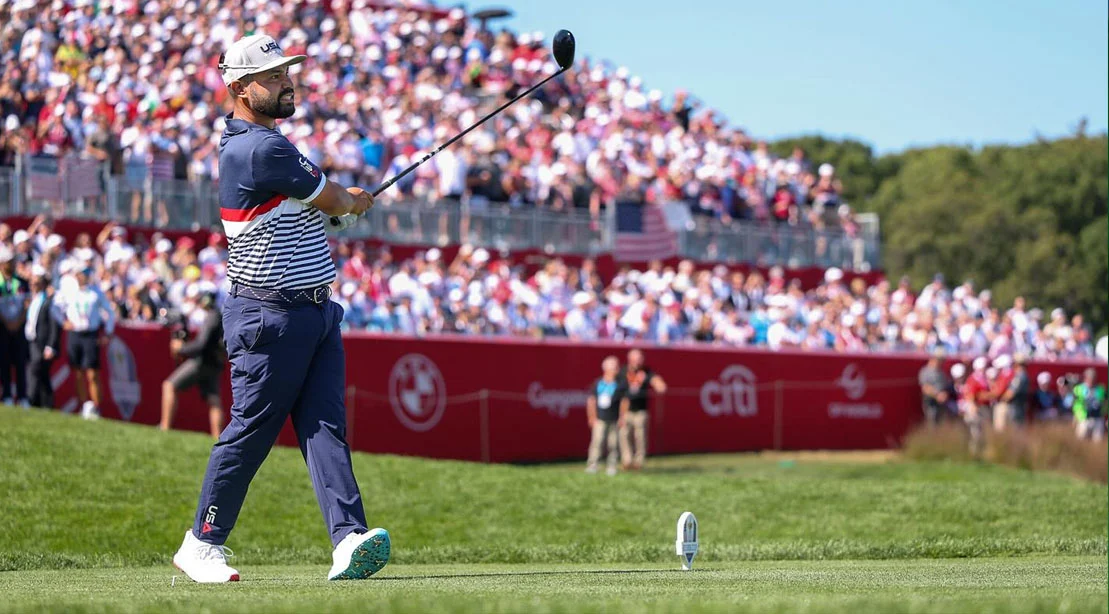
John Michael “JJ” Spaun’s journey to the pinnacle of professional golf is a narrative defined by grit, unexpected physical decline, and a triumphant return to form. For a man who has held a golf club since he was gifted a plastic toy set at the age of three, the game was once an extension of his own identity. However, as the PGA star recently sat down with Muscle & Fitness to share, his path to greatness was nearly derailed by a medical mystery that stripped him of his strength, his consistency, and his confidence.
What followed was a harrowing multi-year struggle involving a misdiagnosis, a rapid physical decline, and the eventual discovery of a condition that, once managed, propelled him to the most significant victories of his career, including a major win at the 125th US Open.
The Early Foundations of a Pro
Before he was a household name on the PGA Tour, JJ Spaun was a multi-sport athlete growing up in Southern California. The region’s vibrant sports culture offered him an array of outlets, from baseball and basketball to hockey and cycling. Perhaps most notably, his youthful obsession with skateboarding provided the unconventional training ground that would eventually shape his signature golf swing.
“I would say, in the majority, golf was a pretty easy sport for me to pick up,” Spaun explains. “But I think I battled with what time and effort I wanted to put into it as a kid. Growing up in Southern California, other sports were pulling me in. Skateboarding was a huge presence at the time. I wanted to do what the other kids were doing culturally.”
While he eventually committed fully to golf, his coach—who has worked with him for over six years—insists that his skateboarding days were far from a distraction. Instead, they were instrumental in building the foundation of his athleticism. “I think those sports all played a role in my development, in my mechanics—like hand-eye coordination and footwork,” Spaun says. “My swing coach is a firm believer that skateboarding really developed my footwork for my golf swing. He considers my feet to be my superpower.”
A Chronology of Decline: The Hidden Battle
Spaun turned professional in 2012 and secured his first PGA Tour Card in 2016, marking a promising trajectory. However, the 2018 season served as the beginning of a grueling, four-year period of instability. As he approached his late 20s, the physical stamina required to navigate the PGA Tour began to vanish.
By 2018, Spaun was struggling to simply complete a round of golf. The symptoms were insidious at first, then impossible to ignore. “I was 28 at the time,” he recalls. “I remember putting on my belt and running out of holes to put the notch in, so my belt was now too big for me. I suffered with severe thirst at night, and then frequently urinating, like, three or four times every night. I started losing weight very rapidly.”
Despite the red flags, the physical toll was initially dismissed as the result of a demanding season. It wasn’t until he stepped on a scale and realized he had lost 20 pounds in a matter of months that he sought medical intervention. The initial diagnosis was Type 2 diabetes. For three years, Spaun attempted to manage his health under this assumption, following standard protocols that proved entirely ineffective. During this window, his weight plummeted to 155 pounds—a figure he hadn’t seen since high school—and his golf game suffered accordingly. By the 2020-21 season, he had lost his tour card, finishing 174th in the FedEx Cup rankings.
The Turning Point: Correcting the Diagnosis
The trajectory of Spaun’s career changed when he finally consulted an endocrinologist who identified the error. He was not suffering from Type 2 diabetes, which is often associated with lifestyle and insulin resistance; he was living with Type 1 diabetes, an autoimmune condition where the body’s immune system attacks insulin-producing cells in the pancreas.
While 90% of diabetes cases are Type 2, the rarity of Type 1 in adults often leads to diagnostic delays. For Spaun, receiving the correct diagnosis was not a moment of despair, but a moment of liberation. “They felt sorry for me, telling me that I was Type 1, but I said this is great, because I’ve been living miserably,” he recalls. “My energy was at an all-time low. My golf was going down the drain. And now I had a real solution.”
Clinical Management and Technological Advancements
Following the 2021 diagnosis, Spaun transitioned to insulin therapy, and the recovery was nearly instantaneous. “In a matter of weeks, I could feel the strength coming back,” he says. “I was able to eat things without restricting my glucose range as you do with Type 2. I started to feel better and things started coming together.”
Managing Type 1 diabetes as a professional athlete requires a high level of vigilance, but modern technology has made this hurdle manageable. Spaun relies on a Dexcom G7 continuous glucose monitor (CGM) to provide real-time data on his blood sugar levels, allowing him to make micro-adjustments during the heat of competition. Furthermore, he has transitioned from manual insulin injections to the Omnipod 5, a tubeless automated insulin delivery system. “It’s been a game changer for me,” he notes.
Regaining the 50 pounds of lost weight required more than just medication; it required a complete recalibration of his swing mechanics. “Your mechanics and your movements are off,” Spaun explains, noting the difficulty of regaining the muscle mass and motor control necessary for high-level golf. “I’m glad to be handling things well. It’s definitely a challenge, but I’ve got all the support in the world to really make it as easy for me as possible.”
The 2025 Breakthrough and Beyond
The results of this diligent management became evident in 2025, a year that will go down as the most significant of Spaun’s career. His victory at the 125th US Open served as the ultimate validation of his recovery. The win was not just a trophy; it was a testament to his ability to master his own biology while competing against the best in the world.
His momentum continued into 2026. In September, Spaun secured a victory at the BMW PGA Championship at Wentworth in England. Beyond the leaderboard, the win highlighted his character; he donated a portion of his winnings to the Addington Fund, a British charity supporting farming families. His connection to the cause stemmed from his travels in the Cotswolds, where he became an avid fan of the Prime series Clarkson’s Farm, which chronicles the financial hardships faced by independent farmers.
Implications for Athletes and the Diabetic Community
JJ Spaun’s story carries significant implications for both professional sports and the broader public. First, it underscores the critical importance of accurate medical diagnosis. The three-year gap between the onset of his symptoms and his correct diagnosis highlights a systemic need for better awareness regarding adult-onset Type 1 diabetes.
Second, it serves as a powerful message to those living with chronic conditions. Spaun has effectively dismantled the narrative that a diagnosis of Type 1 diabetes marks the end of a high-performance career. By integrating technology into his training and remaining disciplined in his treatment, he has proven that one can thrive in elite environments while managing a complex medical condition.
“I’m the type of guy that likes to put in the work, because I’m a strong believer that you get out of this game what you put in,” Spaun reflects. With the 2026 season behind him, he is now shifting his focus to family time and further travel.
Perhaps most importantly, the ordeal has altered his perspective on success. While he remains a highly competitive athlete with a trophy case that serves as evidence of his skill, his battle with his health has provided him with a new priority: presence. Today, Spaun is less concerned with the weight of expectations and more focused on the present moment—whether that involves sinking a putt at a major tournament or simply heading out for the daily school run.
JJ Spaun’s career serves as a blueprint for resilience, proving that while health may falter, the human spirit—when supported by the right science and unwavering dedication—is capable of remarkable comebacks.